
01
Dual-Concentric Tuning
Features a two-stage tuning wheel with an outer main dial and an inner spread dial for fine-tuning congested shortwave frequencies.
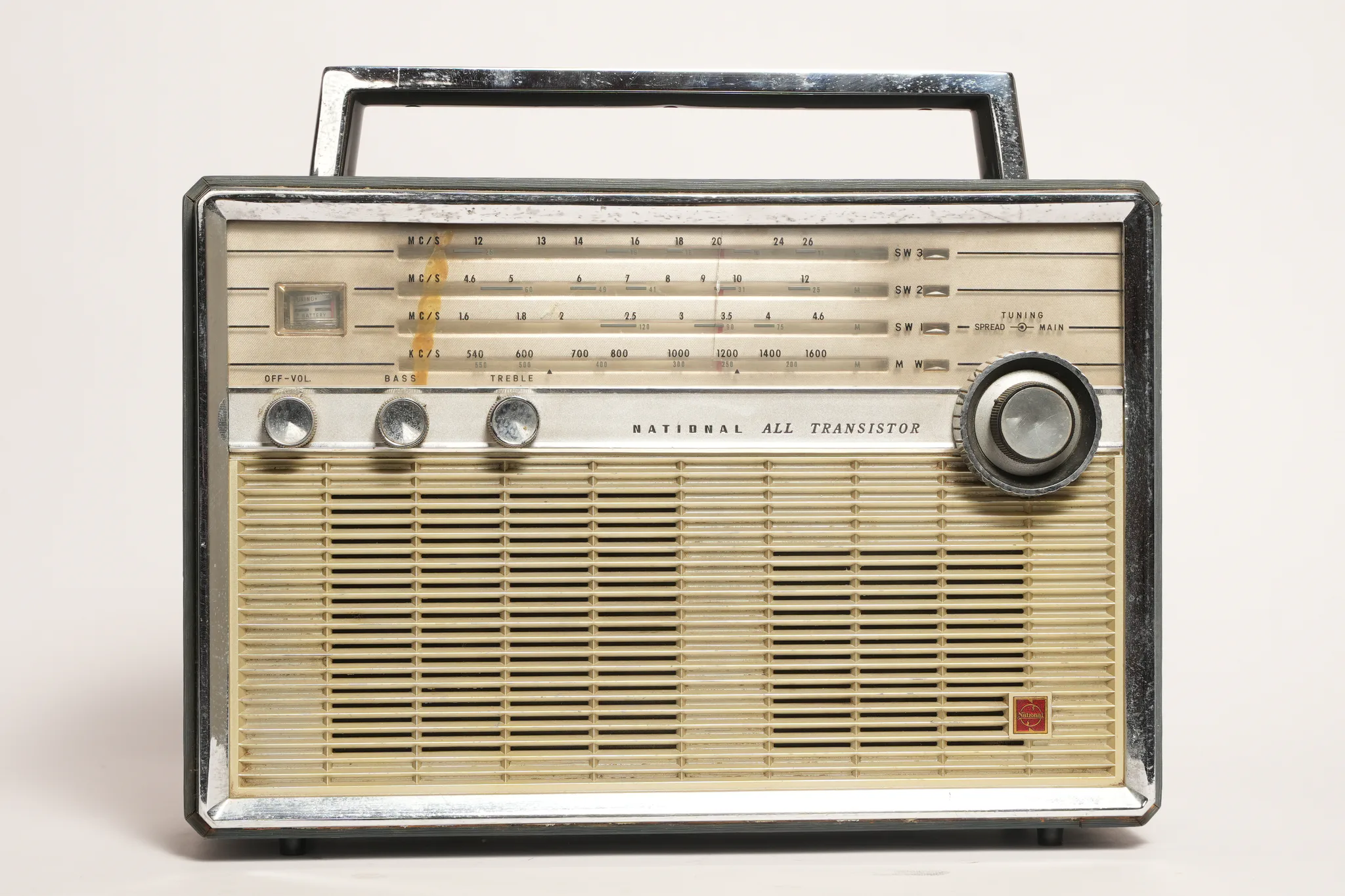
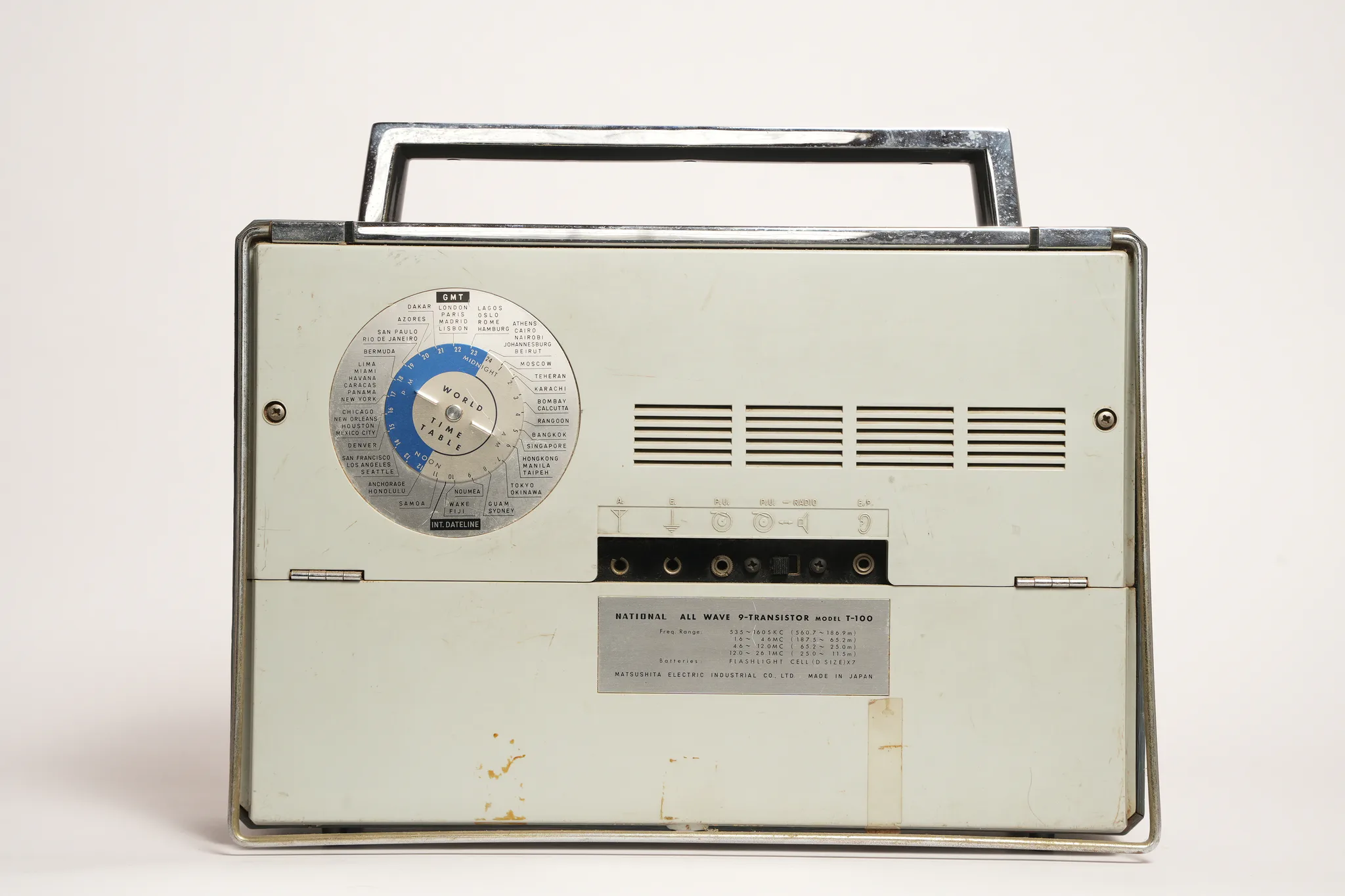
The National T-66 is an early 1960s portable multiband receiver built by Matsushita Electric in Japan, housed in a textured grey vinyl cabinet with polished chrome accents. Its front fascia incorporates an ivory-toned slatted loudspeaker grille, an illuminated analog tuning and battery meter, and dedicated bass and treble tone knobs. Operating across standard medium wave and three shortwave bands, it utilizes a dual-concentric main and bandspread tuning knob for precise frequency selection.
Features a two-stage tuning wheel with an outer main dial and an inner spread dial for fine-tuning congested shortwave frequencies.
Covers medium wave alongside three dedicated shortwave spectrums spanning from 1.6 mc/s up to 26 mc/s.
Equipped with a compact front-mounted analog needle meter indicating both signal reception strength and battery reserve.
Includes separate rotary Bass and Treble tone adjustments alongside the primary power and volume potentiometer.
Features a heavy chrome perimeter frame enclosing an ivory horizontally louvered front loudspeaker grille.
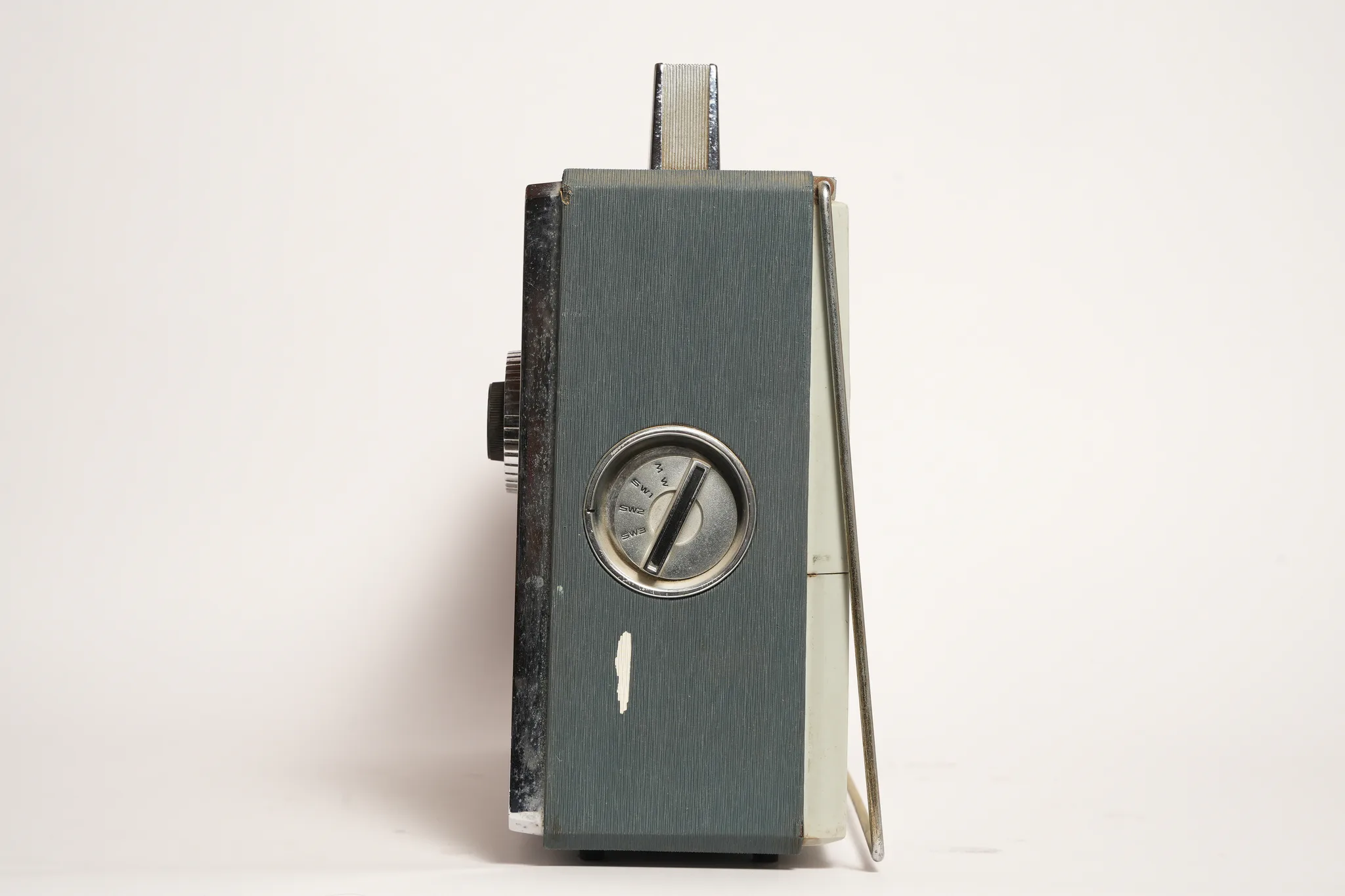
Side profile reveals an integrated rear support stand designed to tilt the receiver back for optimal desktop viewing.
Measurements, construction, identity, and seller-supplied details are kept together for direct comparison.
Provenance documentation was not supplied for this specific National T-66 4-Band All Transistor Portable Radio; this listing is based on the supplied photographs only.
Visible in the primary face photograph, the dual-concentric dial mechanism separated broad frequency traversal from minute shortwave adjustments. This mechanical reduction allowed global listeners to isolate distant international broadcast signals on crowded high-frequency bands.
Seen in the lateral profile photograph, the cabinet balances functional portability with desktop stability. The slim profile integrates a textured vinyl wrap and a rear metal prop, allowing easy transport and angled tabletop operation during extended listening.
Japanese manufacturers expanded all-transistor architecture into complex multi-band world receivers, reducing reliance on vacuum tubes.
Matsushita Electric launched the T-66 portable radio featuring three shortwave bands and dedicated bandspread tuning.
The model established National as a premier maker of reliable consumer shortwave and medium-wave portable equipment.
Matsushita phased out early 1960s horizontal desktop designs in favor of vertical military-inspired field receivers under the RF series.
The radio displays authentic cosmetic wear consistent with age, notably two vertical strips of aged yellowish tape adhesive residue across the left section of the clear dial face. The polished chrome trim along the outer bezel and top carrying handle exhibits moderate surface pitting, oxidation, and scattered patina. The slatted front grille and dial surface show generalized surface dust and light discolouration, while the side covering remains structurally sound.
Two distinct vertical amber-yellow tape adhesive residue marks are visible on the clear dial window over the tuning scales.
The chrome bezel surrounding the front fascia and the top rectangular handle display visible pitting, hazing, and age spotting.
The textured grey outer wrap shows mild surface dust and edge handling, with minor scuffs near the bottom corner joints.
The ivory-tone molded speaker grille and control knobs show minor surface dirt in the horizontal recesses, with the red National logo intact.
Inspected, photographed, and packed with its condition report.
Custom-fit protective packing with tracked, insured courier service.
Return requests are accepted within fourteen days of confirmed delivery.
Prepared for courier handoff within three to five business days.
Contact the seller for more information or to discuss this object.