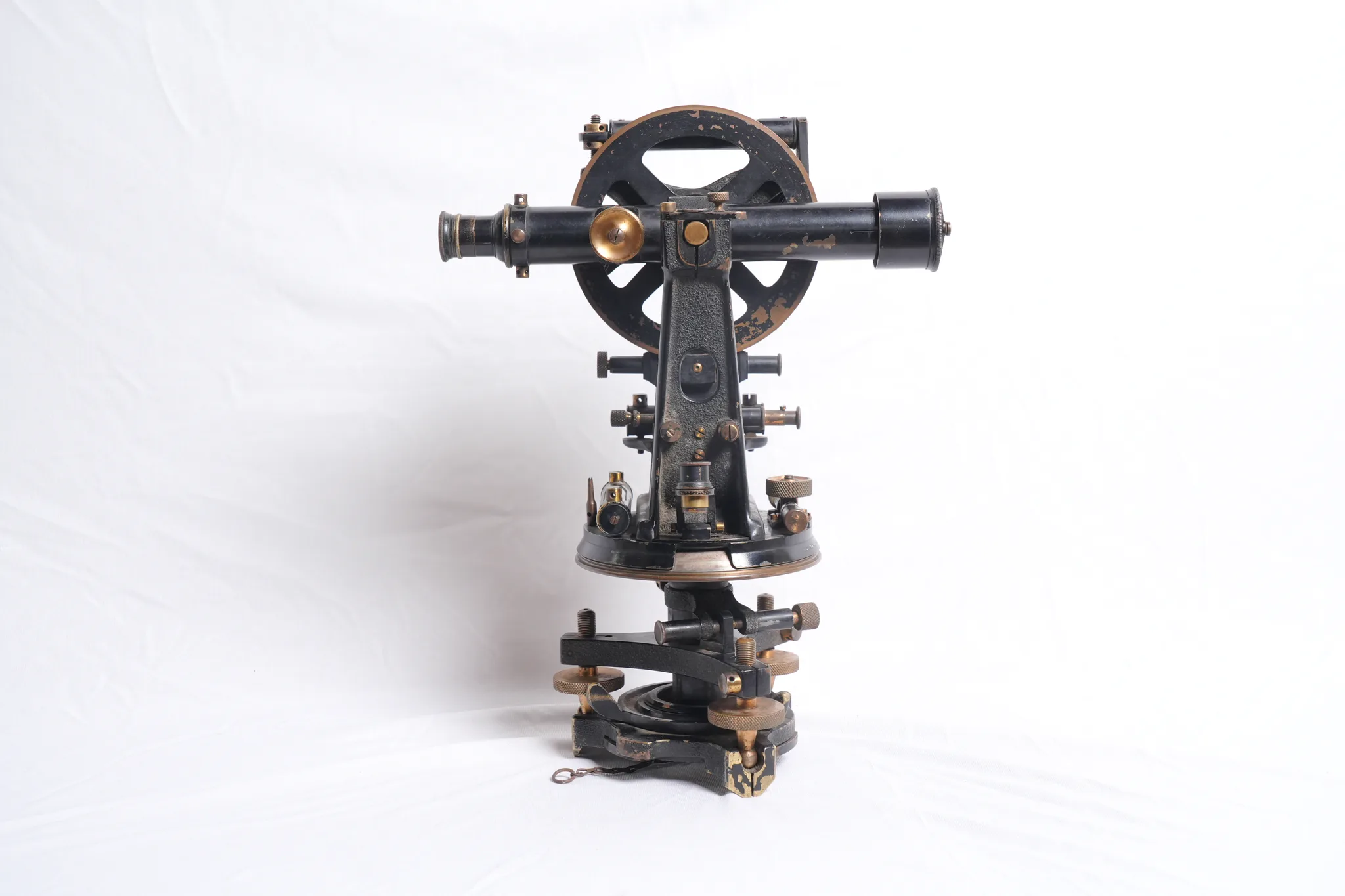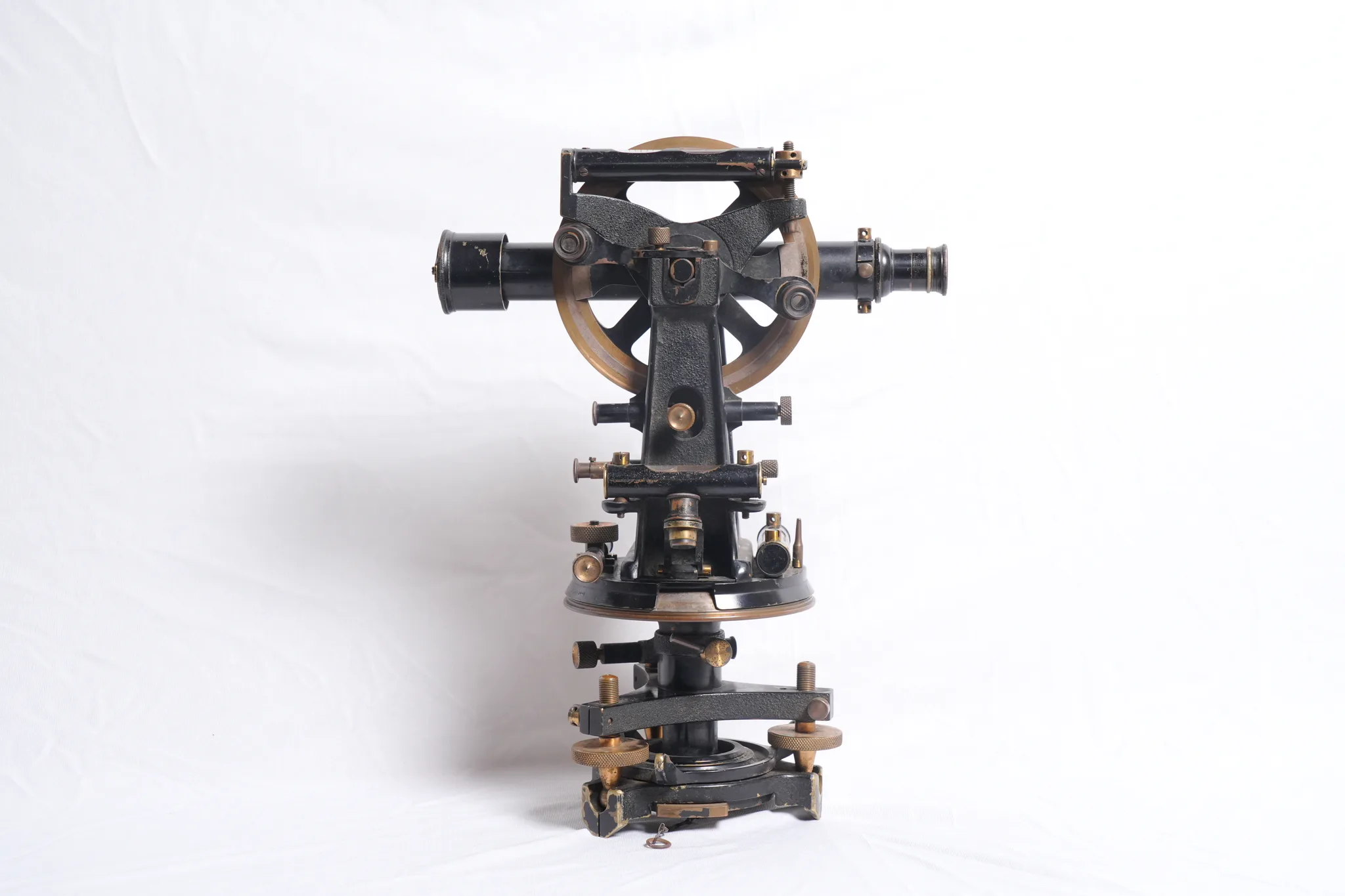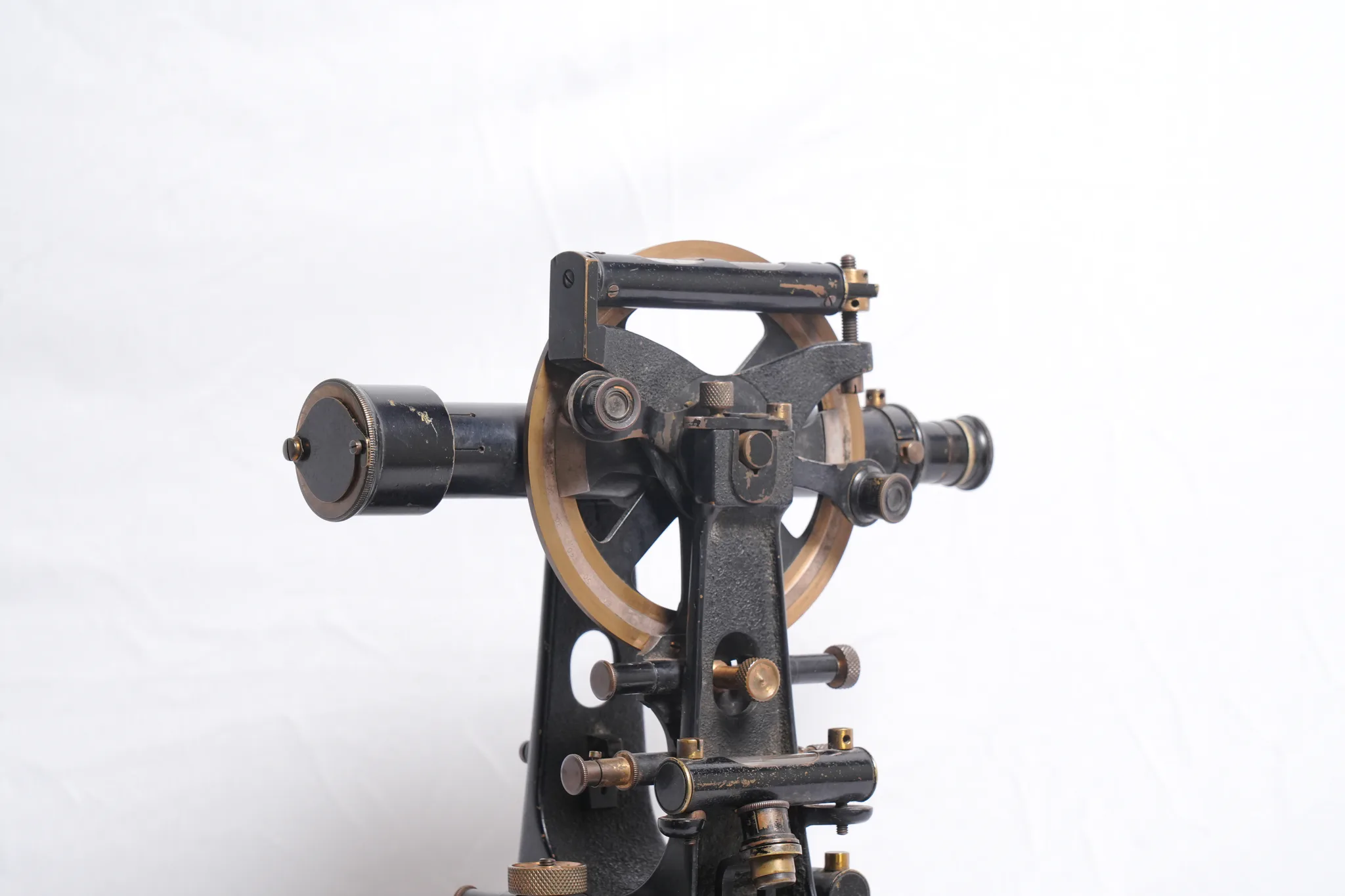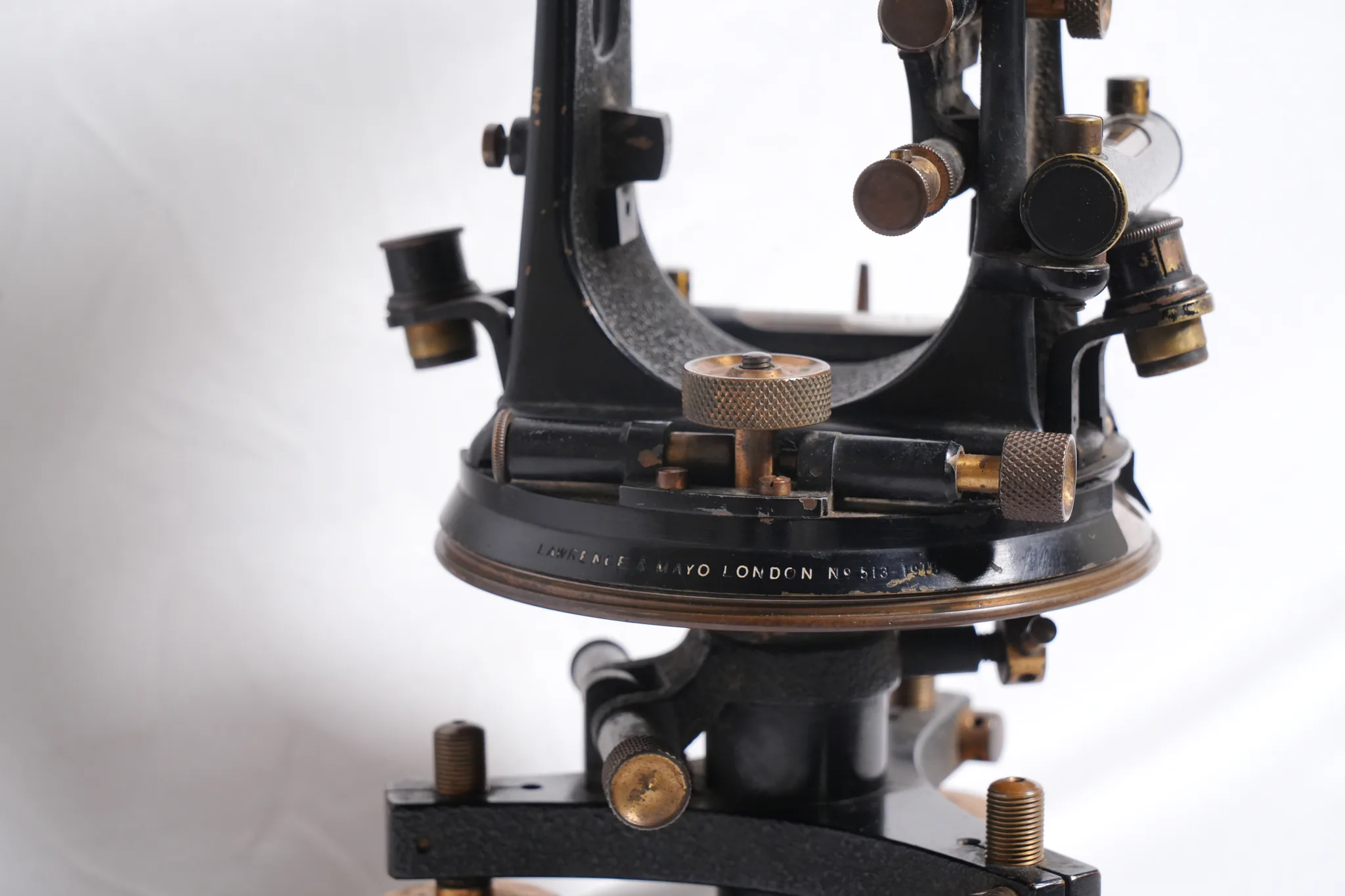
Lawrence & Mayo Transit Theodolite No. 513
United Kingdom · 1913
United Kingdom · 1913
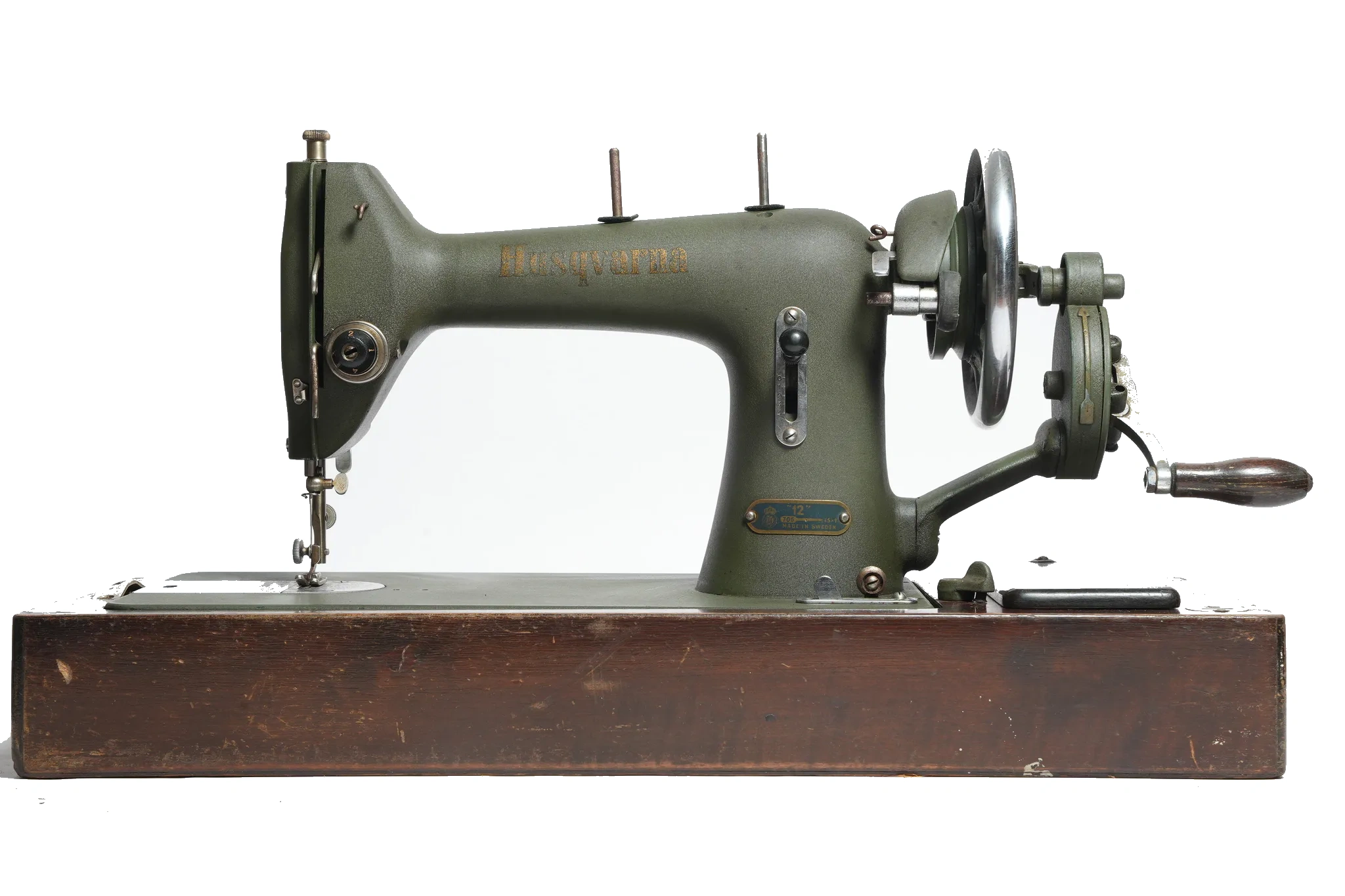
Sweden · 1948
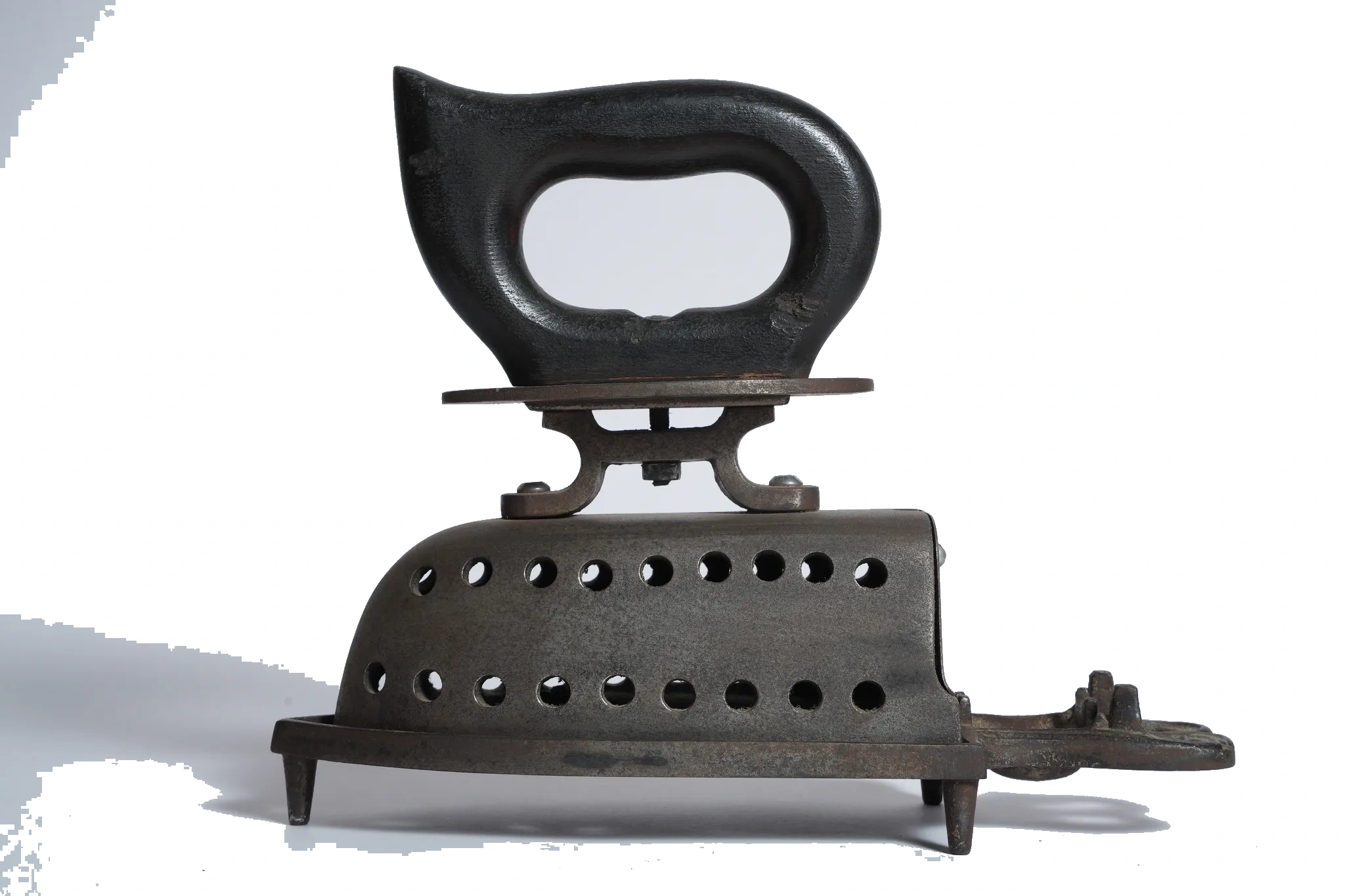
Origin unconfirmed · 1900
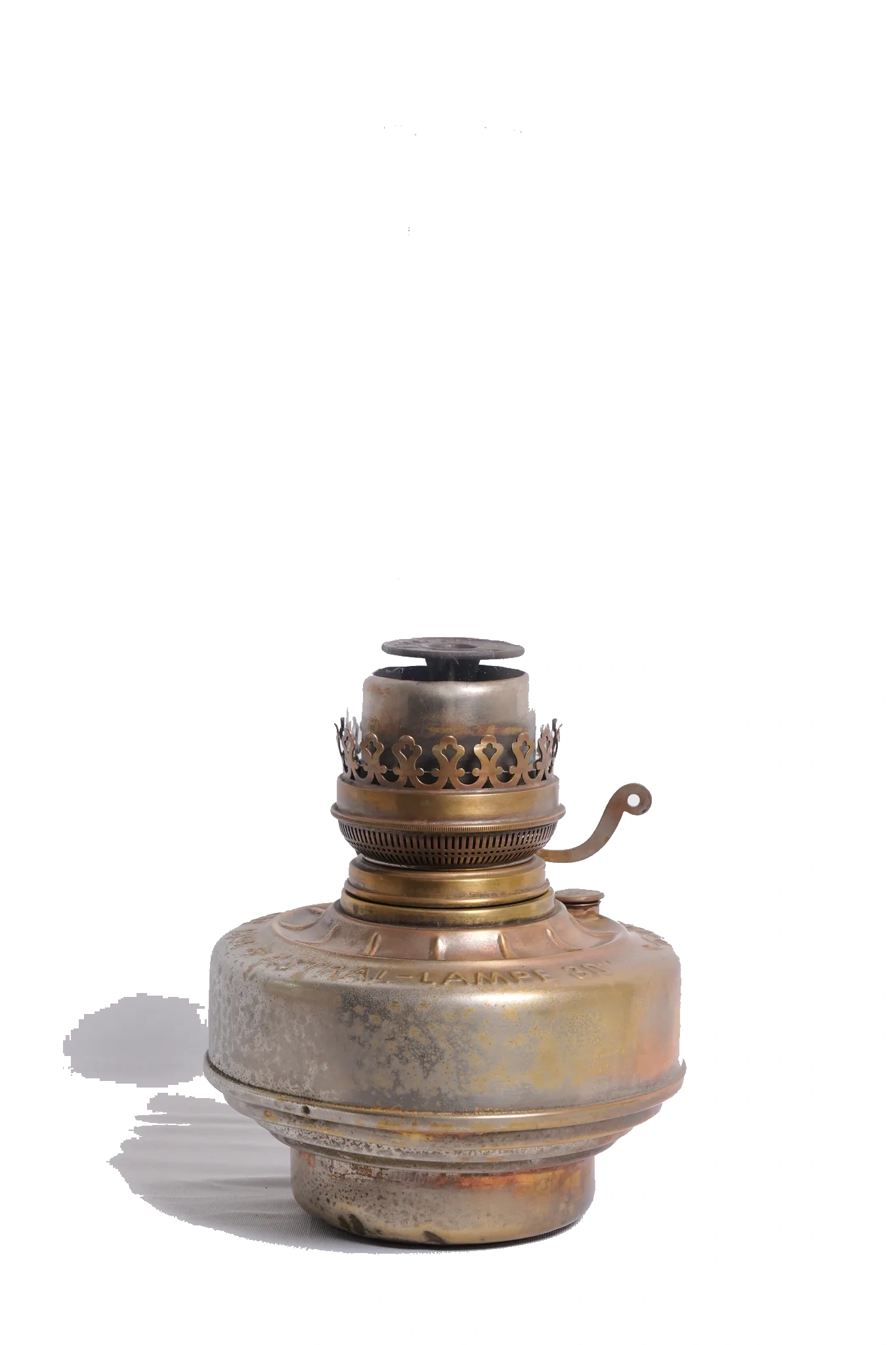
Austria · 1880
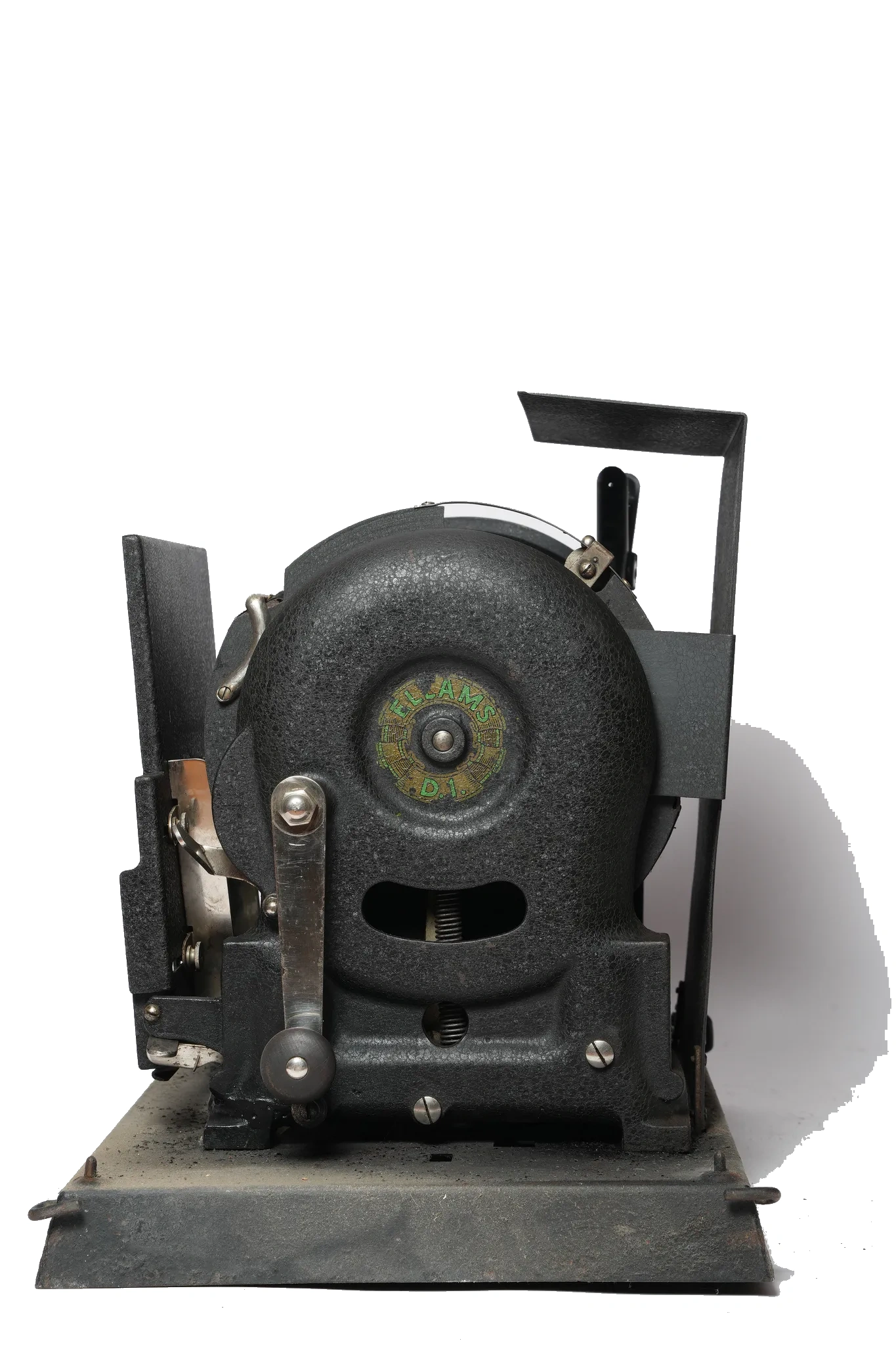
Origin unconfirmed · 1930
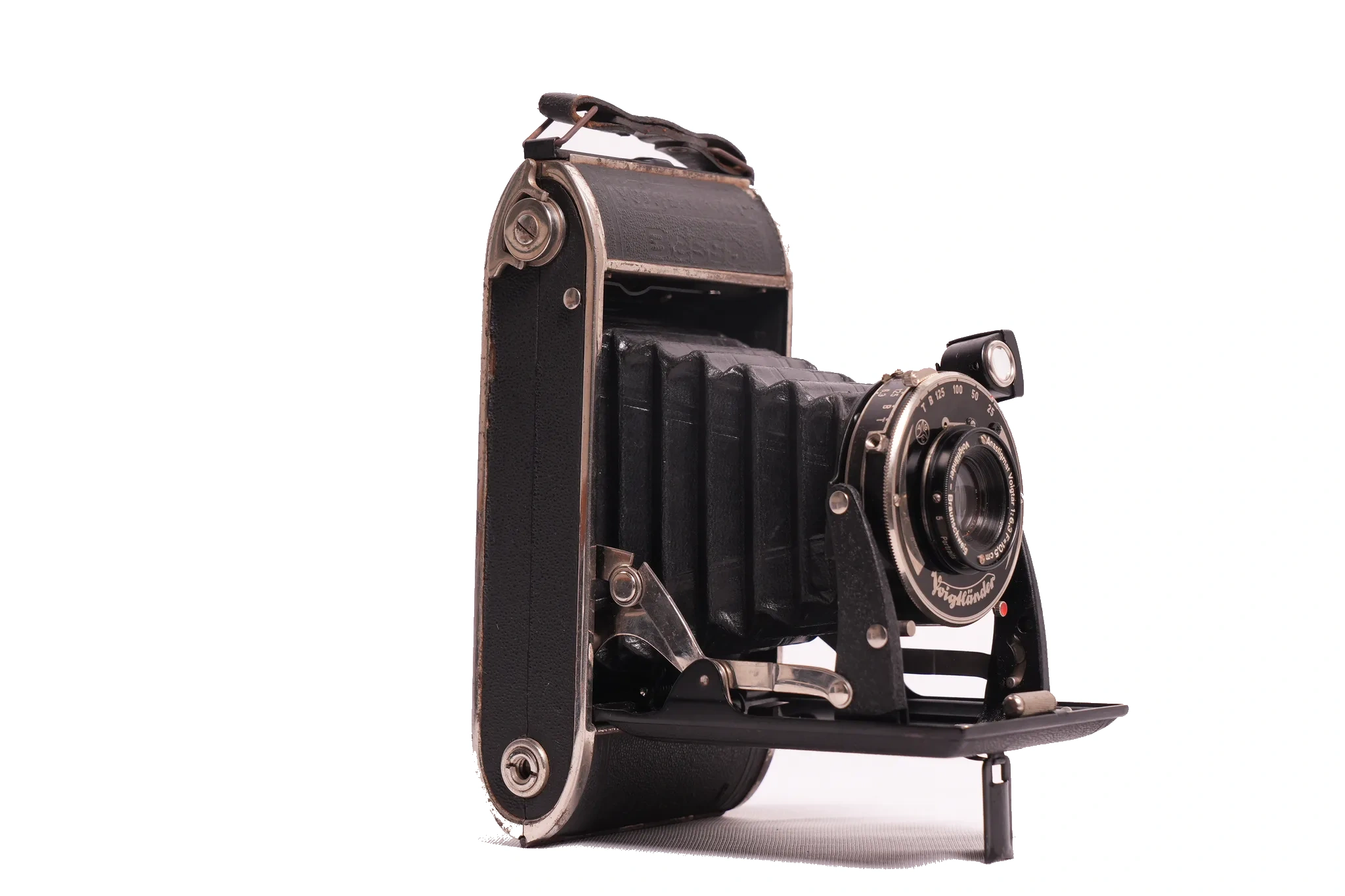
Germany · 1929
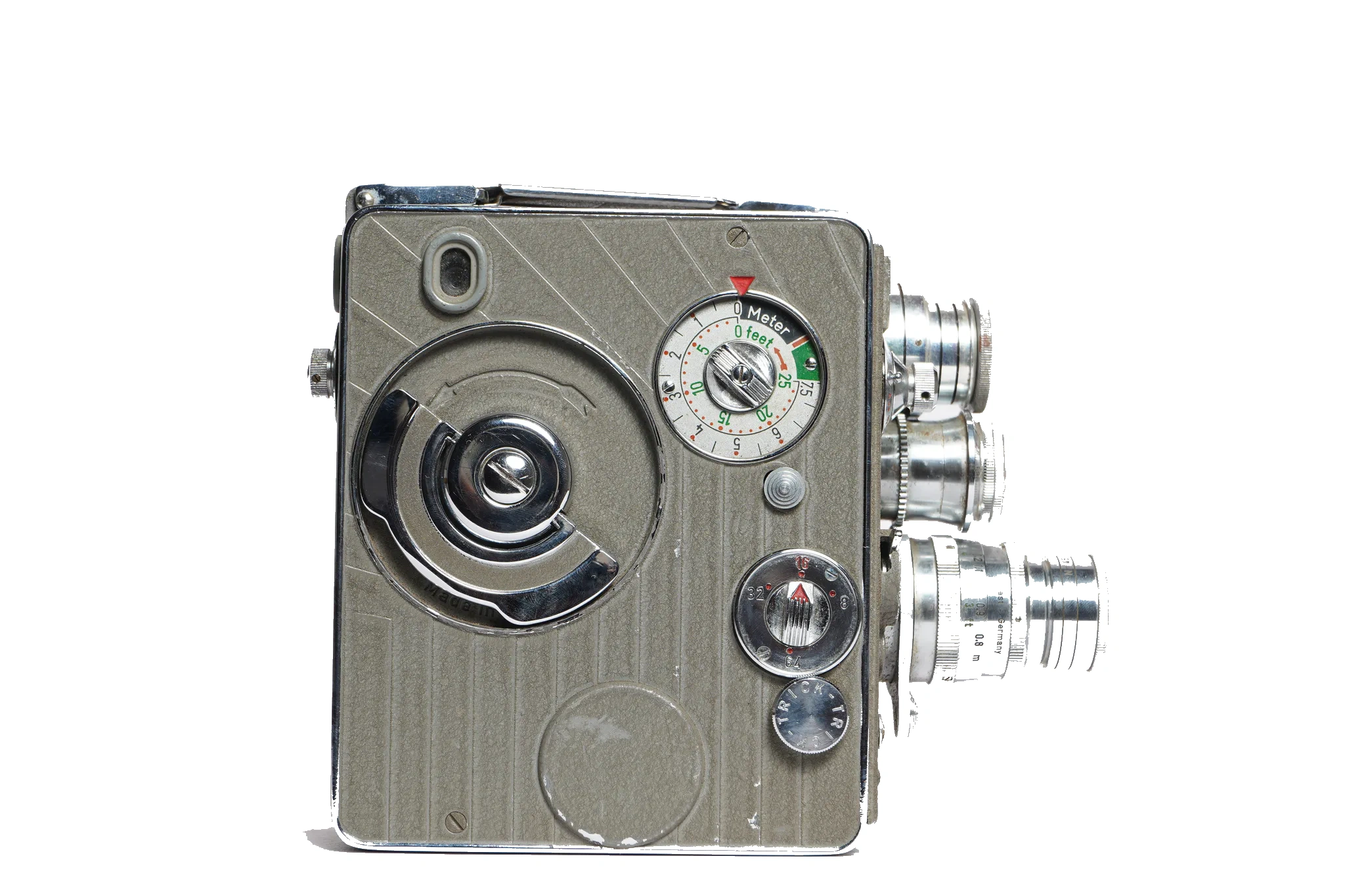
Germany · 1954
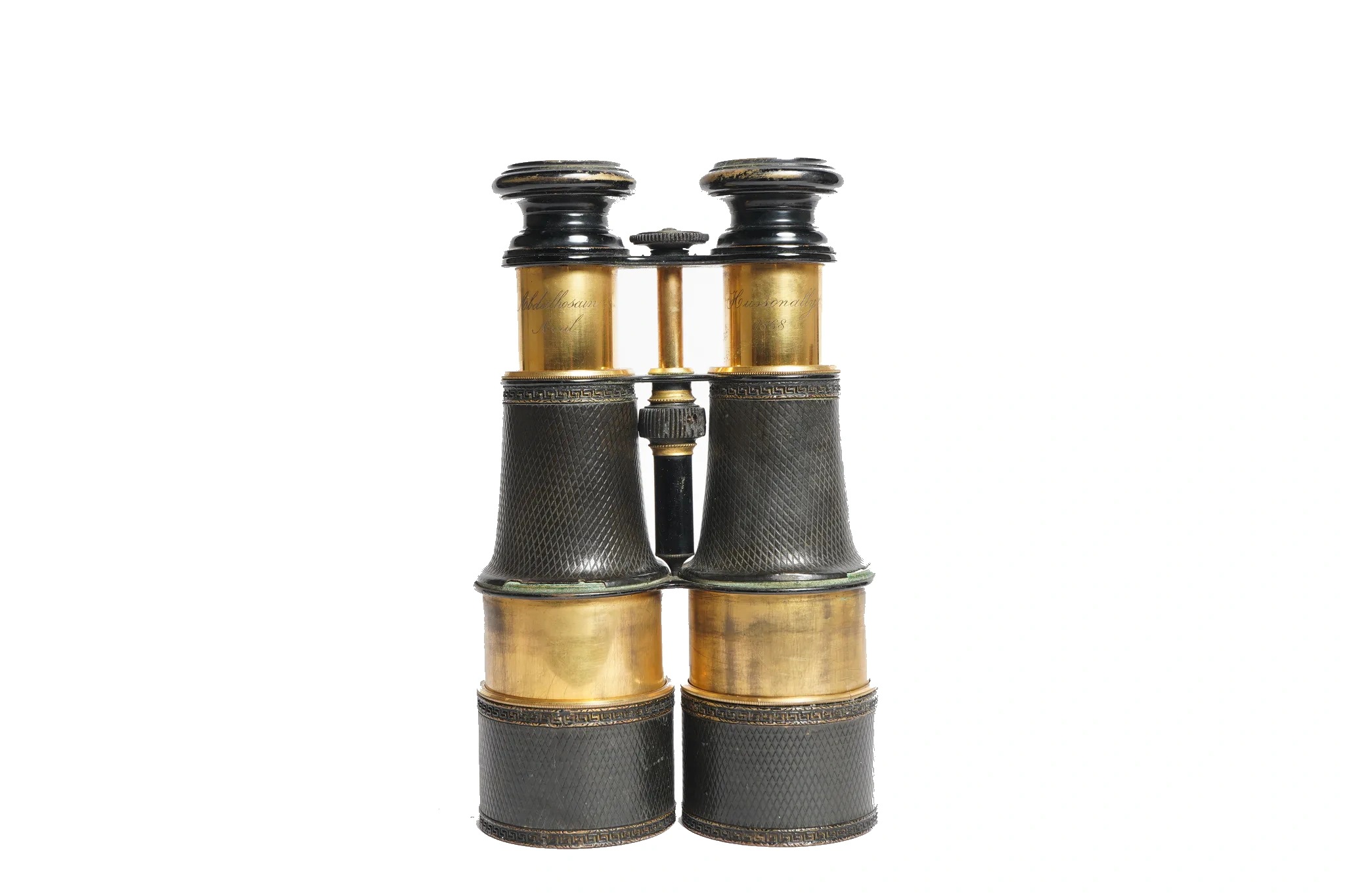
United Kingdom / British India · 1868
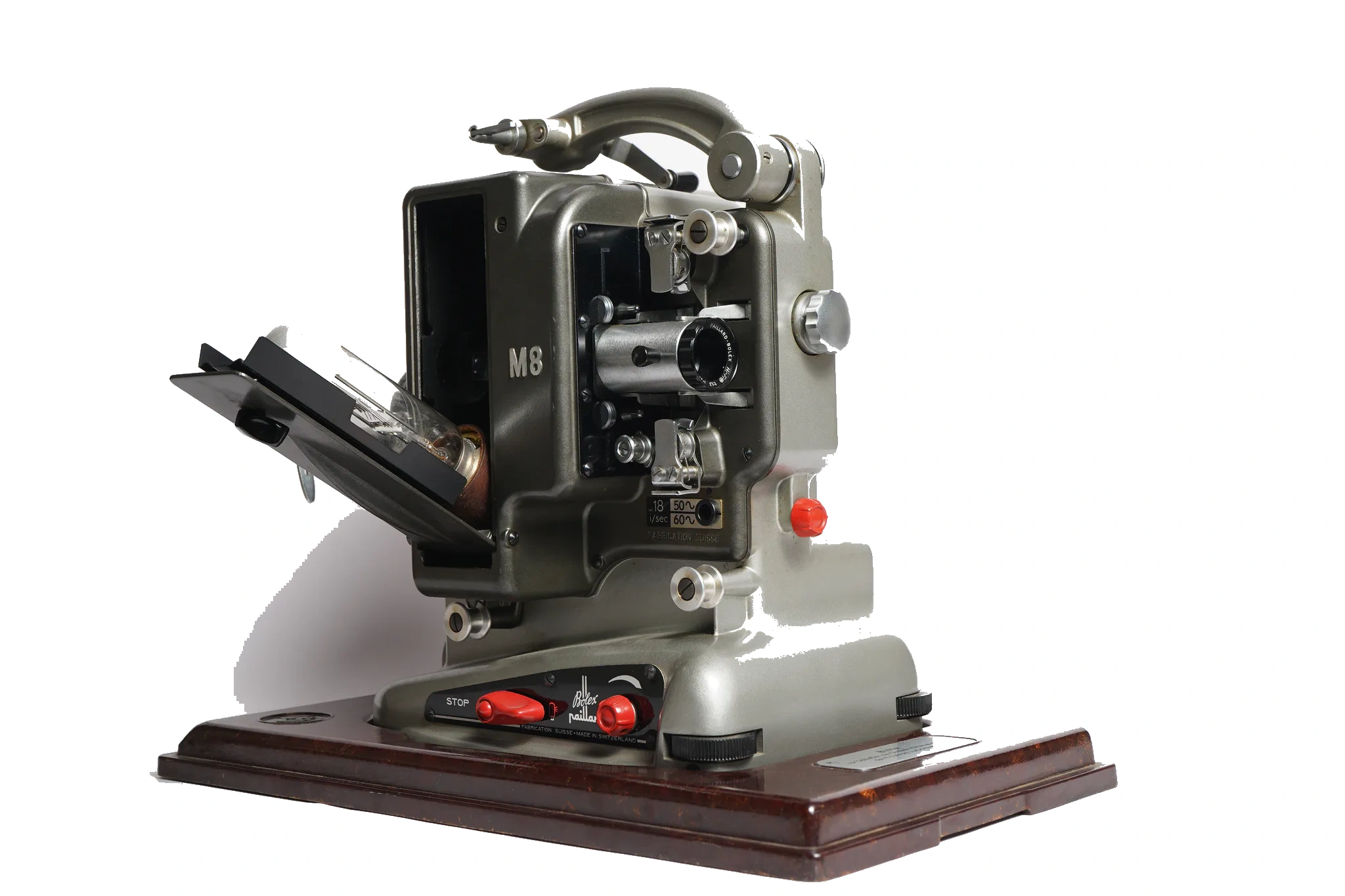
Switzerland · 1955
USA · 1948
United Kingdom · 1946
West Germany · 1957
United Kingdom, 1913
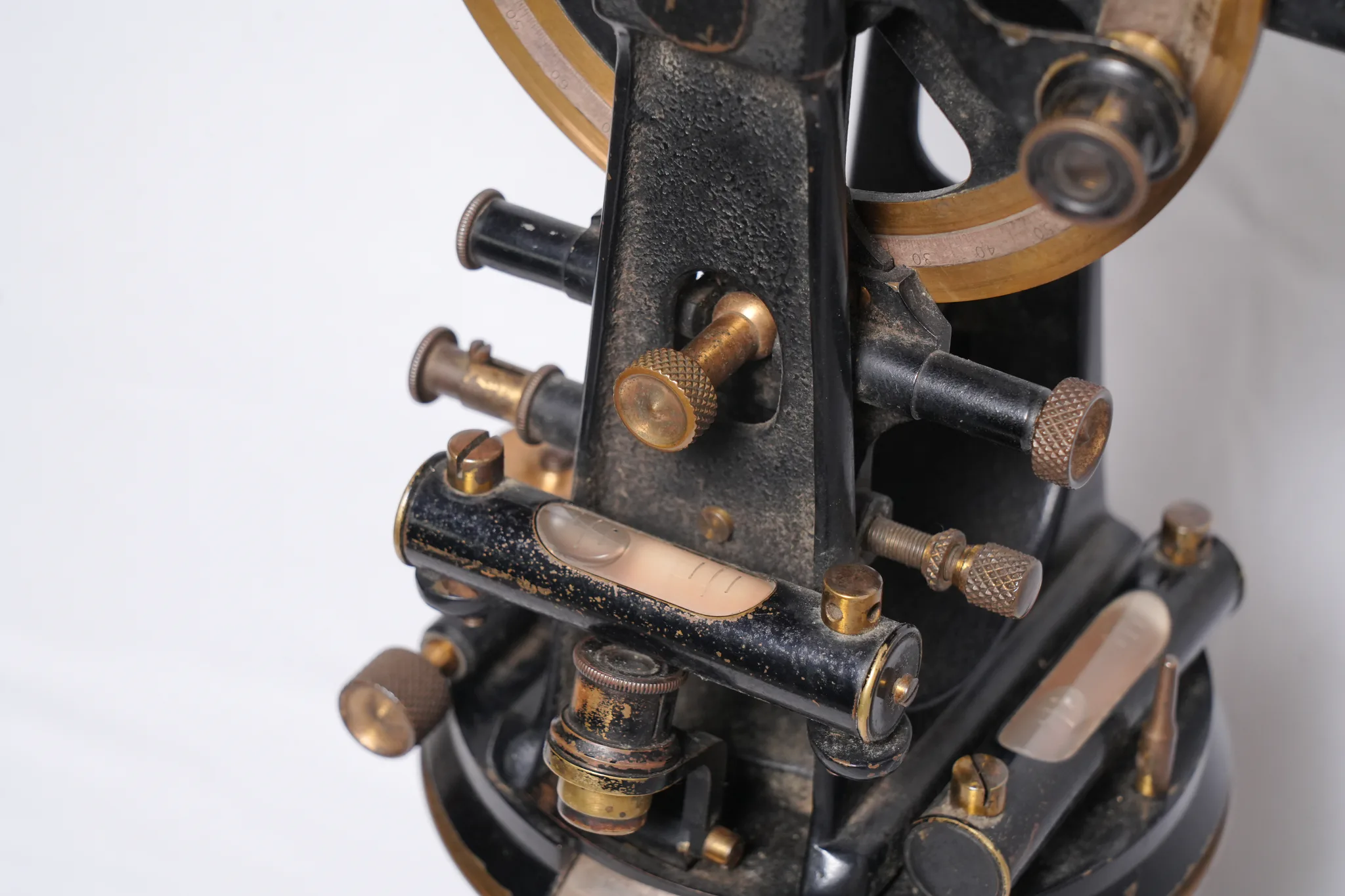
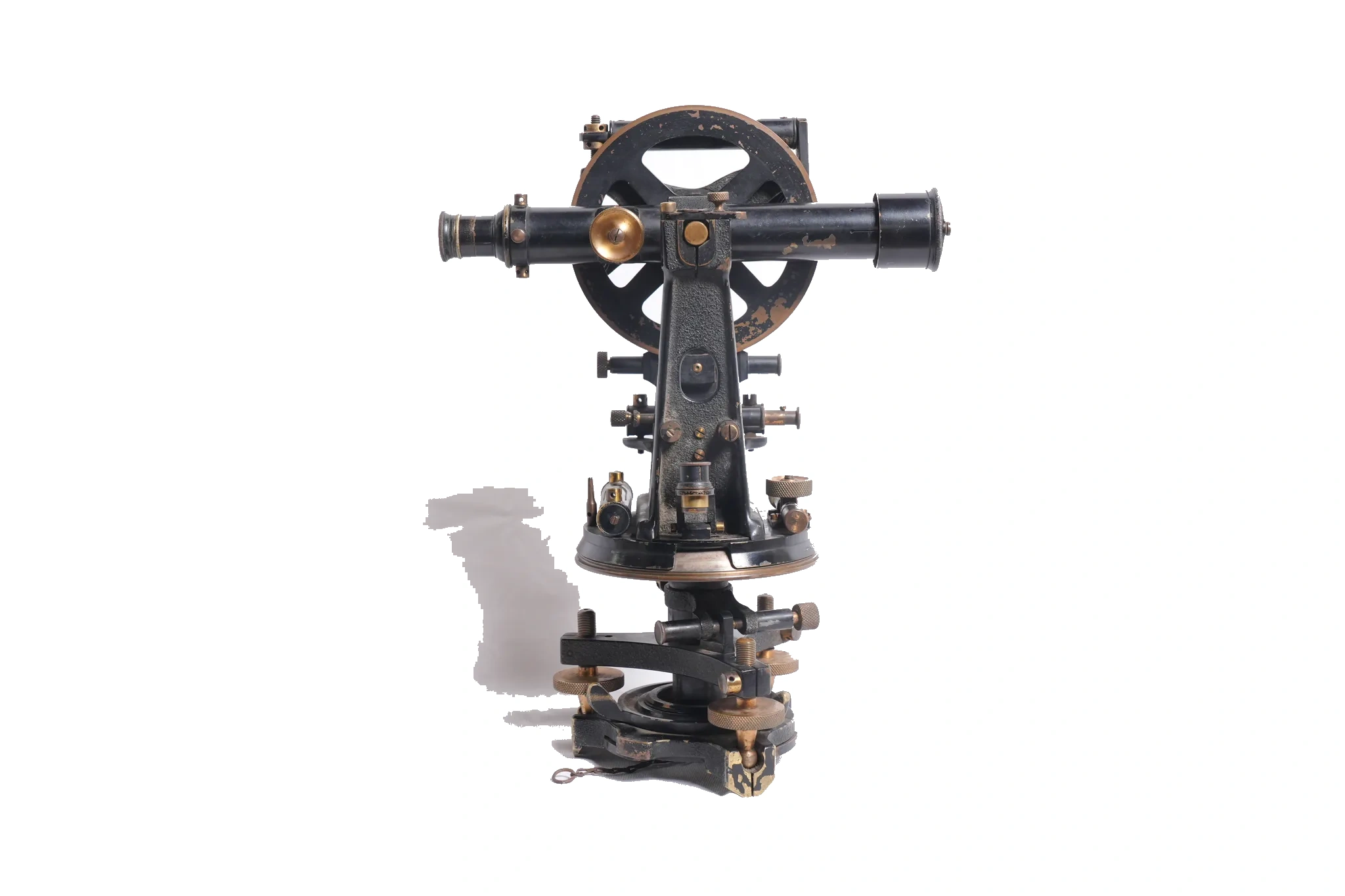
A classic British vernier transit theodolite by Lawrence & Mayo of London, engineered for precision surveying and civil engineering. Finished in black enamel with exposed lacquered brass scales and verniers, the instrument features a full vertical circle, sensitive spirit levels, and a three-screw leveling tribrach base.
Precision British brass and cast iron surveying instrument by Lawrence & Mayo, London
The theodolite displays authentic historical wear with edge chipping, rubbing, and paint loss across the black-enameled A-frames and base casting. The brass scales, knurled adjustment screws, and vernier readouts show natural patina and minor surface oxidation. Glass spirit levels and telescope lenses appear intact with expected dust and superficial handling marks.
Provenance documentation was not supplied for this specific Lawrence & Mayo Transit Theodolite No. 513; this listing is based on the supplied photographs only.
LAWRENCE & MAYO LONDON Nº 513
Vernier Transit Theodolite
Three-screw leveling tribrach with knurled thumbscrews
Dual tubular spirit levels mounted on plate and vertical standards
Terrestrial surveying telescope with rack-and-pinion focusing and objective cover
Clear period hallmark reads 'LAWRENCE & MAYO LONDON Nº 513' stamped directly into the horizontal limb edge.
Equipped with a finely divided brass vertical circle and dual vernier reading magnifiers for zenith angle measurement.
Rigid black-lacquered dual-standard frame supporting the central transit telescope axis without flexure.
Features multiple adjustable tubular spirit levels mounted on the horizontal plate and upper standards for exact leveling.
Classic geodetic tribrach design featuring large knurled brass leveling screws and a threaded tripod mount socket.
Equipped with brass objective end cap, knurled focusing controls, and an eyepiece with diopter adjustment.
Surveying instruments like this transit theodolite formed the backbone of British railway construction, municipal surveying, and geographical triangulation, providing the rigid mechanics necessary for uncompromised accuracy across demanding colonial terrains.
Each instrument produced by Lawrence & Mayo underwent exhaustive hand-finishing, with its serial number and London provenance permanently engraved into the brass dial, attesting to rigorous optical and mechanical calibration before leaving the workshop.
Lawrence & Mayo is established in London, quickly expanding into optical, navigational, and surveying instruments across the British Empire.
The firm establishes offices and workshops in Bombay and Calcutta to supply precision instruments to railways and government surveys.
Transit theodolite serial number 513 is manufactured in London for high-accuracy field triangulation and civil engineering works.
Traditional open-vernier transit theodolites gradually give way to enclosed glass-circle tachymeters and modern optical designs.
Visible chipping, paint flaking, and edge wear down to the underlying brass on the standards and barrel.
Even aged patina and surface oxidation on adjustment wheels, scale rings, and thumbscrews.
The maker engraving 'LAWRENCE & MAYO LONDON Nº 513' remains crisp and clearly legible on the lower plate rim.
Tubular glass spirit levels remain mounted in brass housings with intact fluid reservoirs.
Photographs and catalogue attribution: Curio Gallery.
Sweden, 1948
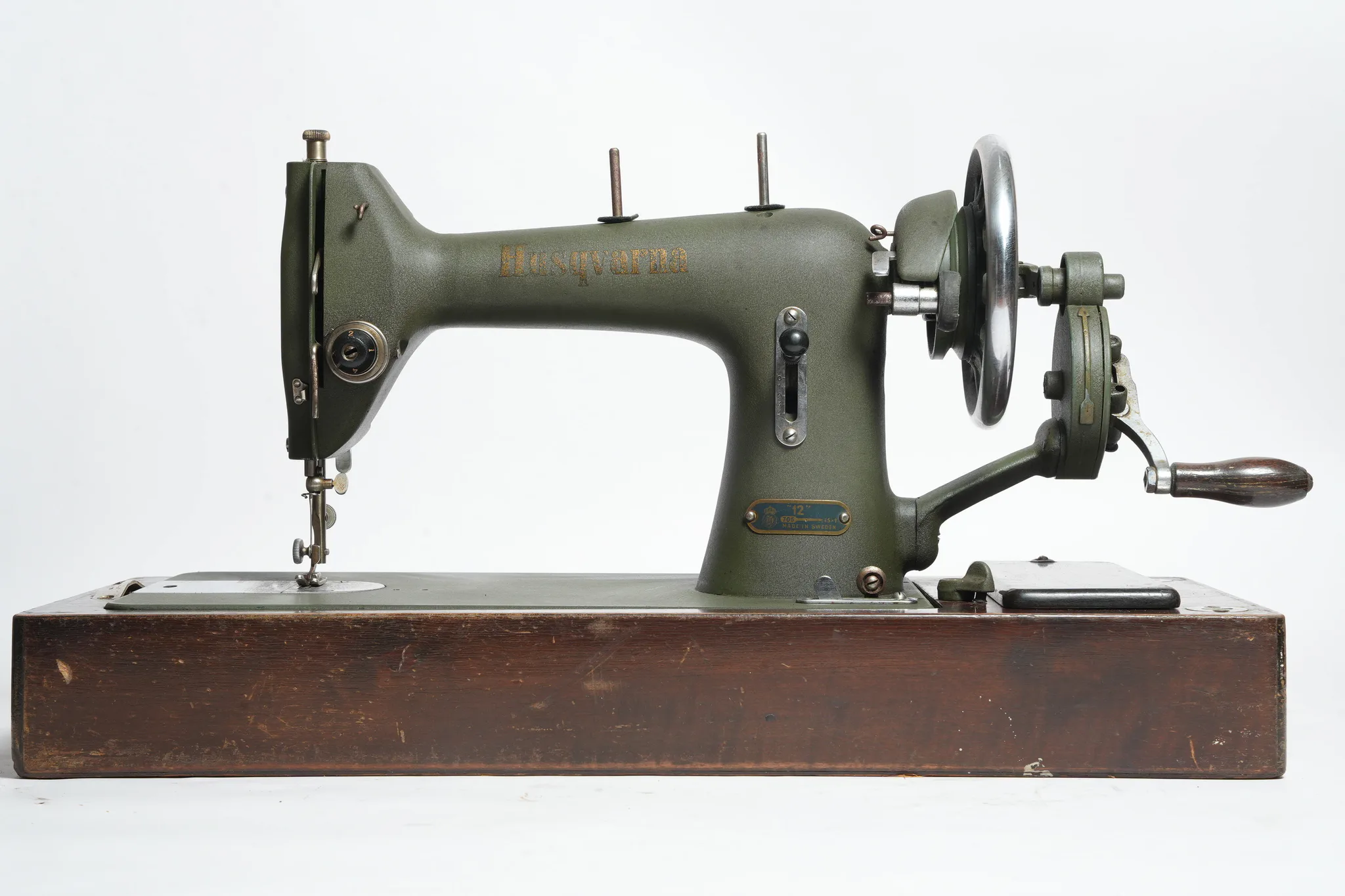
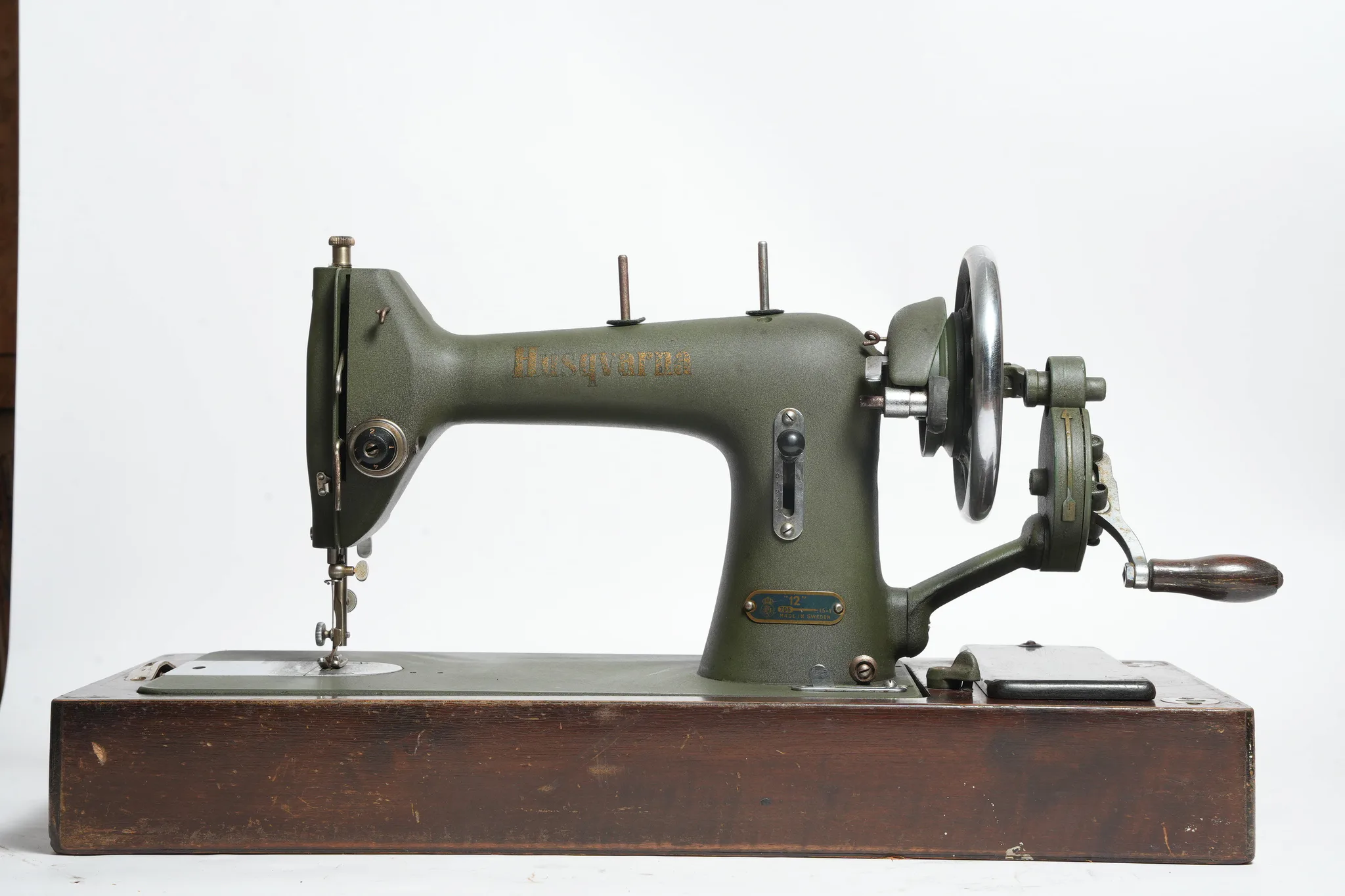
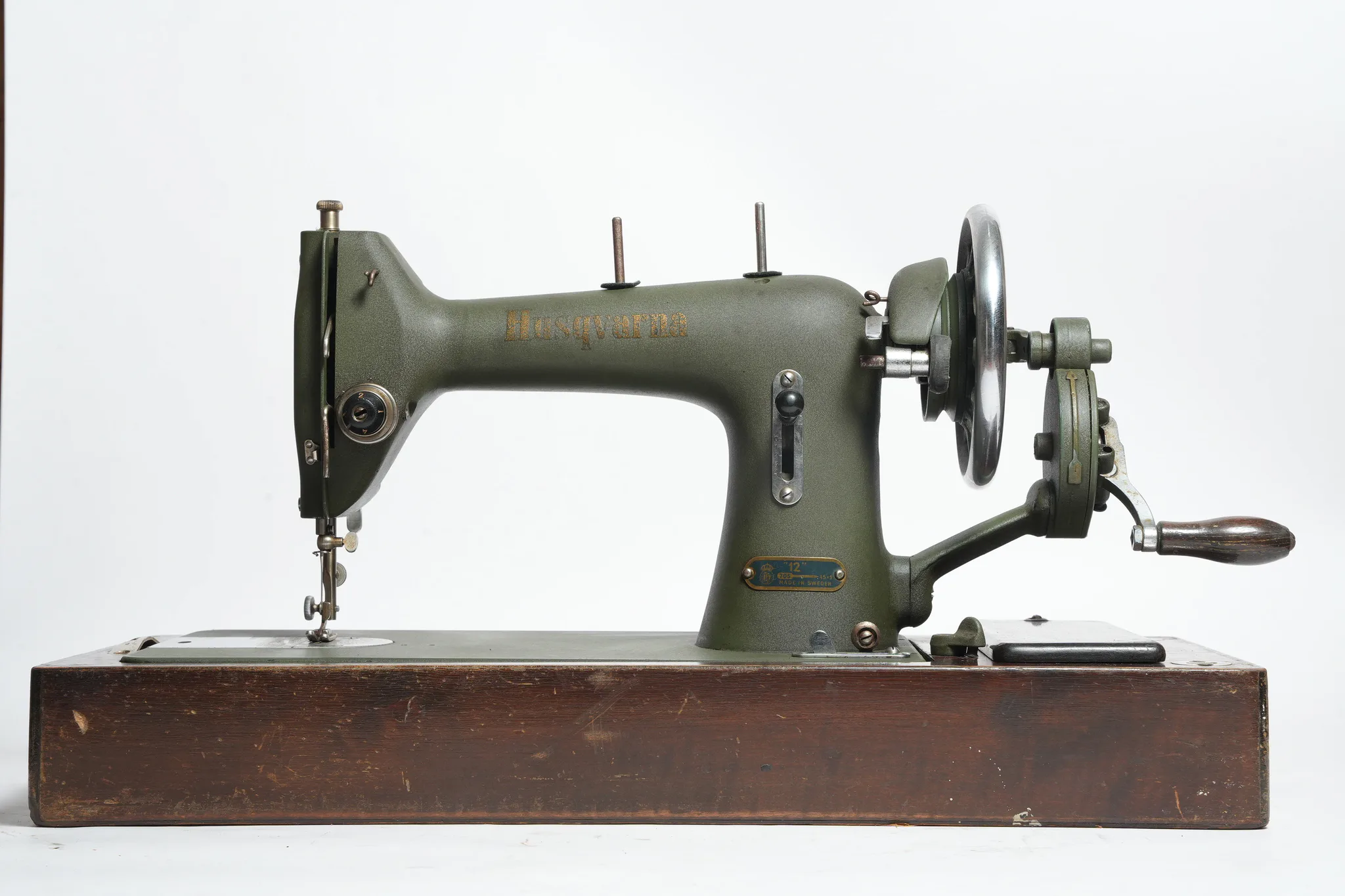
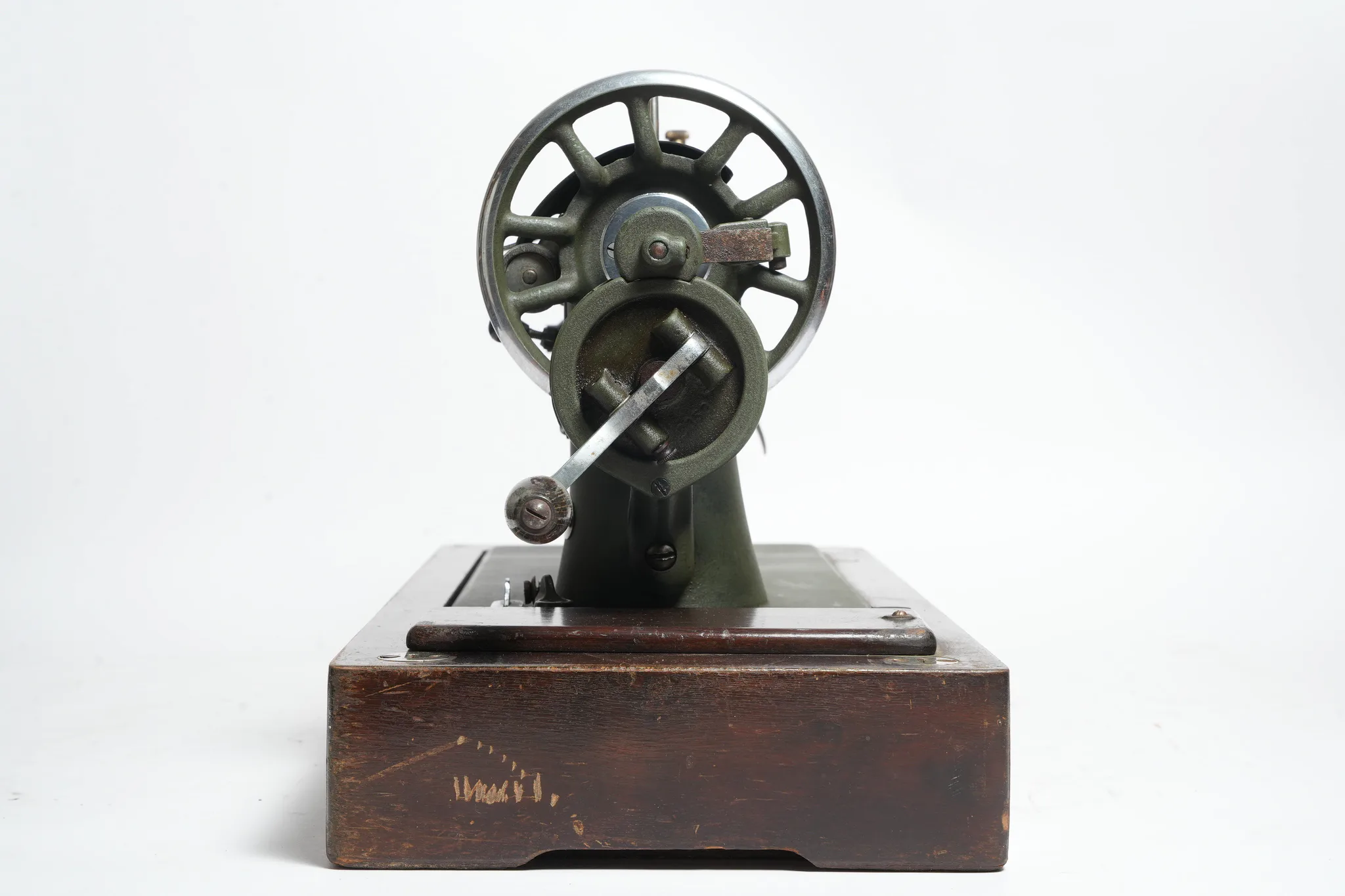
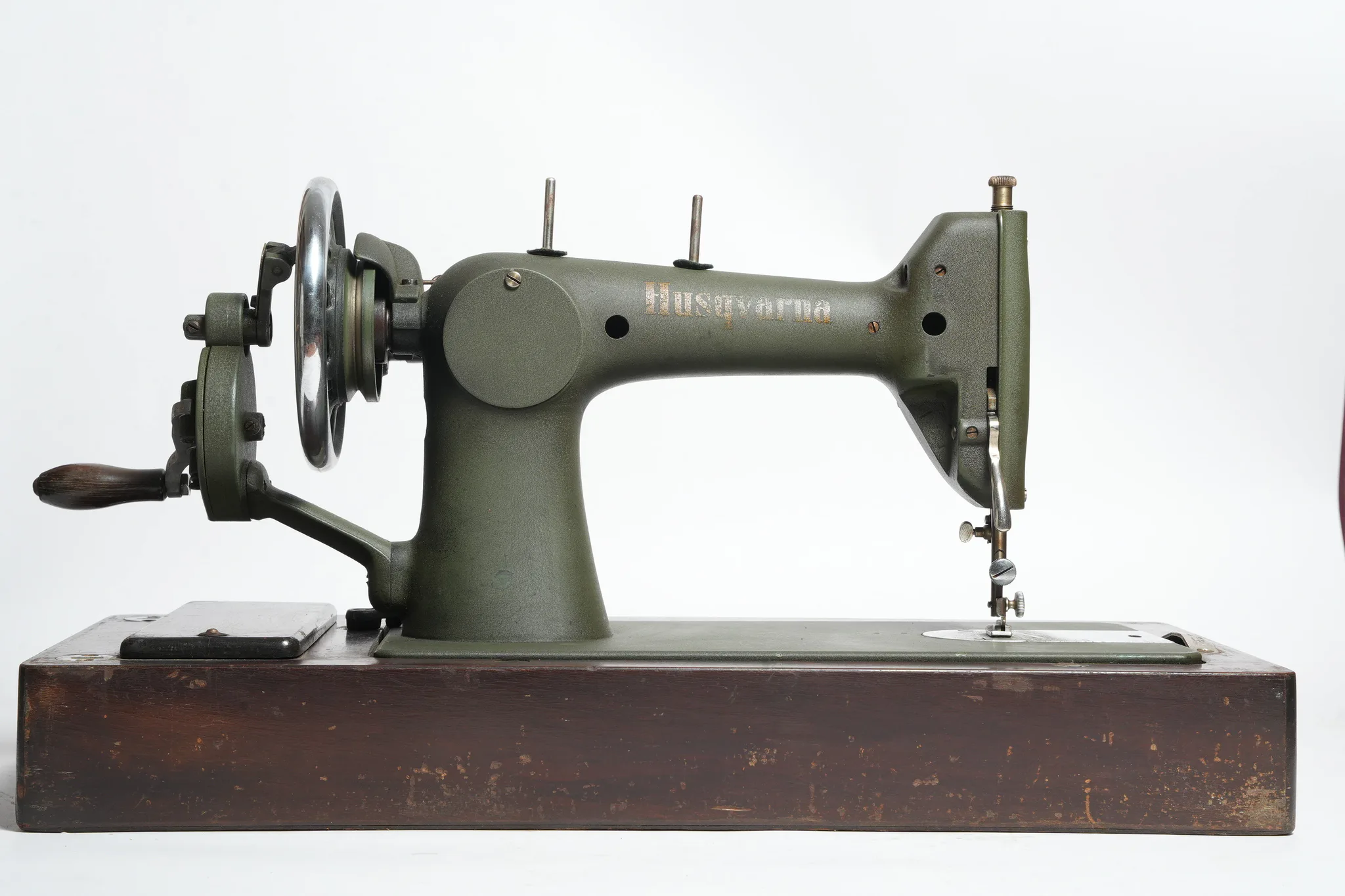
Crafted in Sweden by Husqvarna Vapenfabriks AB, this Class 12 lockstitch sewing machine features a durable olive-green crinkle enamel finish and gilt maker branding across the arm. Equipped with a manual geared hand crank and turned wooden grip, the machine is mounted onto a dark-stained solid wooden base plinth. The head features dual spool pins, a vertical stitch-length adjuster lever, and an integrated needle-bar assembly.
Swedish precision straight-stitch machine in textured olive enamel
The machine survives in well-preserved vintage cosmetic condition, retaining its factory-applied olive crinkle paint and clear gilt Husqvarna branding. Light oxidation and surface patina appear across unpainted steel elements, thread guides, and spool pins. The wooden base shows authentic age-appropriate abrasions, softening at the corners, and minor scuff marks consistent with handling.
Provenance documentation was not supplied for this specific Husqvarna Class 12 Hand-Crank Sewing Machine; this listing is based on the supplied photographs only.
Class 12
Husqvarna Vapenfabriks AB
Manual geared hand-crank with wooden handle
Olive green crinkle / wrinkle enamel
Straight lockstitch
Dark-stained hardwood plinth base
Manufactured in Huskvarna, Sweden, by one of Europe's longest-standing precision engineering firms.
Features a tactile olive-green wrinkle enamel that provides exceptional wear resistance.
Equipped with an authentic geared side crank and turned wooden handle for off-grid sewing.
Twin top-mounted spool pins accommodate multiple thread setups and winding tasks.
Column-mounted vertical sliding lever allows swift calibration of stitch length.
Seated within a solid timber box plinth that serves as an authentic period mounting platform.
Manufactured by Husqvarna Vapenfabriks AB in Sweden, the Class 12 showcased military-grade manufacturing transplanted into domestic tailoring. The distinct olive crinkle enamel reflected robust mid-century Scandinavian industrial design, built to operate reliably across generations without electrical power.
Fitted with a geared hand crank and dark turned wooden handle, this machine enabled precise, portable stitch control. As captured in the profile photograph, the polished chrome balance wheel balanced manual torque with smooth mechanical sewing cadence.
Husqvarna pivots precision manufacturing expertise from firearms to producing sewing machines.
Husqvarna launches the robust Model 12 family using central-bobbin straight-stitch mechanics.
Adoption of durable textured crinkle coatings in distinctive olive and forest green finishes.
Production transitions toward modern freearm designs, concluding the classic hand-crank Model 12 lineage.
Textured olive green finish remains largely intact across the casting, with original gold lettering clearly preserved on the horizontal arm.
Manual crank mechanism, wooden turned grip, and chrome-plated balance wheel remain securely attached and intact.
Chrome fittings, stitch regulator plate, and tension discs display modest surface aging and light authentic tarnish.
Solid hardwood base exhibits surface scratches, small pressure marks, and honest patina along outer edges.
Photographs and catalogue attribution: Curio Gallery.
Unknown, 1900
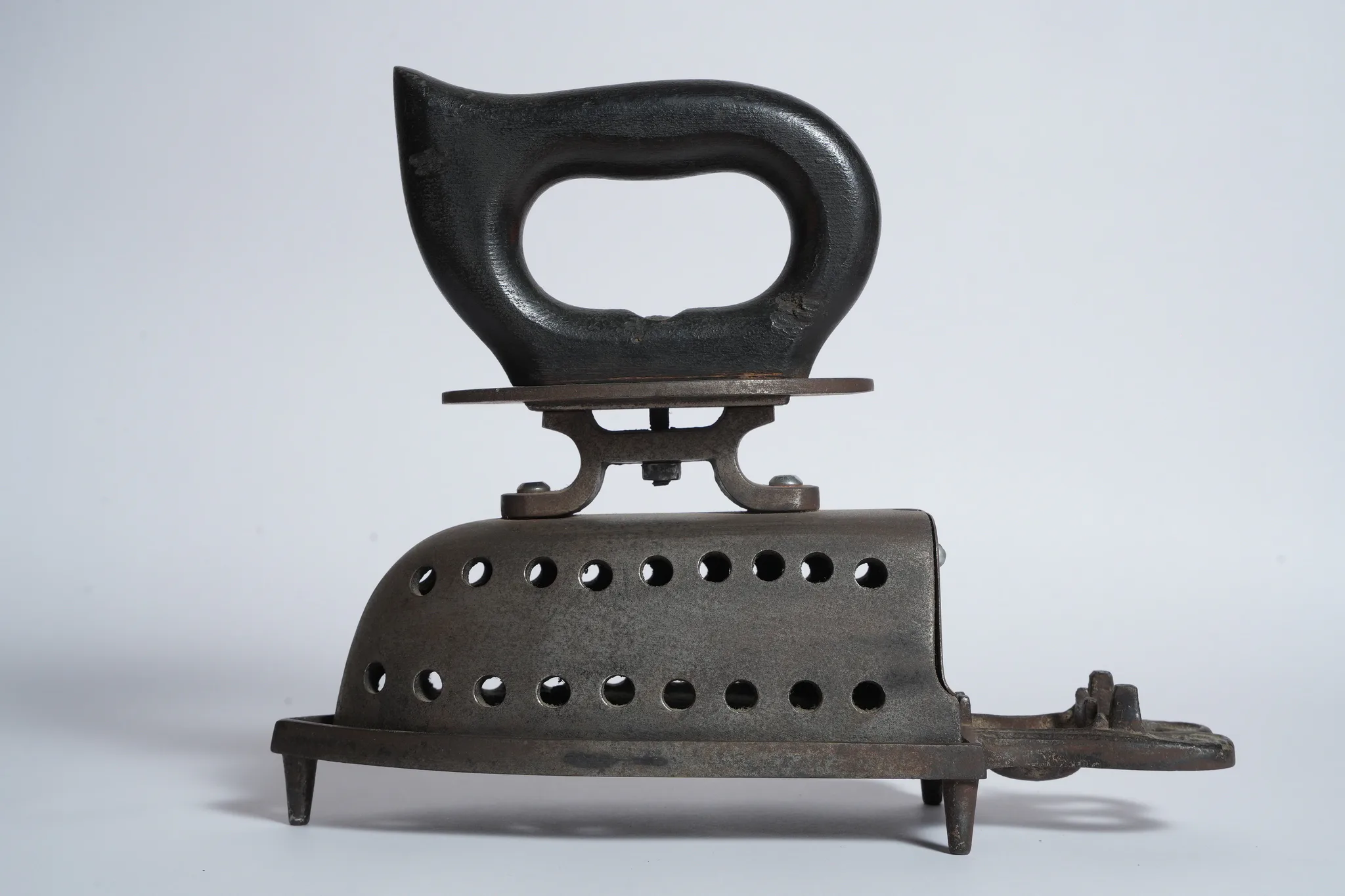
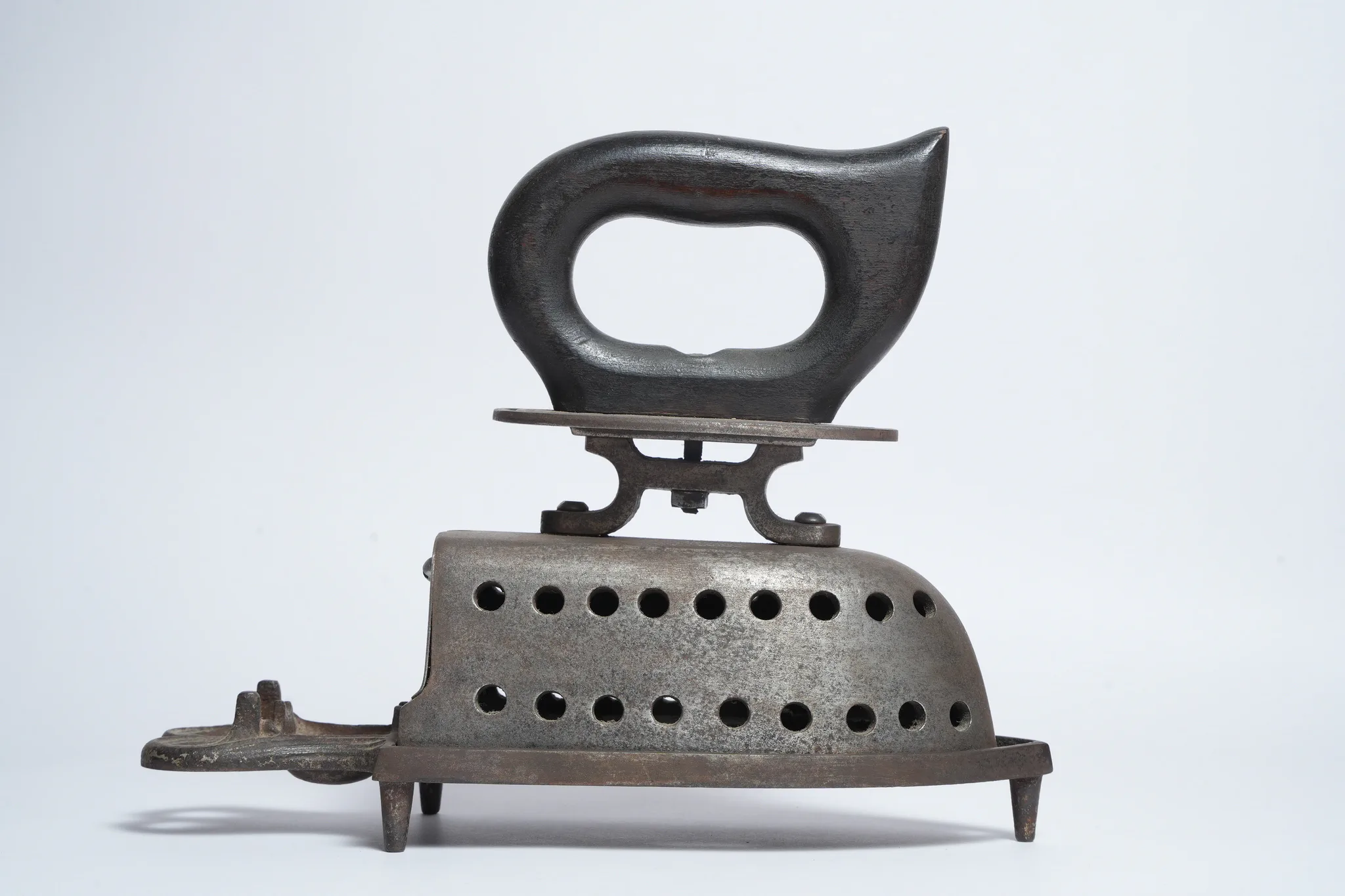
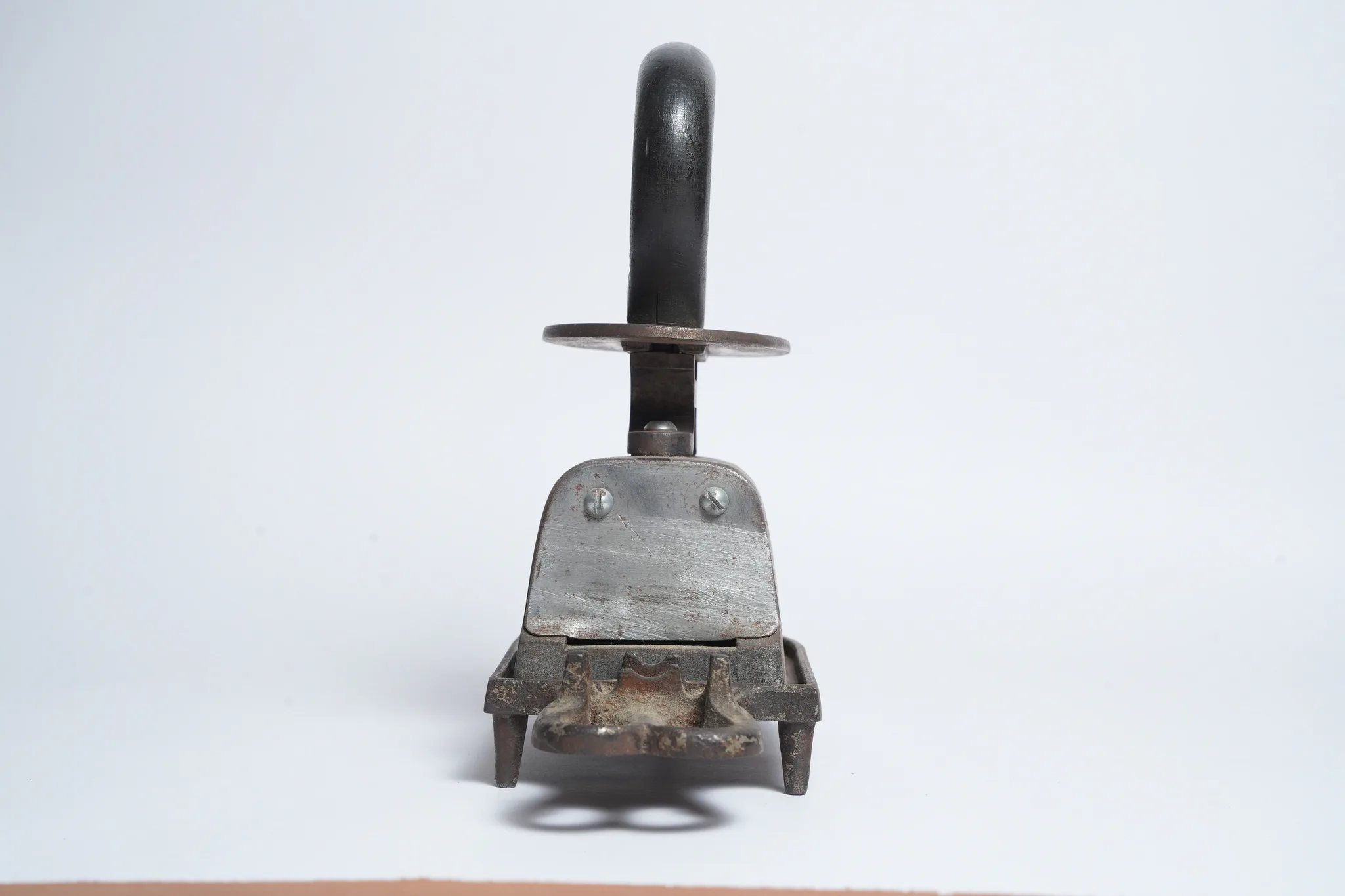
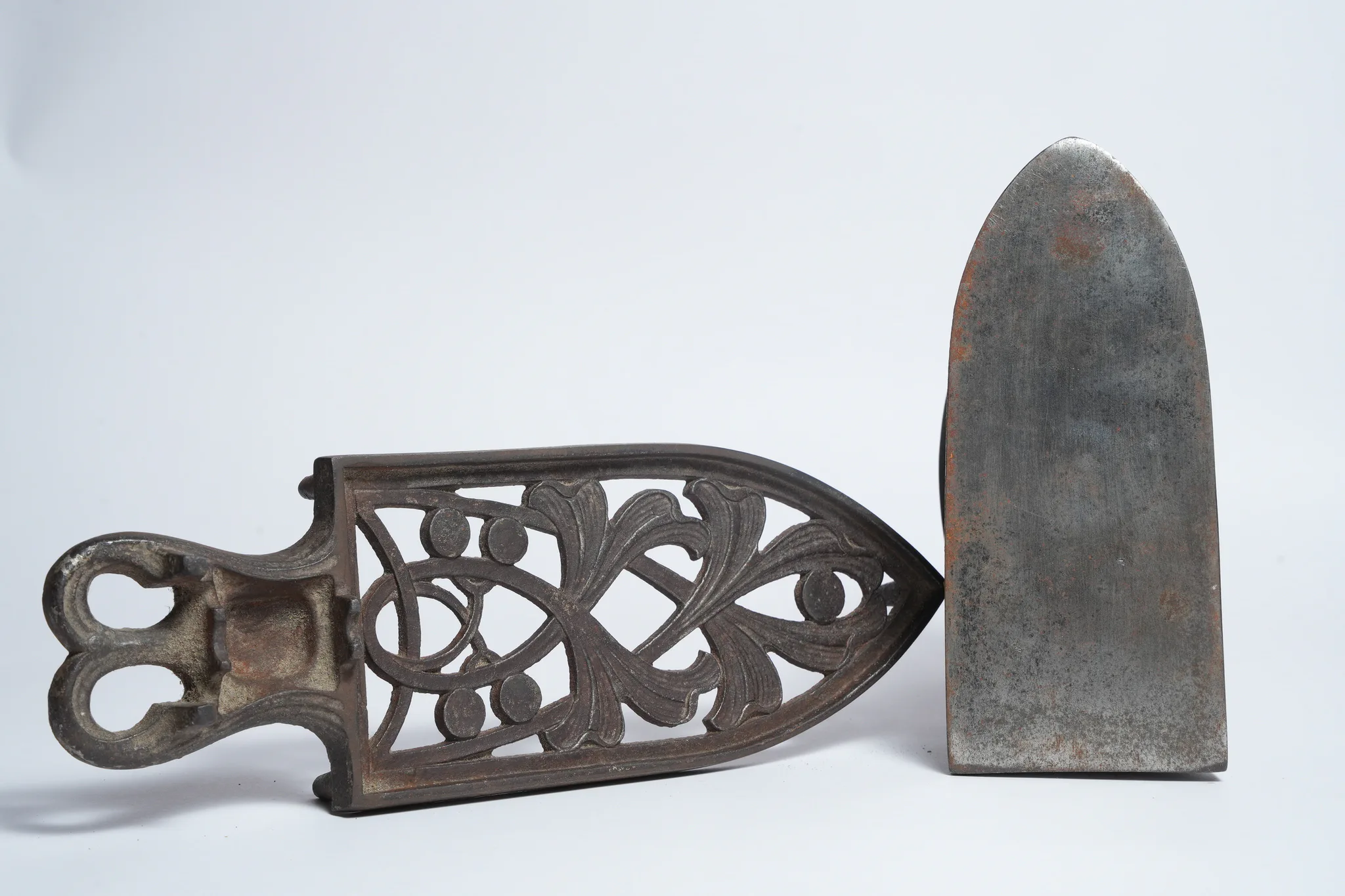
This antique charcoal box iron features a heavy cast-iron chamber with two rows of draft holes to facilitate airflow across glowing embers. It is fitted with an ergonomic carved wooden handle mounted above a protective heat shield, resting atop a matching cast-iron footed trivet.
Early domestic laundry iron with dual-row vent holes and wooden grip
The cast-iron body and matching stand show age-appropriate surface oxidation, scattered pitting, and a dark aged patina throughout. The carved wooden handle displays minor handling wear and finish smoothing but remains securely attached to its mounting hardware. The rear plate shows tool marks, light surface corrosion, and minor finish scuffs.
Provenance documentation was not supplied for this specific Antique Charcoal Box Iron with Trivet Stand; this listing is based on the supplied photographs only.
Charcoal box iron (sad iron) with matching trivet
Cast iron and wrought metal components
Turned and shaped hardwood
Dual rows of circular draft holes on both flanks
Not visible in photographs
Drilled draft perforations along both sides provide chimney-style airflow to keep coals smoldering.
Carved hardwood grip with an integrated upper thumb rest ensures a comfortable, secure hold.
An intermediate oval metal plate deflects radiant heat away from the user's hand during use.
Elevated iron stand provides stable clearance to protect work surfaces from hot metal.
Heavy-gauge iron walls maximize heat retention across the polished pressing surface.
Curved openwork bracketry combines structural rigidity with classic industrial folk styling.
Ventilation holes drilled along the cast iron body provided continuous airflow to maintain burning embers inside. As seen in the side profile, this draft design allowed users to press textiles smoothly without constantly reheating the sole on a stove.
The sculpted wooden handle is separated from the hot iron chamber by an arched bracket and protective baffle plate. The rear view highlights this ergonomic isolation, which kept the grip cool and safe during extended pressing sessions.
Ventilated box irons grew widespread across Europe and the Americas as self-heating laundry solutions.
Domestic foundries perfected charcoal iron bodies with dual draft vents and heat deflection shields.
The advent of electric resistance irons gradually displaced solid-fuel pressing tools in households.
Surviving intact coal and charcoal irons became prized decorative objects celebrating early domestic folk art.
Natural dark oxidation and areas of surface rust consistent with antique cast-iron housewares.
Solid hardwood handle intact with smooth handling wear and no structural splits visible.
Slotted mounting screws and bracket bolts are intact, securing the handle and heat shield firmly.
Cast-iron three-legged base is complete with intact resting feet and rear openwork extension.
Photographs and catalogue attribution: Curio Gallery.
Austria, 1880
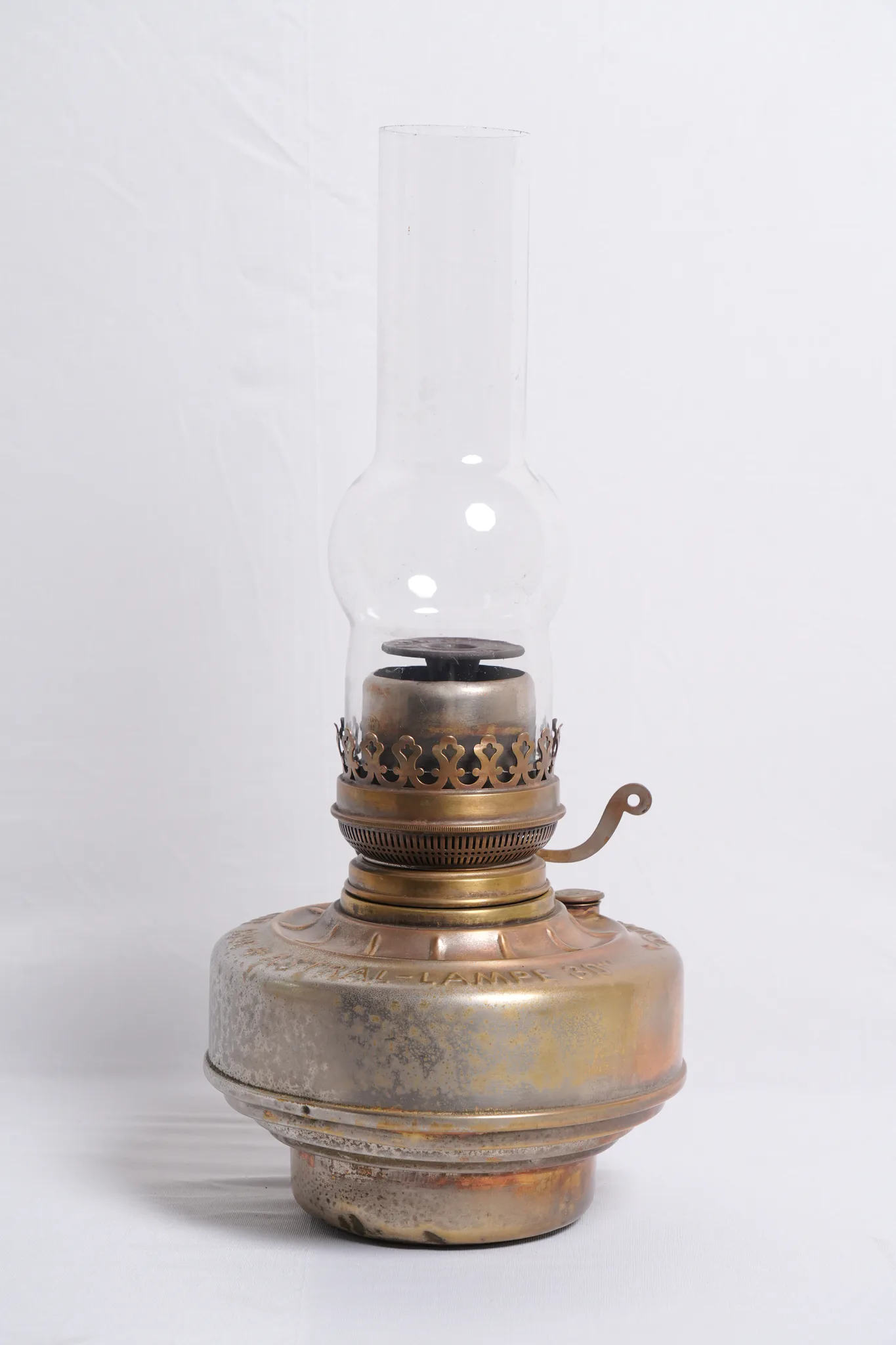
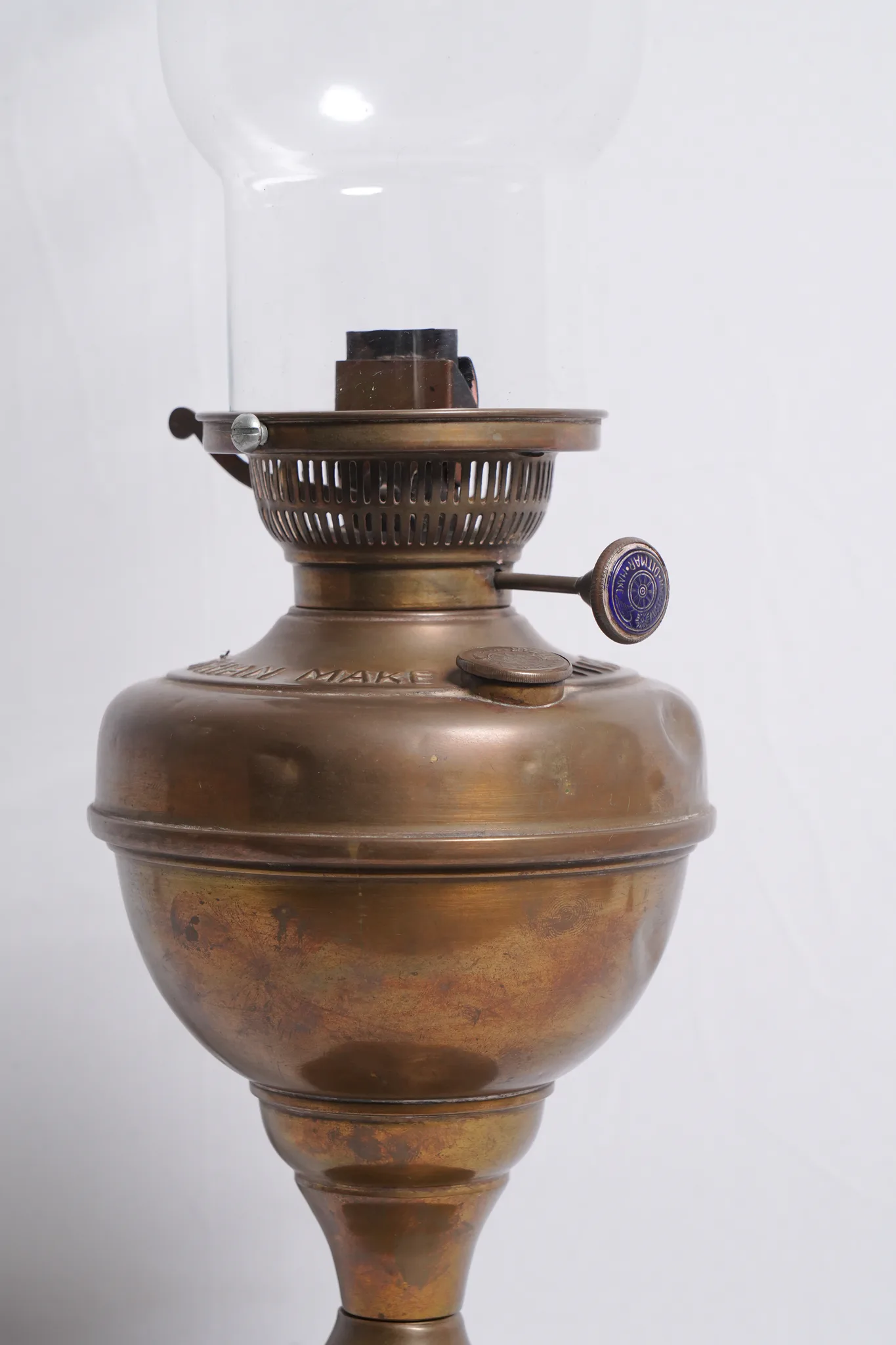
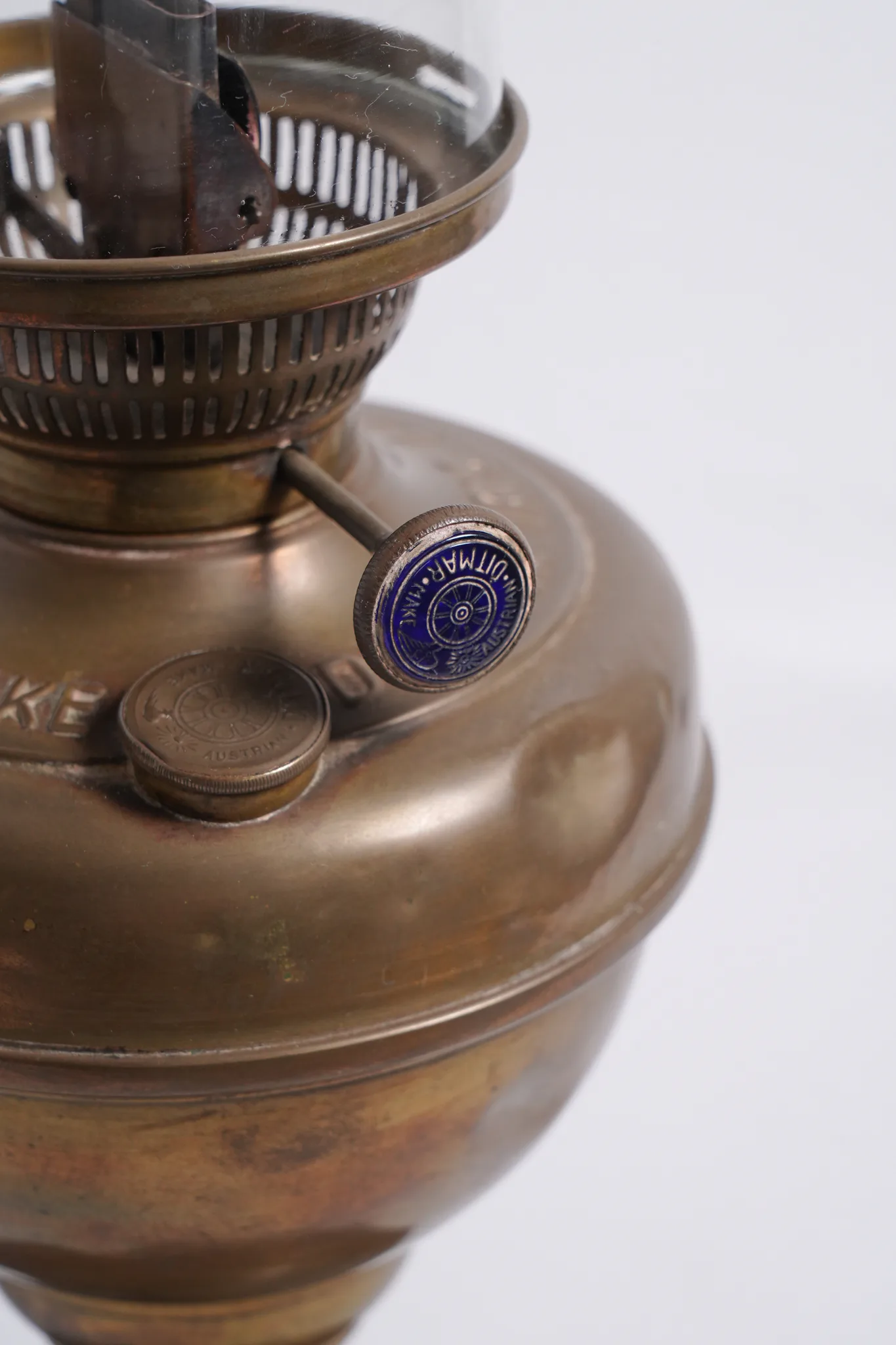
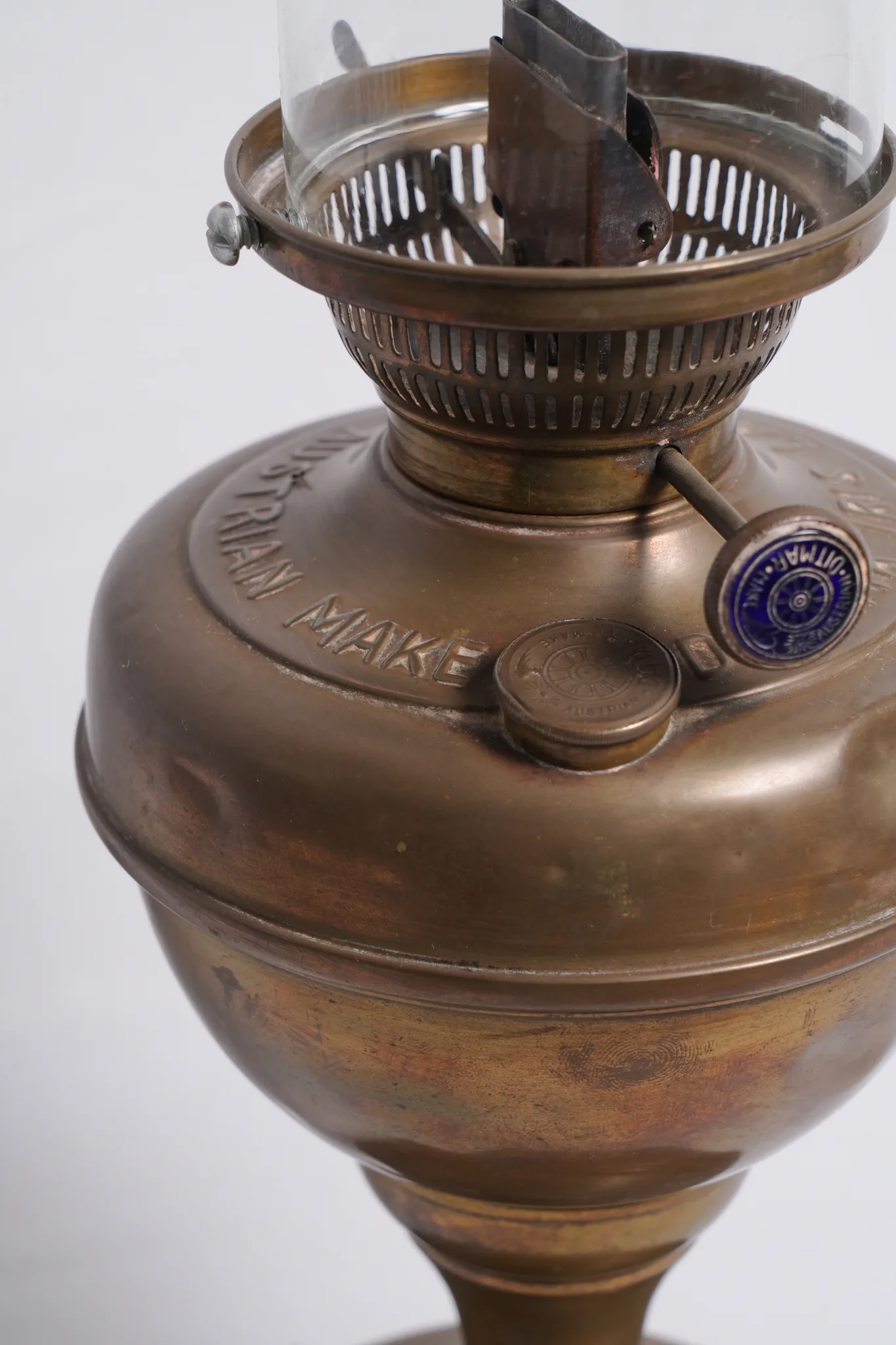
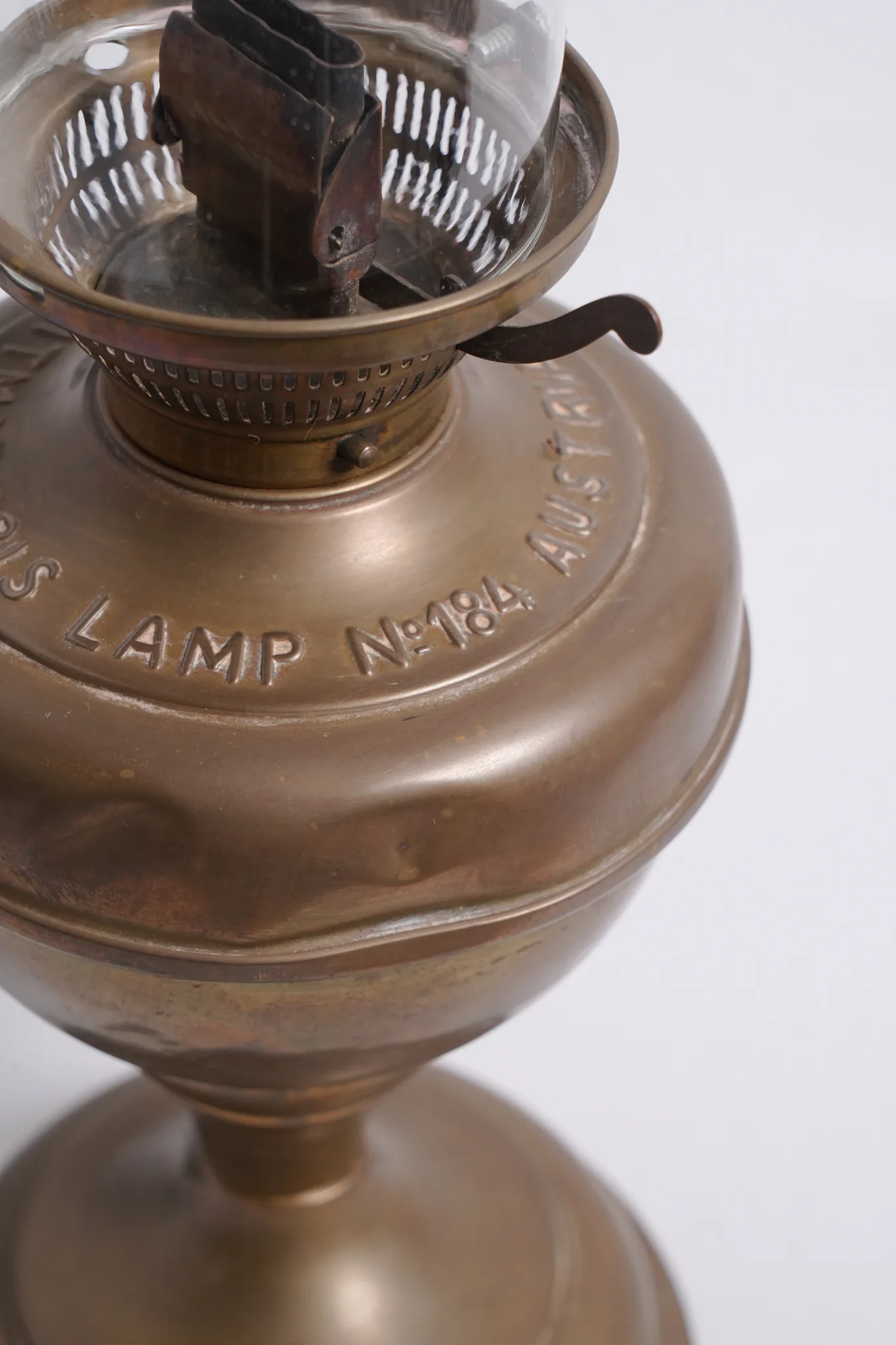
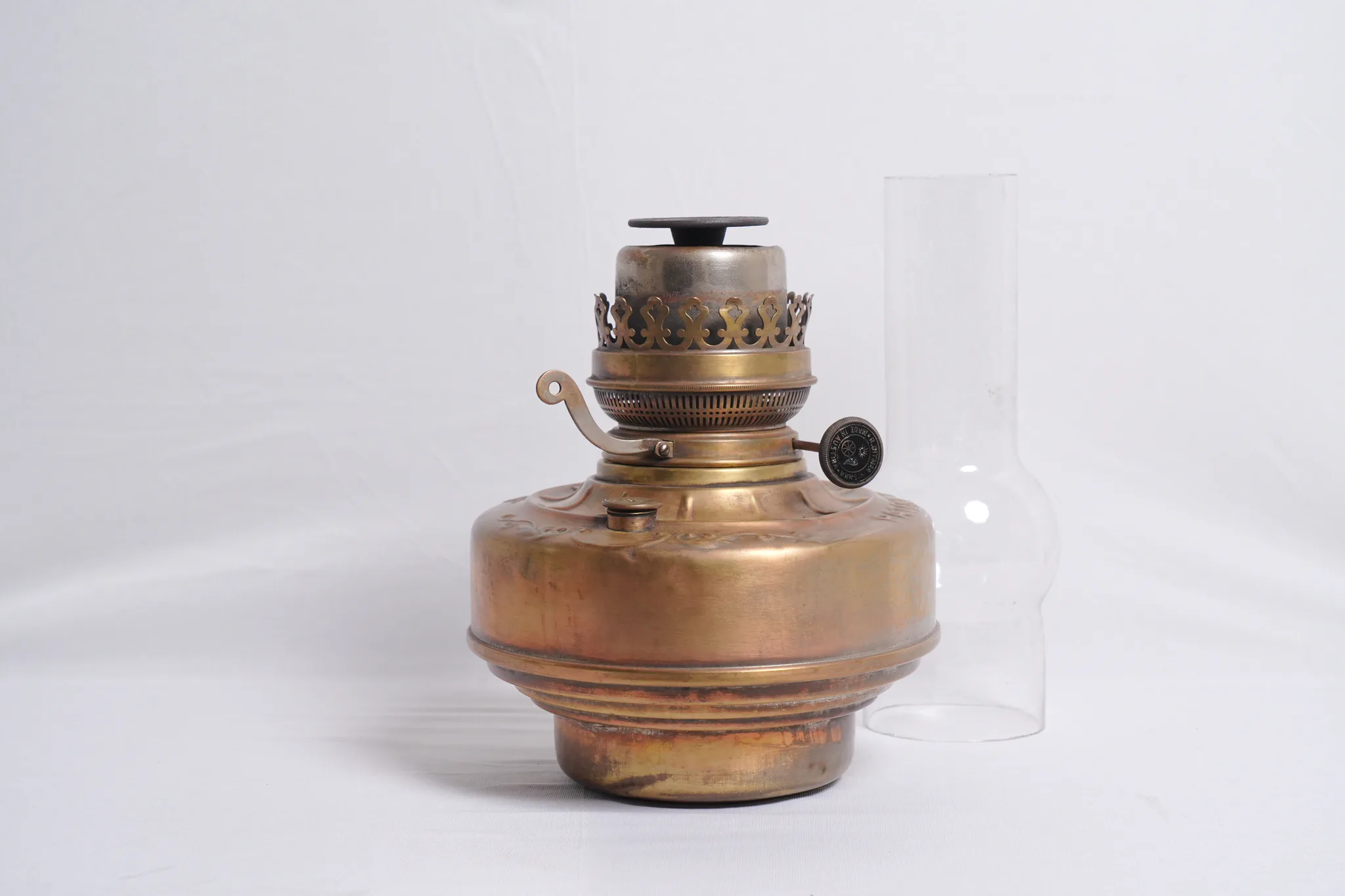
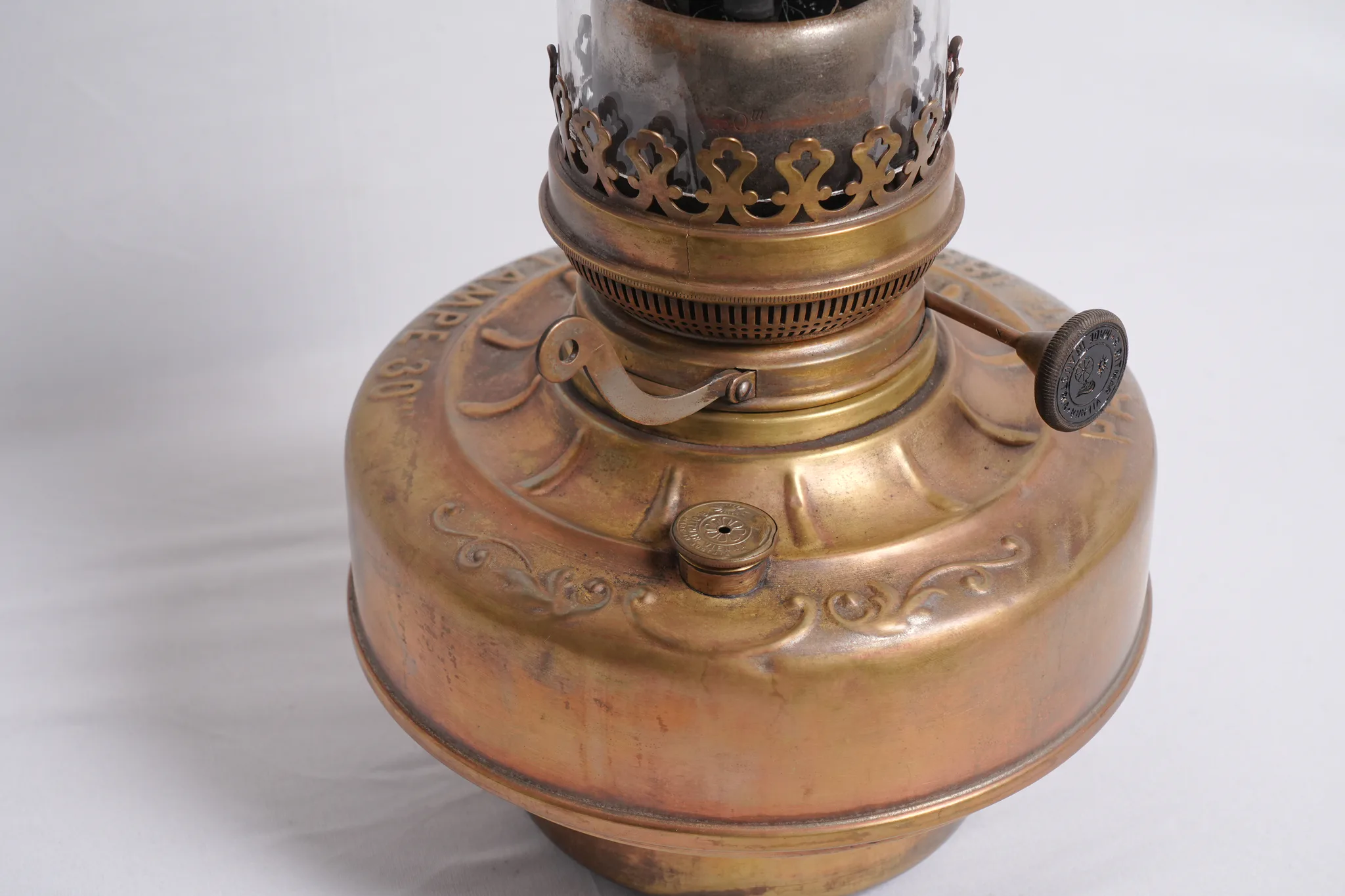
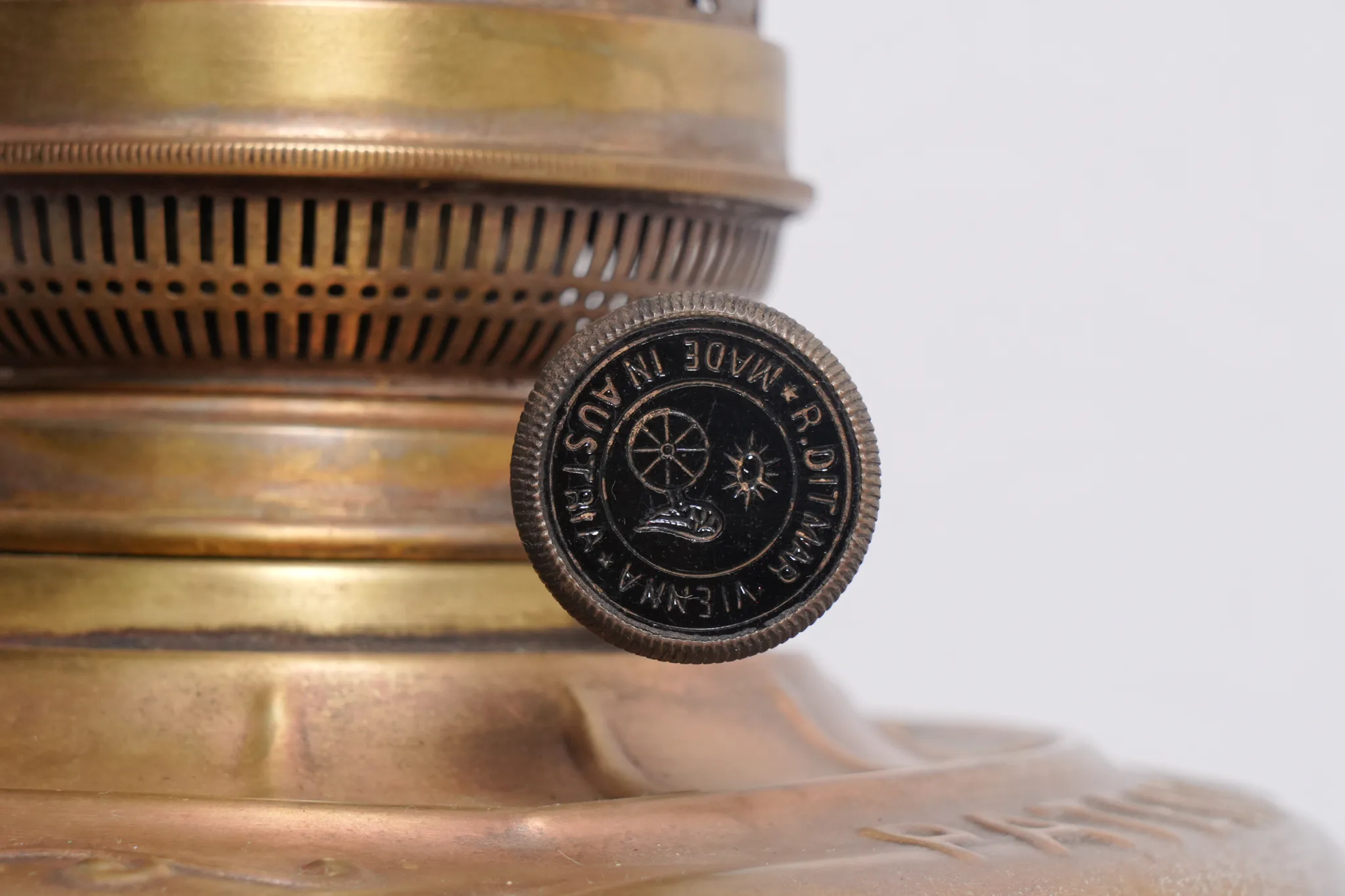
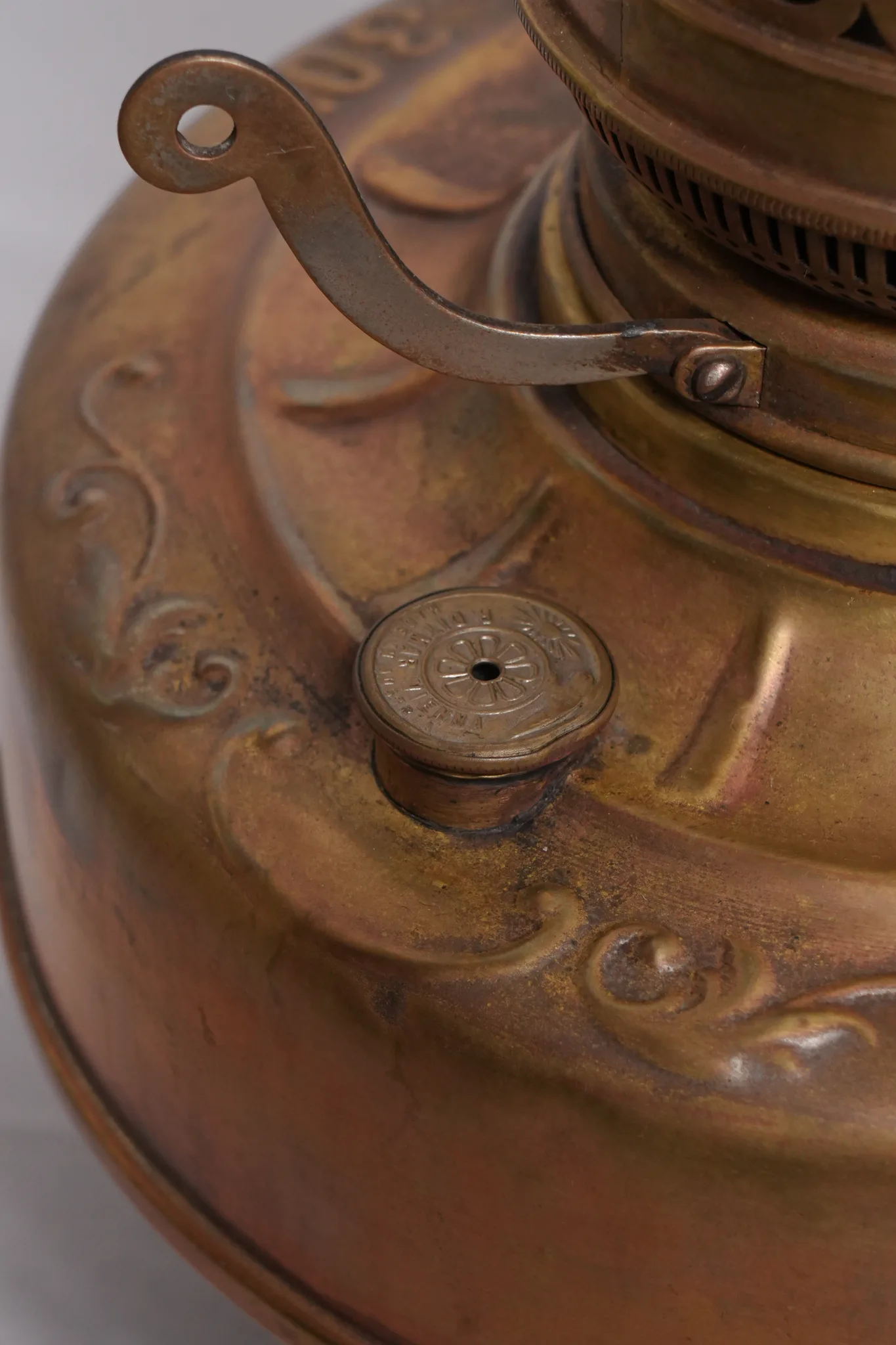
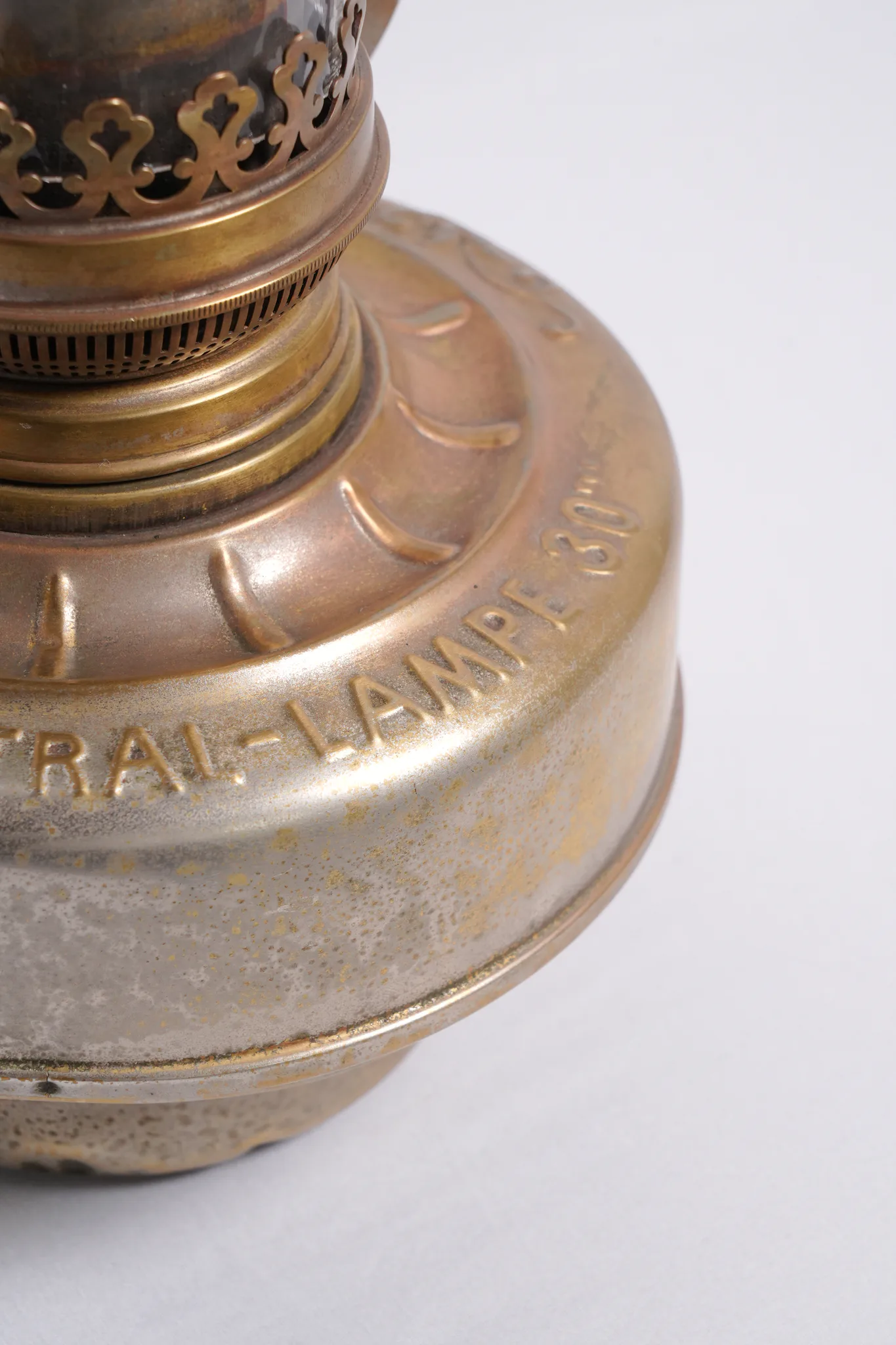
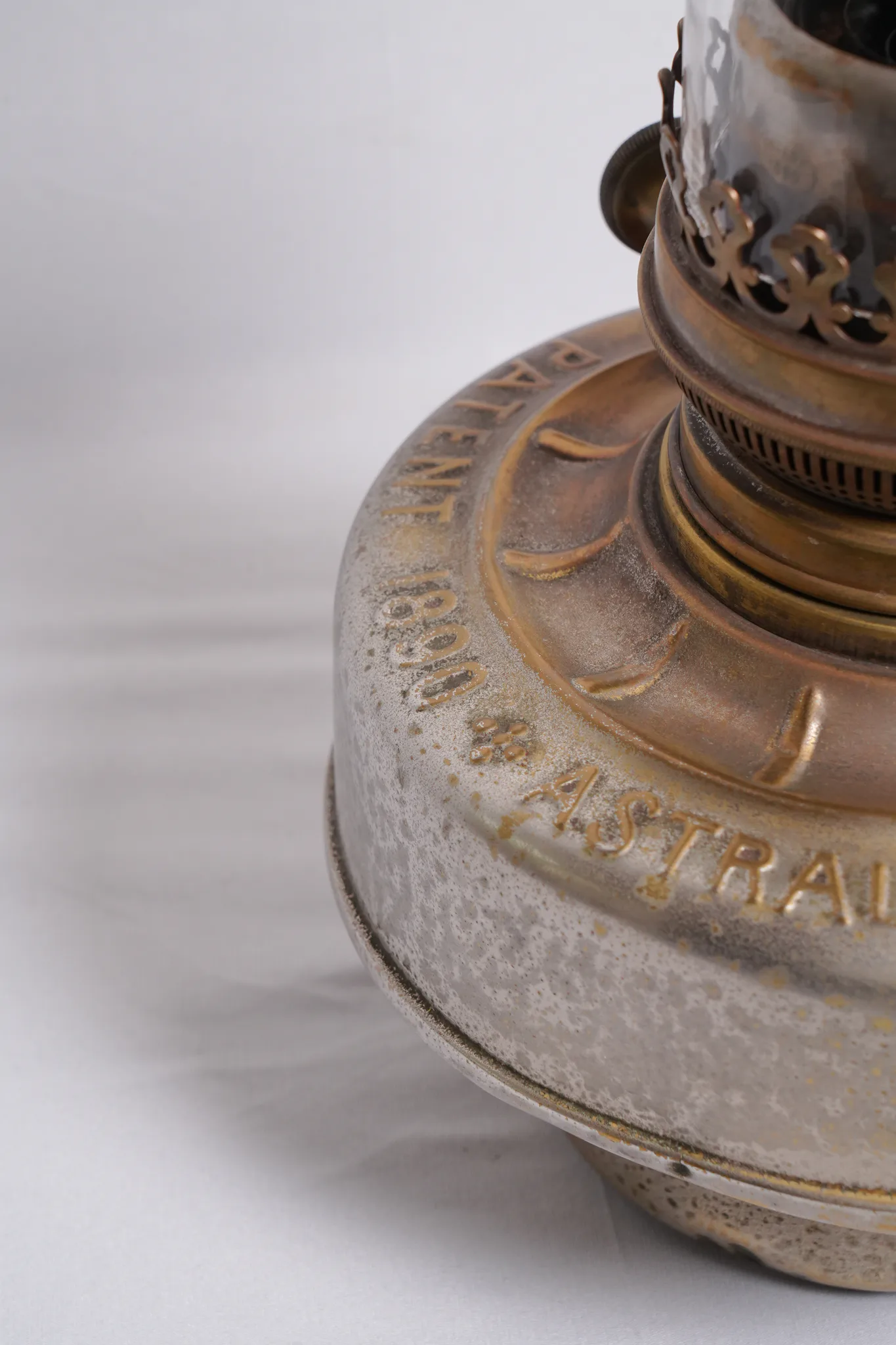
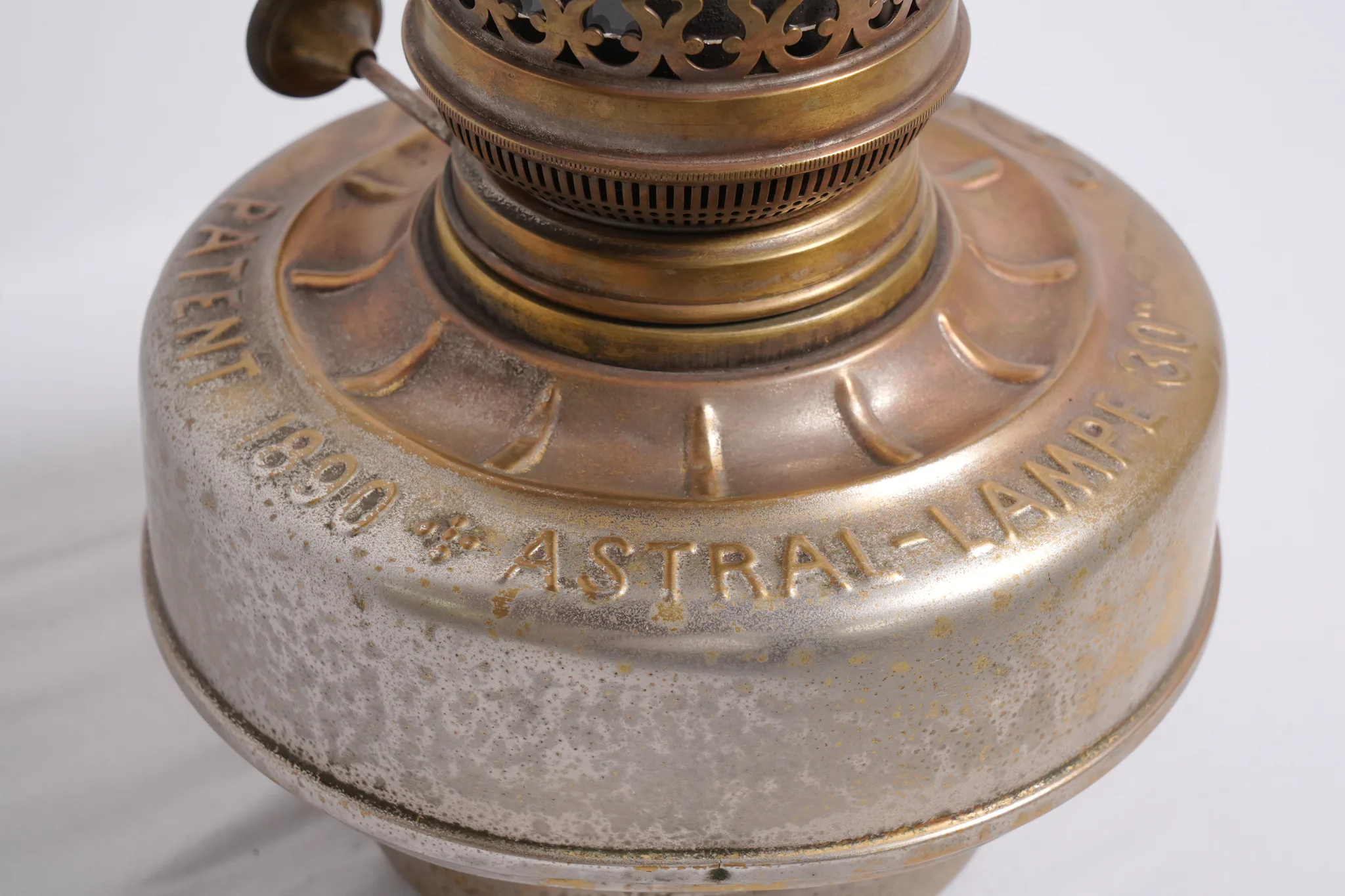
This antique kerosene or oil lamp is crafted from brass and features a clear glass chimney. The burner control knob is marked 'AUSTRIAN MAKE' with a blue enamel center depicting a starburst motif. An additional embossed filler cap on the fuel reservoir is also stamped with 'AUSTRIAN'.
Authentic Austro-Hungarian brass lamp featuring blue enamel wick adjuster
The lamp displays a natural aged brass patina with some localized tarnishing and discoloration. The clear glass chimney is intact, and the burner mechanism with its blue enamel adjuster appears complete and functional.
Provenance documentation was not supplied for this specific Vintage Dittmar Austrian Make Brass Kerosene Oil Lamp; this listing is based on the supplied photographs only.
Kerosene / Paraffin Oil
Flat wick burner with rotating thumbwheel
'AUSTRIAN MAKE' on fuel reservoir and wick adjuster
Detachable clear glass hurricane chimney
Vintage Dittmar Austrian Make Brass Kerosene Oil Lamp by R. Ditmar (Rudolf Ditmar), Vienna, identified from the supplied photographs and catalogue evidence.
Brass, clear blown glass; visible finish and hardware are recorded without adding unseen components.
Austria period specification
Distinctive proportions, controls, markings, and surface details visible on this individual Vintage Dittmar Austrian Make Brass Kerosene Oil Lamp.
R. Ditmar (Rudolf Ditmar), Vienna production places this piece within the documented history of Vintage Dittmar Austrian Make Brass Kerosene Oil Lamp.
The included image set for Vintage Dittmar Austrian Make Brass Kerosene Oil Lamp is the reference for identity, completeness, and condition; details not shown are not assumed.
Vintage Dittmar Austrian Make Brass Kerosene Oil Lamp carries the material language of Austria manufacturing around 1880: purposeful controls, repairable construction, and a design made for use rather than disposal. Its surviving details connect today's collector with the hands that made and used it.
Every mark and fitting shown belongs to this individual Vintage Dittmar Austrian Make Brass Kerosene Oil Lamp. Its documented details give collectors a precise, honest connection to the people and practices that shaped R. Ditmar (Rudolf Ditmar), Vienna. The photographic record keeps that connection specific, personal, and grounded in the evidence presented.
Produced by R. Ditmar (Rudolf Ditmar), Vienna in Austria; the photographed Vintage Dittmar Austrian Make Brass Kerosene Oil Lamp retains its period design language.
Used in optics work during the working life of Vintage Dittmar Austrian Make Brass Kerosene Oil Lamp, with the controls and surfaces shown in the supplied photographs.
Preserved after active service, this Vintage Dittmar Austrian Make Brass Kerosene Oil Lamp became a reference point for collectors studying R. Ditmar (Rudolf Ditmar), Vienna workmanship.
Vintage Dittmar Austrian Make Brass Kerosene Oil Lamp was photographed, condition-reviewed, and catalogued for a documented Curio Gallery acquisition.
The lamp displays a natural aged brass patina with some localized tarnishing and discoloration. The clear glass chimney is intact, and the burner mechanism with its blue enamel adjuster appears complete and functional.
Only components visible in the photographs of this Vintage Dittmar Austrian Make Brass Kerosene Oil Lamp are included; unseen accessories are not assumed.
Operational performance for this individual Vintage Dittmar Austrian Make Brass Kerosene Oil Lamp is not claimed unless demonstrated in the photographs or separately tested.
Age, patina, wear, and any missing elements shown in the Vintage Dittmar Austrian Make Brass Kerosene Oil Lamp images should be considered part of its condition.
Photographs and catalogue attribution: Curio Gallery.
Unknown, 1930
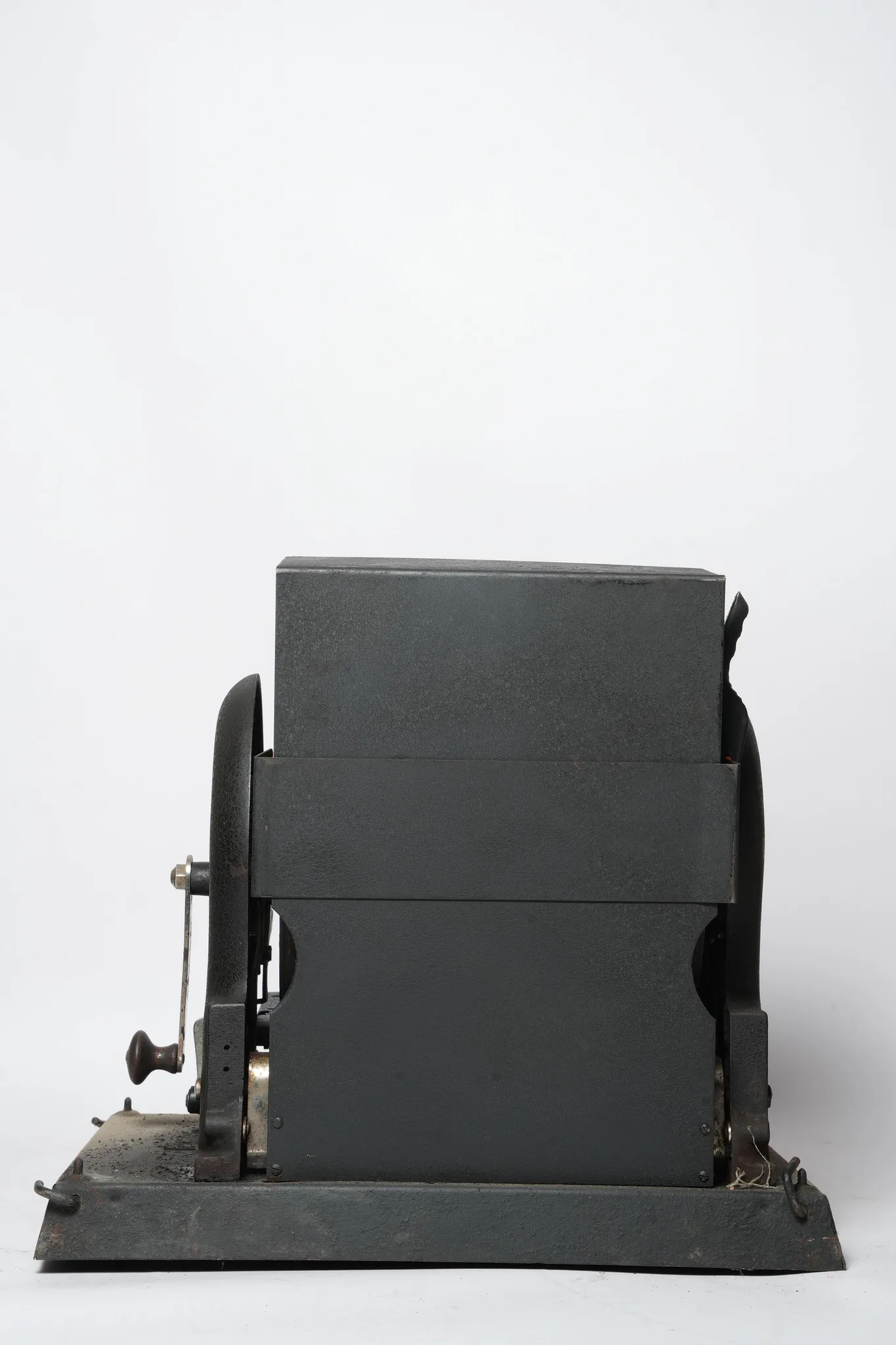
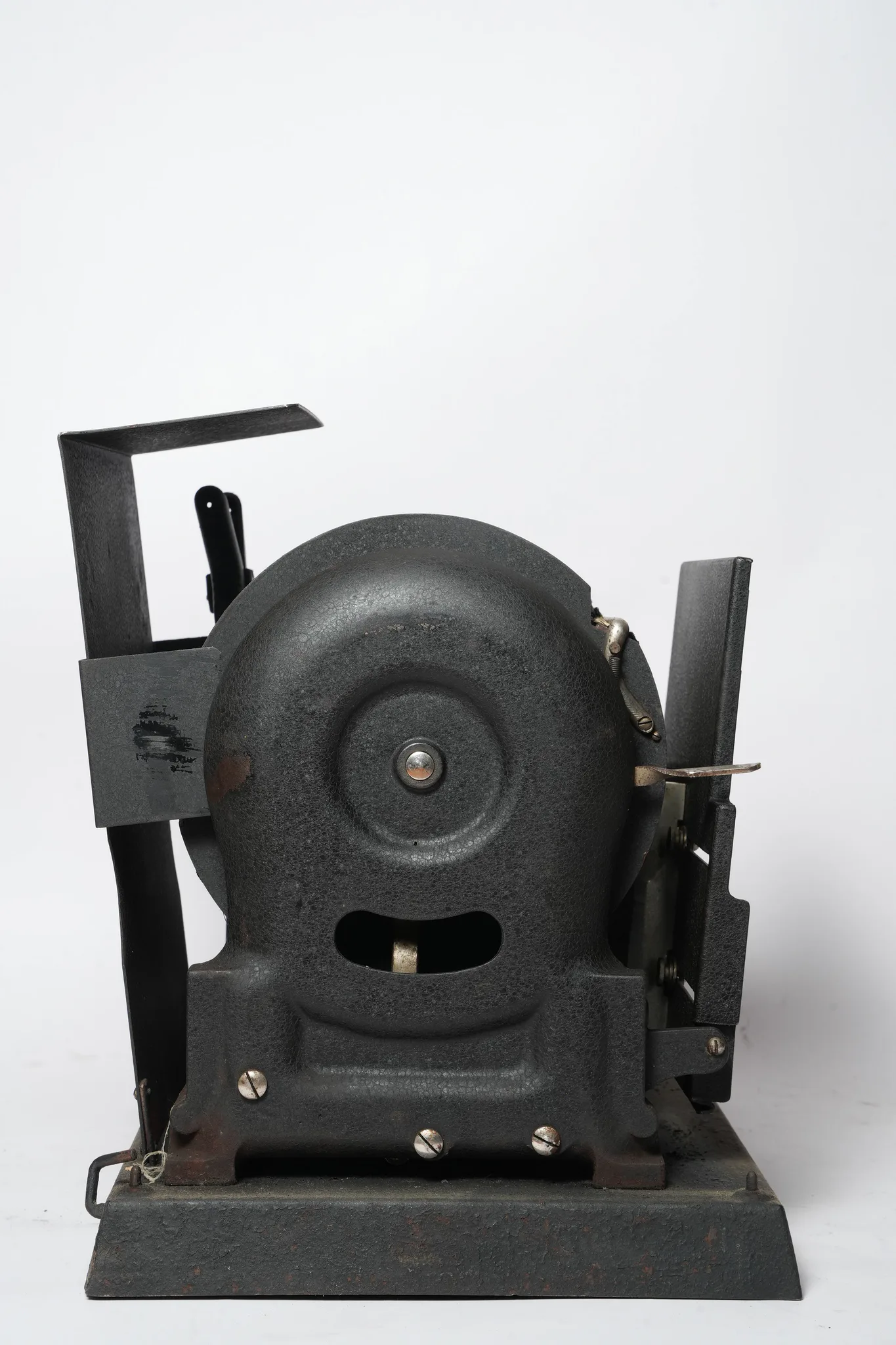
This heavy-duty technical camera accessory features a robust cast-metal mounting flange coupled to a hand-cranked internal transport mechanism. The central rectangular sheet-metal housing encloses a roll film or paper feeding assembly flanked by precision rollers and operated via a top-mounted crank with a turned wooden knob. A form-fitting black sheet-metal protective cover with dual wire bail latches and a turned wooden carrying handle encloses the unit for transport.
Industrial-grade hand-cranked film magazine featuring cast frame and lidded hood
The unit exhibits authentic age-related patina across all painted and bare metal surfaces. The black protective hood retains solid structural form with minor surface scuffs, localized finish wear, and light oxidation along the edges and base flange. The internal mechanism shows intact wrinkle lacquer on the cast frame, honest mechanical wear around the crank assembly, and sound structural integrity throughout.
Provenance documentation was not supplied for this specific Vintage Hand-Cranked Roll Film Magazine Back with Cover; this listing is based on the supplied photographs only.
Hand-cranked roll film / photographic paper magazine back
Manual crank with turned wooden handle knob and geared roller feed
Cast-metal frame with black wrinkle finish and folded sheet-steel enclosure
Detachable sheet-metal transport hood with turned wooden bail handle and wire latches
Flanged base plate with dual perimeter latch loops
Not visible in photographs
Top-mounted crank arm with a smooth turned wooden knob allows controlled frame advancement.
Protective sheet-steel transport cover completely shields the internal loading mechanism from light and impacts.
Traditional contoured wooden grip secured by pivoting steel brackets provides secure portage.
Distinctive period black wrinkle (crackle) enamel coats the primary cast-metal support arm.
Vintage spring-wire loop catches secure the transport hood firmly to the heavy mounting base plate.
Fabricated from robust cast iron and formed sheet steel built for demanding photographic studio environments.
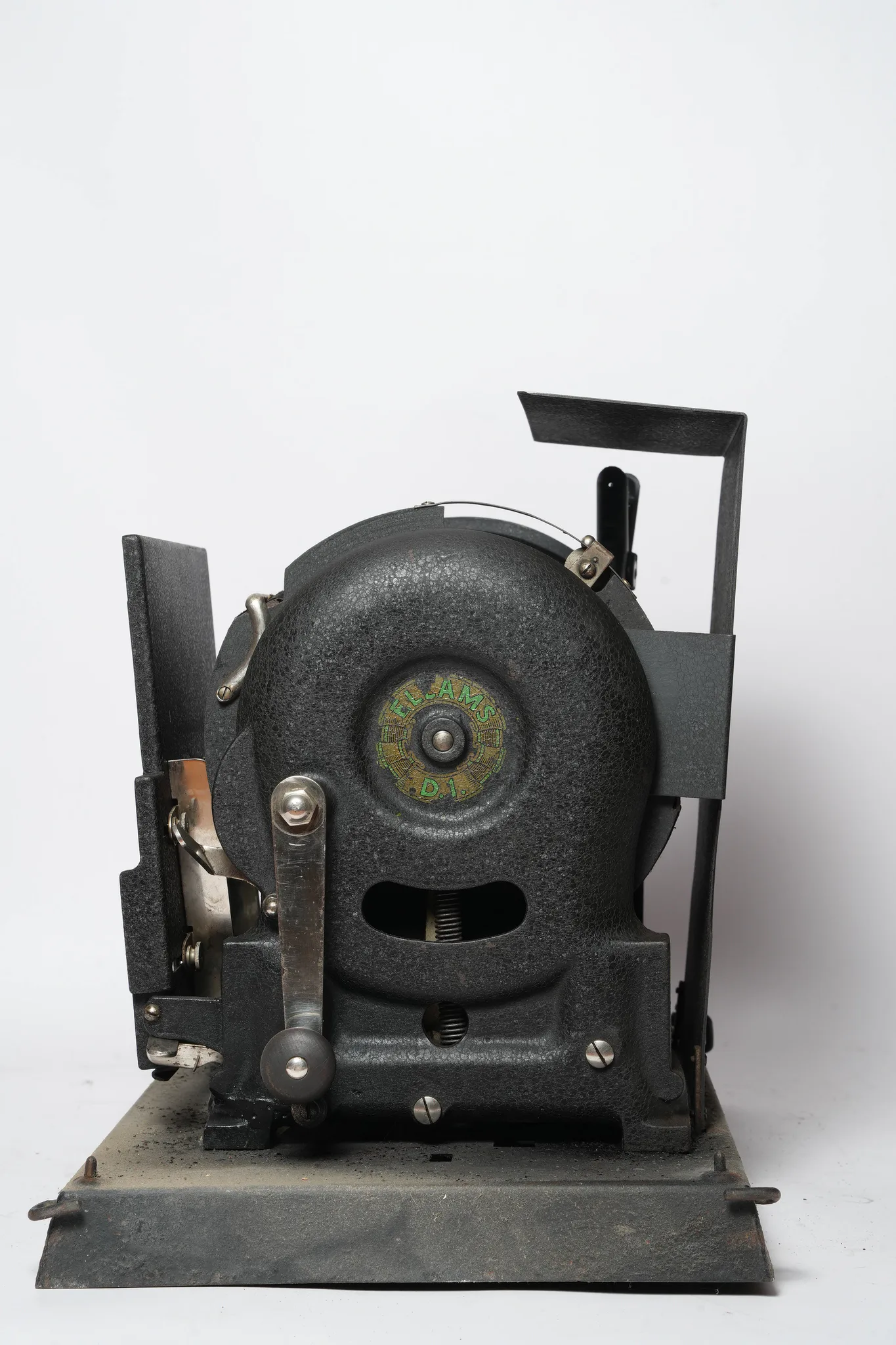
Designed to eliminate constant dark slide exchanges, this roll magazine allowed technical photographers to advance fresh emulsion swiftly between exposures using the mechanical top-mounted hand crank visible in the second photograph.
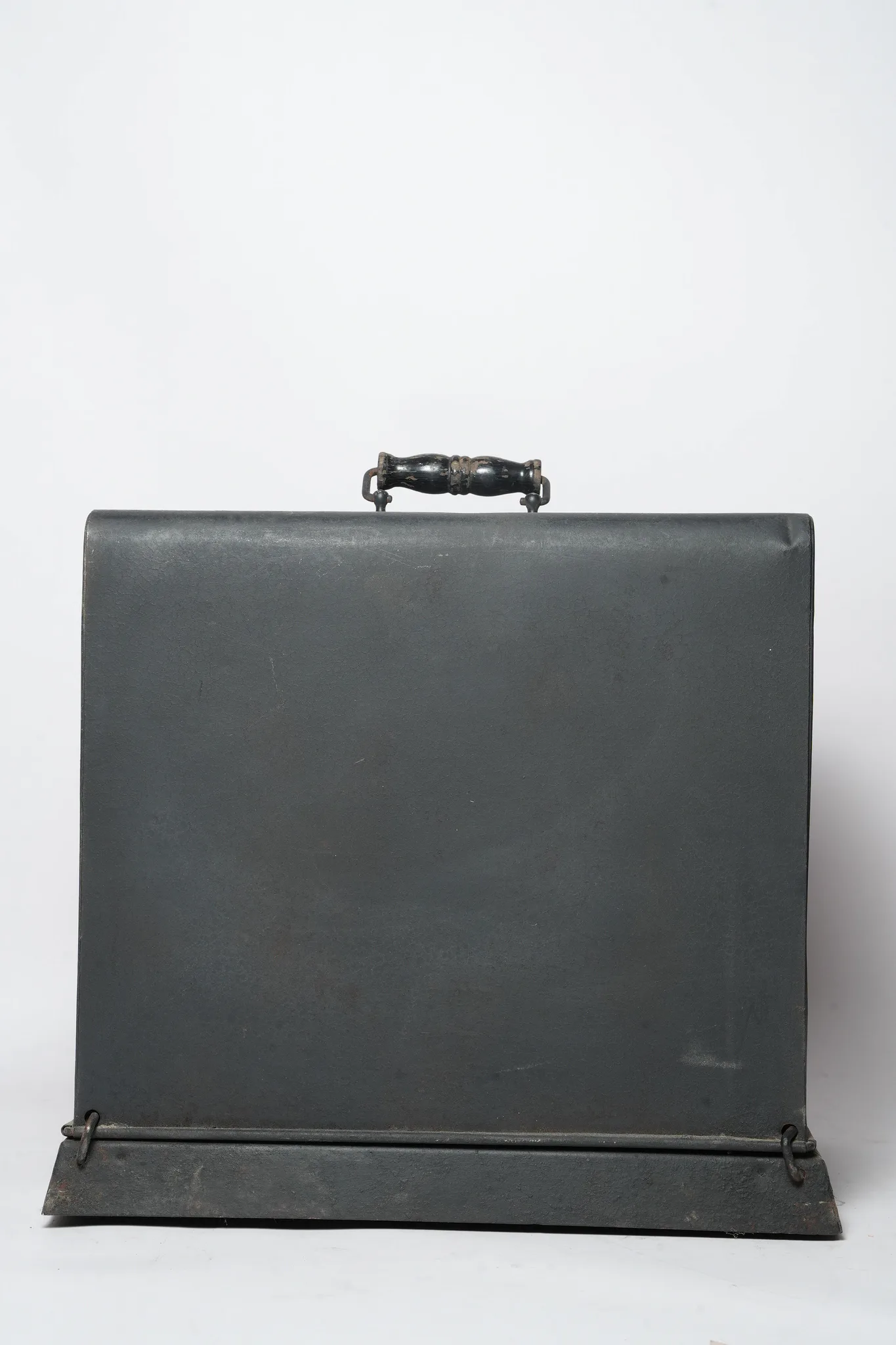
Shown closed in the first image, the fitted metal canopy latches firmly over the delicate internal rollers, transforming the intricate mechanical back into a self-contained, easily transportable unit via its integrated turned wooden handle.
Commercial and technical photography studios adopt specialized roll film backs to accelerate multi-exposure workflows.
Manufacture of heavy-gauge manual roll magazines incorporating durable wrinkle finishes and robust field-ready transport cases.
Widespread utility of high-capacity roll holders across reproduction, document copy, and scientific laboratory recording setups.
Preserved as an intriguing artifact of pre-digital studio engineering and mechanical darkroom equipment design.
Outer metal casing displays scattered surface abrasions, corner wear, and intact turned wooden handle with mild finish thinning.
Heavy mounting plate shows authentic edge oxidation, light surface grime, and fully intact dual wire bail latching loops.
Manual winding crank retains its dark wooden knob and securing nut with smooth surface patina and no visible mechanical distortion.
Textured wrinkle finish on the cast bracket is well preserved with minor edge rubbing adjacent to the sheet-metal film chamber.
Photographs and catalogue attribution: Curio Gallery.
Germany, 1929
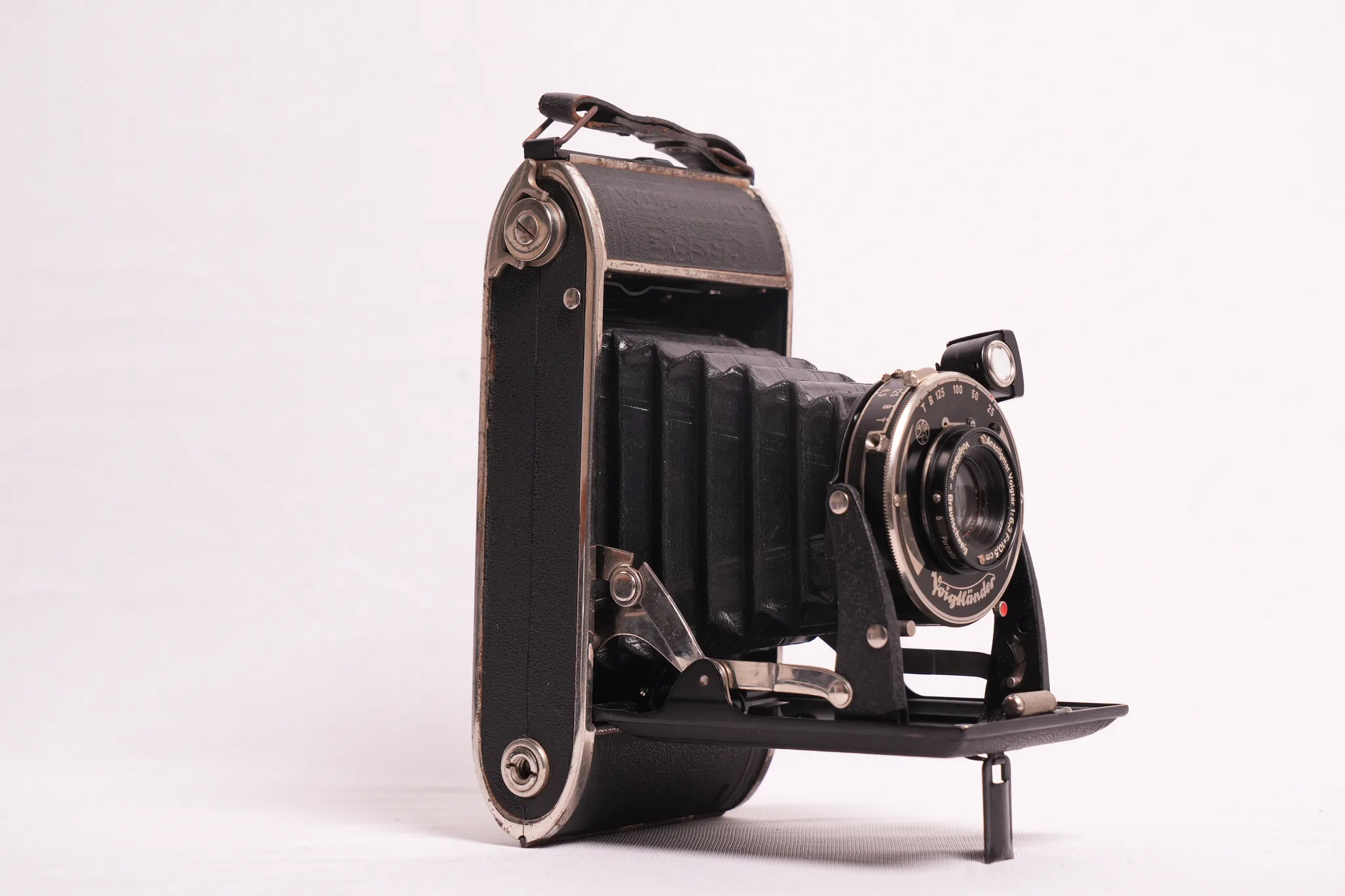
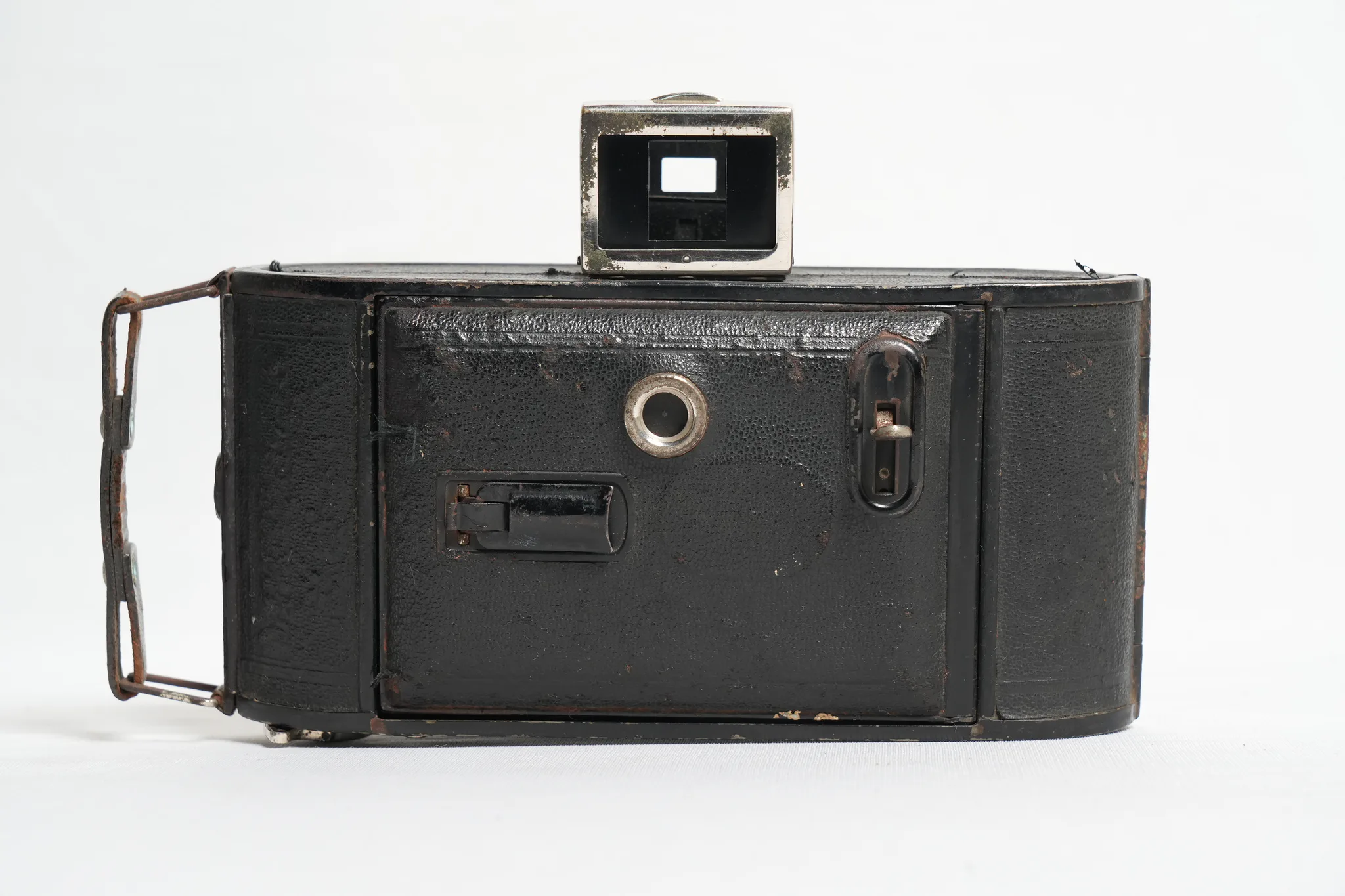
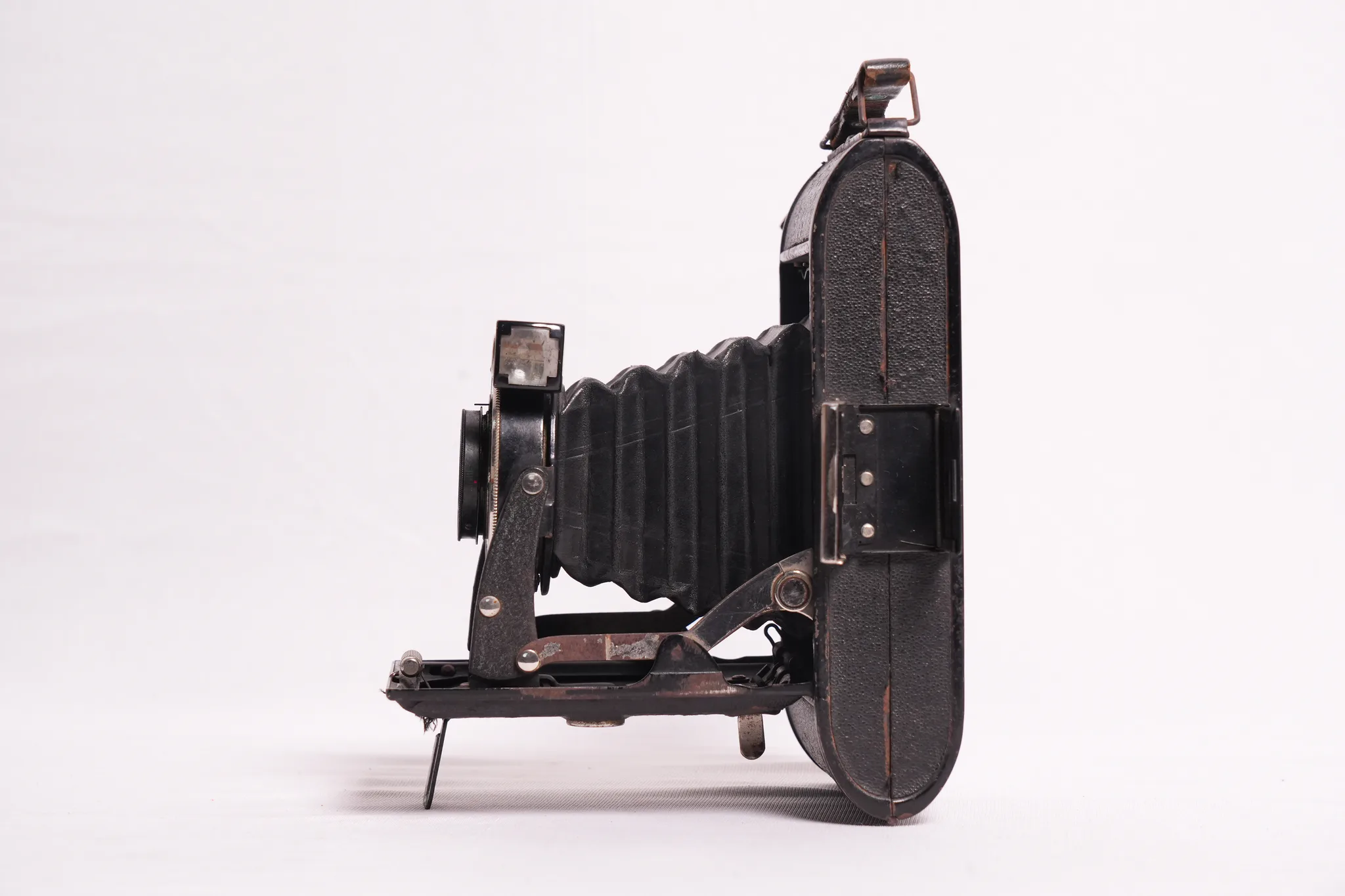
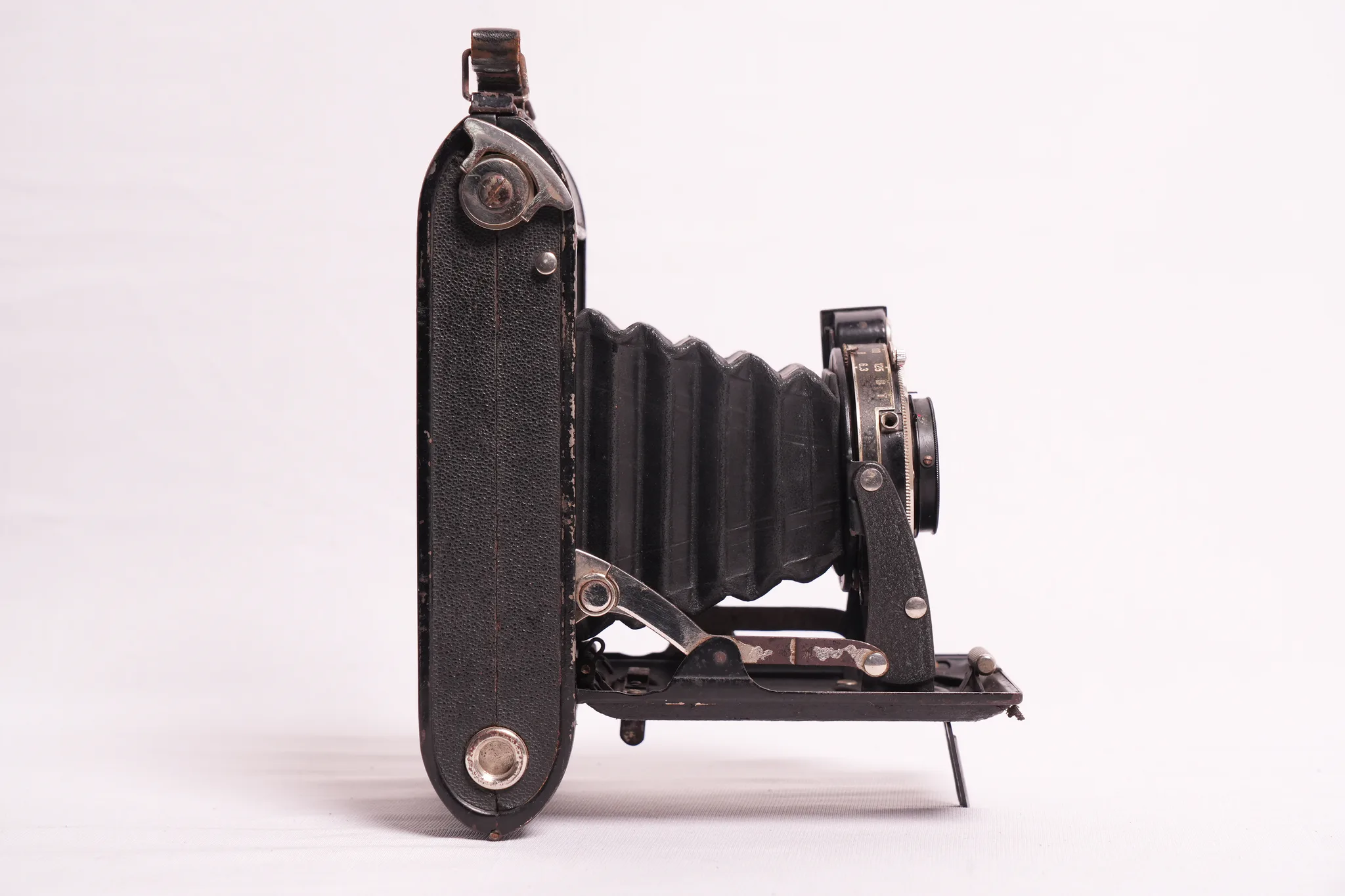
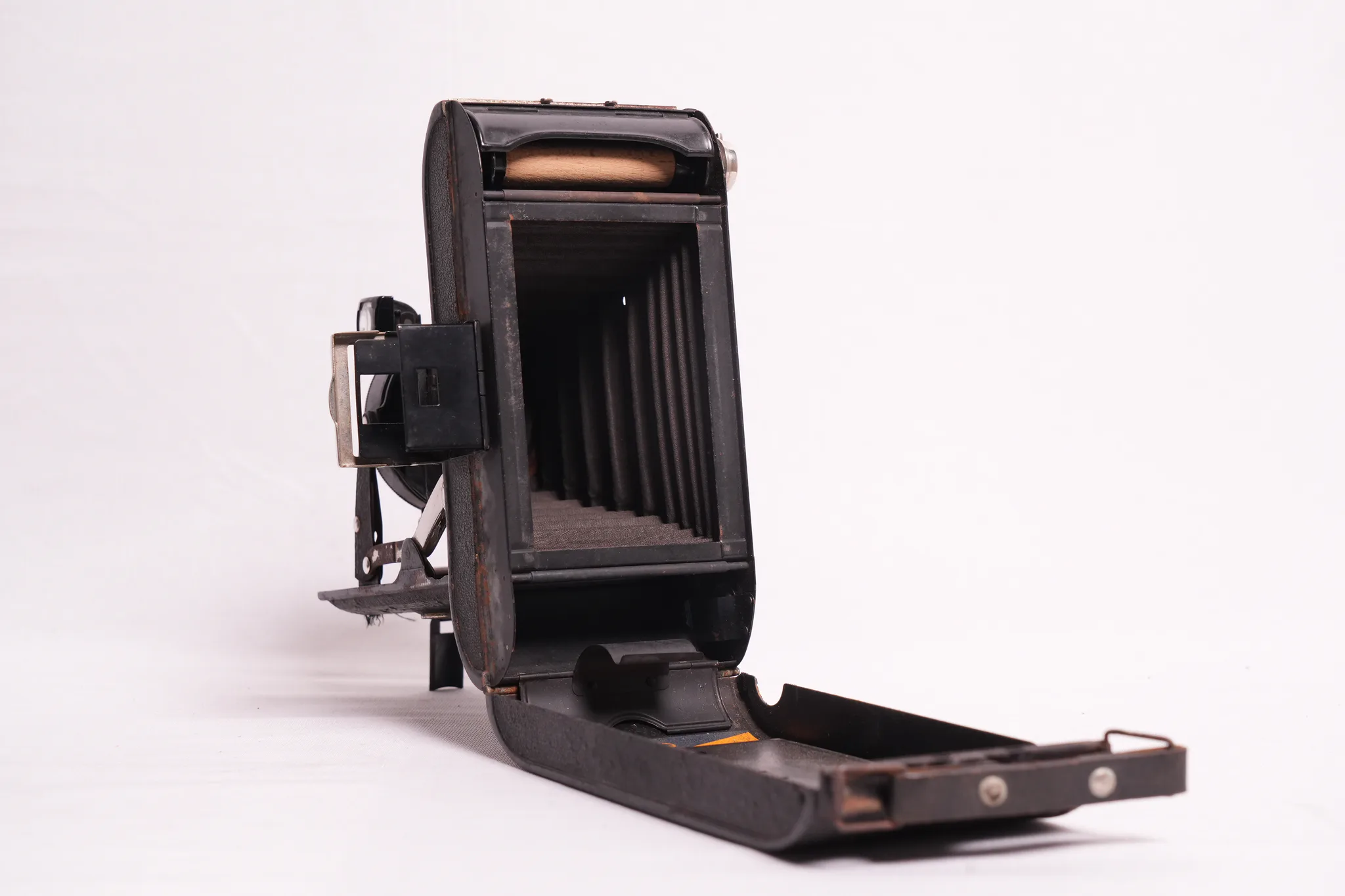
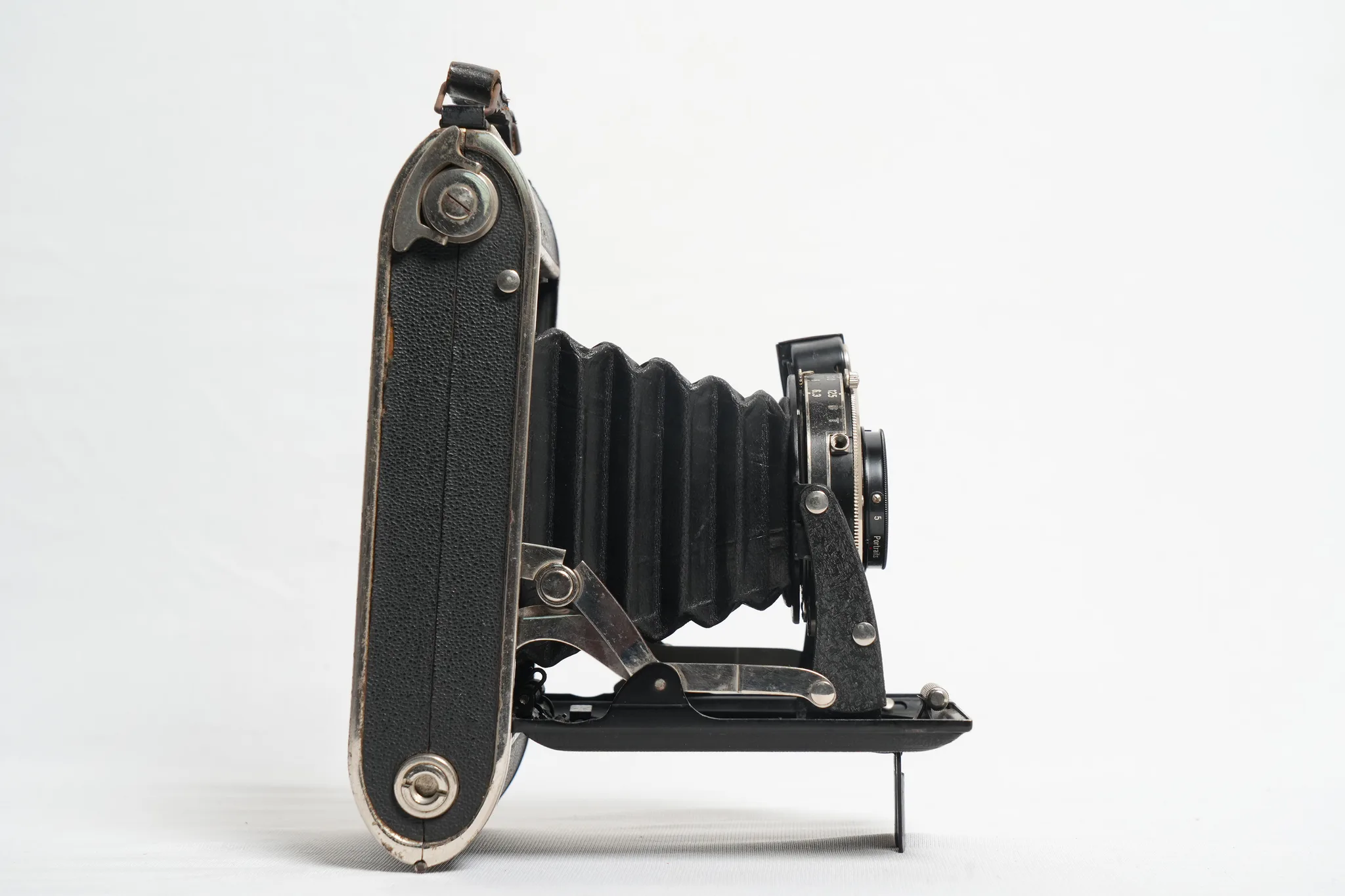
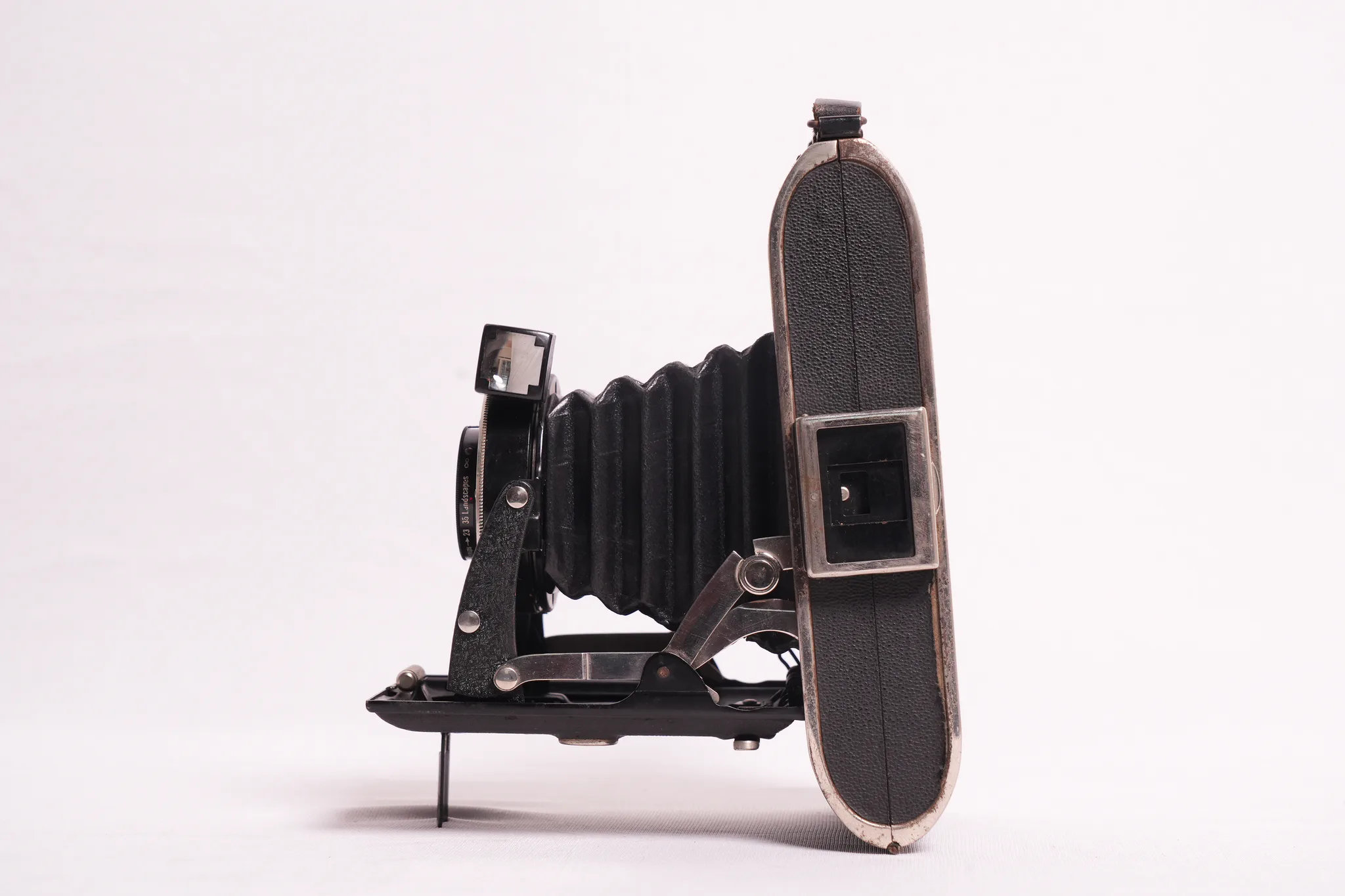
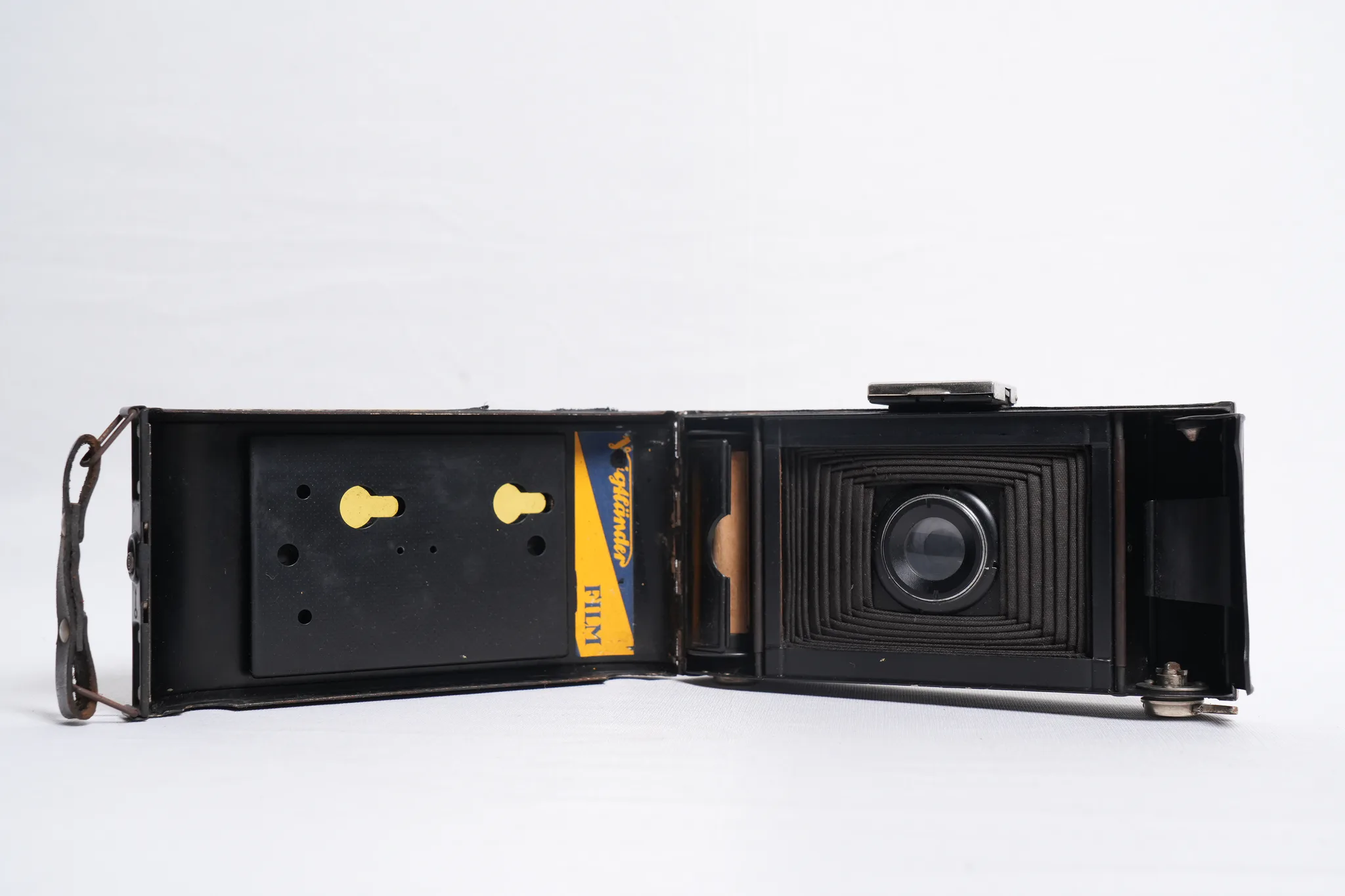
Introduced in 1929 as Voigtländer's first self-erecting rollfilm camera, this early Bessa model shoots 6×9 cm exposures on 120 roll film. The camera features a Voigtar anastigmat lens set in a rim-cocked leaf shutter, complemented by both a swiveling brilliant waist-level finder and a frame-mounted optical direct-vision finder. Its folding bed mechanism features integrated nickel-plated support struts and a fold-out kickstand for tabletop positioning.
Voigtländer's pioneering 1929 self-erecting medium format folder
The camera displays honest vintage wear consistent with age and regular handling. Metal scissor struts, the folding viewfinder frame, and edge rims show moderate paint chipping, oxidation, and surface corrosion. The black textured leatherette shows edge rubbing, dust accumulation in the crevices, and light surface scuffs, while the black bellows appear intact across all folds.
Provenance documentation was not supplied for this specific Voigtländer Bessa 6×9 Rollfilm Folding Camera; this listing is based on the supplied photographs only.
Medium format self-erecting folding rollfilm camera
120 roll film (6×9 cm negatives)
Voigtländer Voigtar Anastigmat
Rim-set central leaf shutter (speeds include T, B, 25, 50, 100, 125)
Dual system: swiveling brilliant waist-level finder and folding optical direct-vision frame finder
Metal chassis with textured black leatherette covering
Opening the front bed automatically deploys and locks the lens standard into shooting position.
Equipped with Voigtländer Braunschweig Voigtar optics optimized for large 6×9 cm negatives.
Features both a rotatable waist-level brilliant finder and a side-mounted folding optical direct-vision finder.
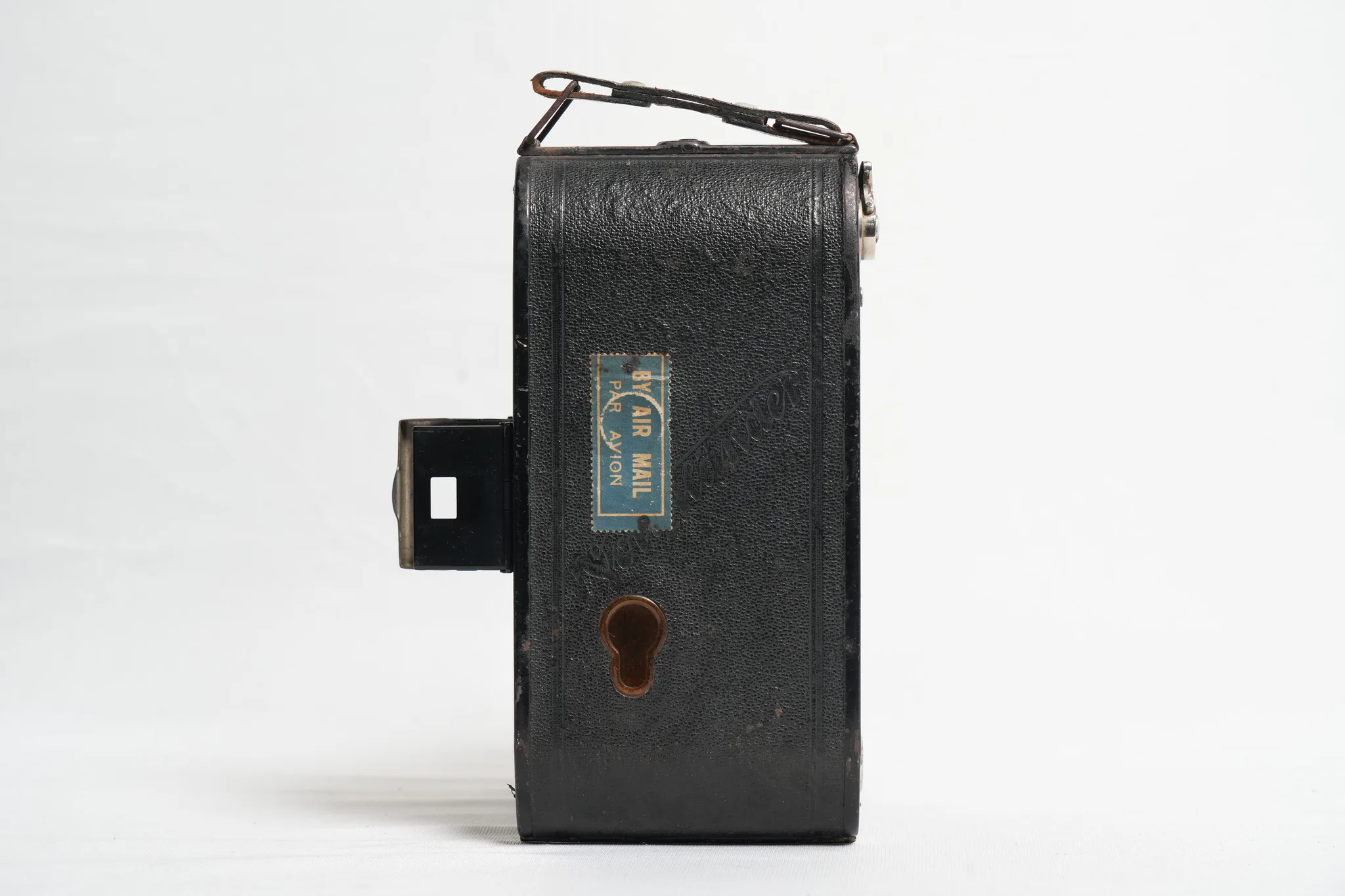
Classic rear window with metal bezel provides visual frame-number tracking on 120 paper backing.
Features the historic Voigtländer cursive branding in relief along the lower shutter mounting arc.
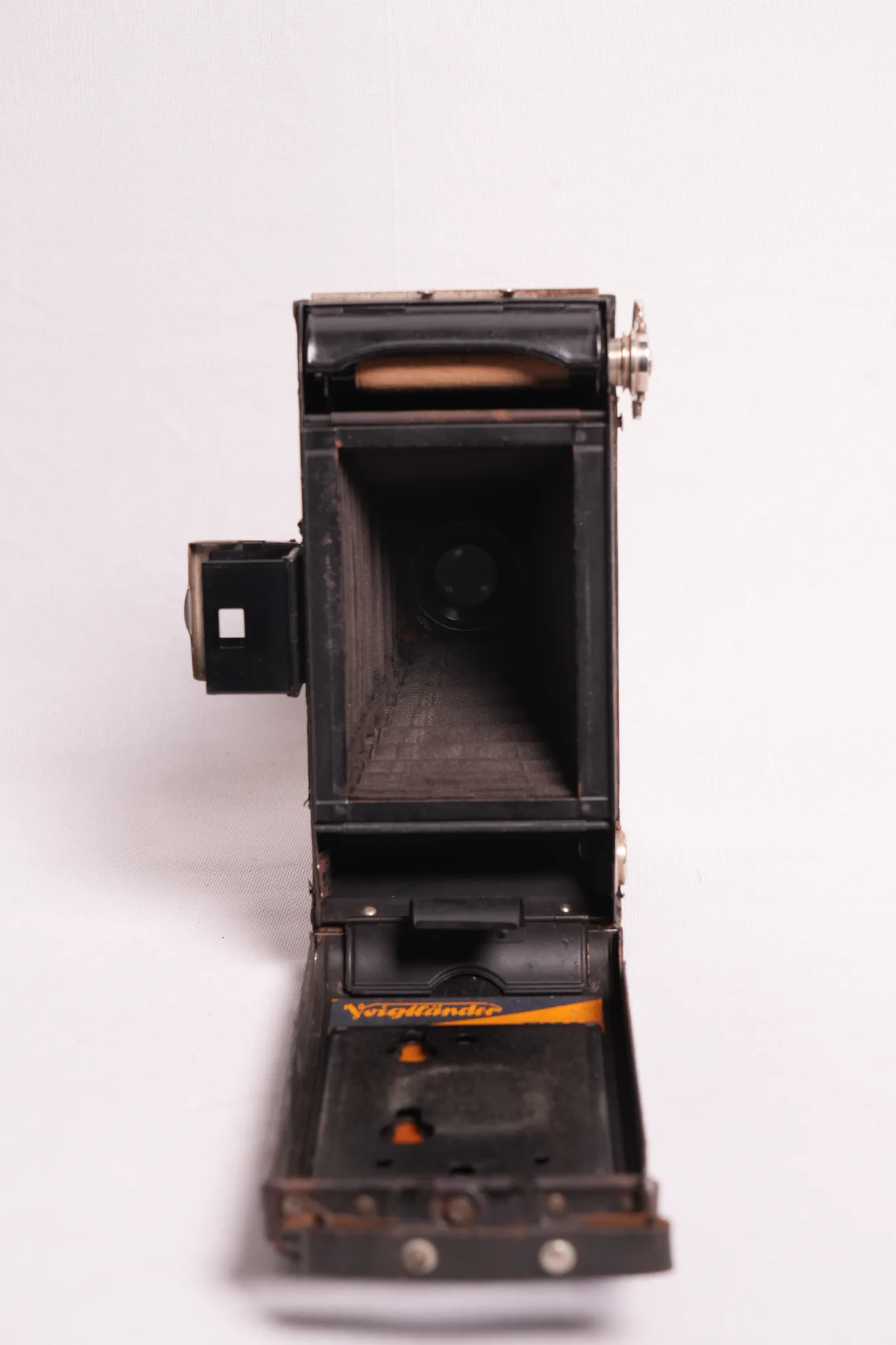
Equipped with a folding foot on the drop bed and a supplementary support leg on the rear door for stable placement.
Shown deployed in the second photograph, the 1929 Bessa discarded cumbersome rail extension by linking the drop bed directly to the front standard via articulated struts, allowing photographers to spring into action instantly.
Visible in profile in the third photograph, this transitional camera combined the 19th-century swiveling waist-level brilliant finder on the shutter block with a modern eye-level optical frame mounted along the body side.
Voigtländer unveils the Bessa 6×9, its first self-erecting folding camera designed for accessible medium format photography.
Voigtländer introduces dual 6×9 and 4.5×6 cm options and refreshed shutter selections across the Bessa line.
The Bessa series is revamped with a signature folding shutter release trigger integrated into the front drop bed.
Voigtländer refines the range into the premium coupled-rangefinder Bessa II before folding camera production ceases.
Surface patina, edge brassing, and scattered spots of oxidation visible on the folding struts and the optical finder frame.
Intact across front and back panels with minor edge fraying, contact rubbing, and embedded surface dust.
Original black pleated bellows remain fully folded and seated, exhibiting surface dust without large visible tears.
Lenses and both finder elements display internal haze and dust specks consistent with unrestored original condition.
Photographs and catalogue attribution: Curio Gallery.
Germany, 1954
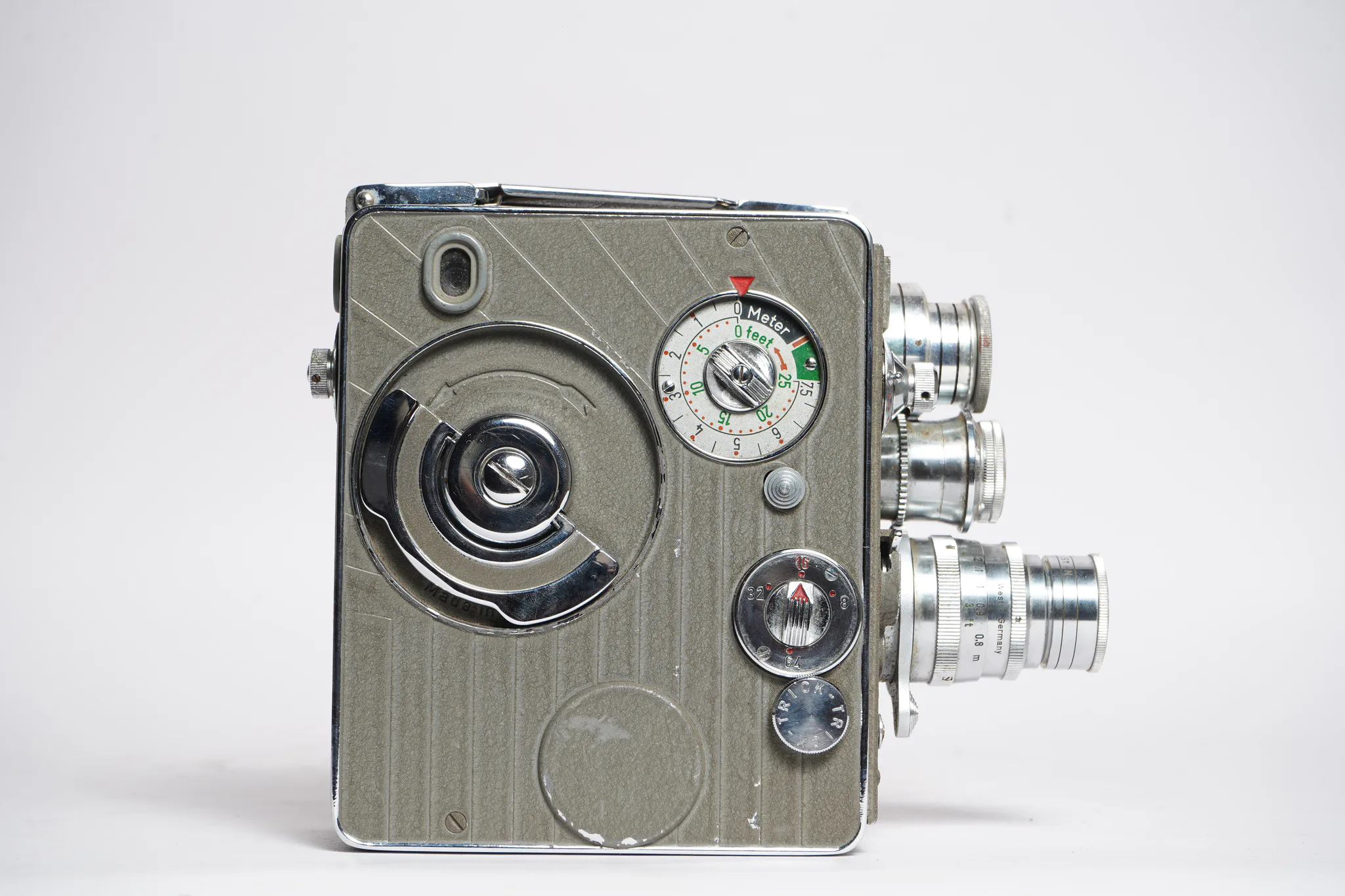
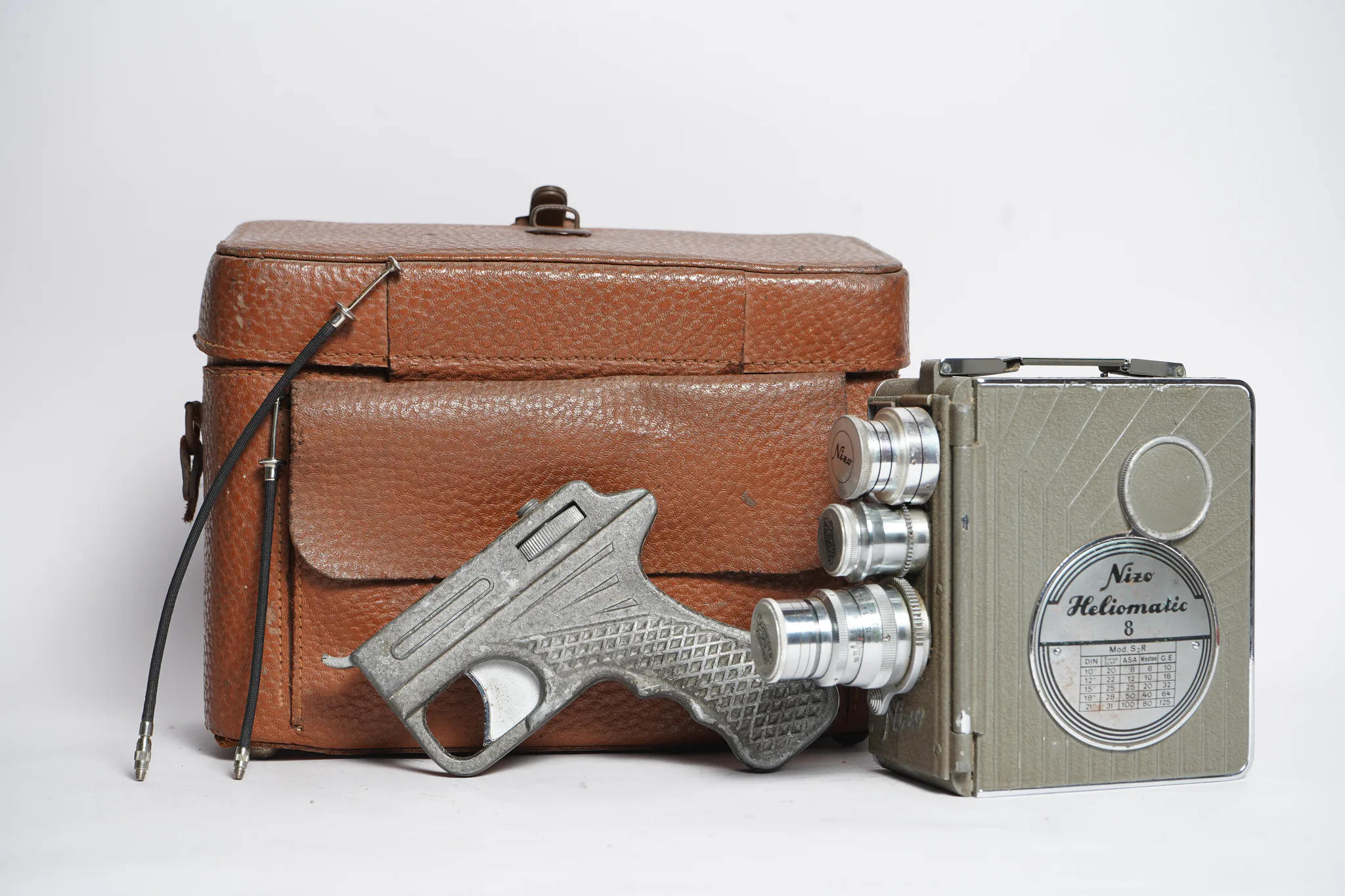
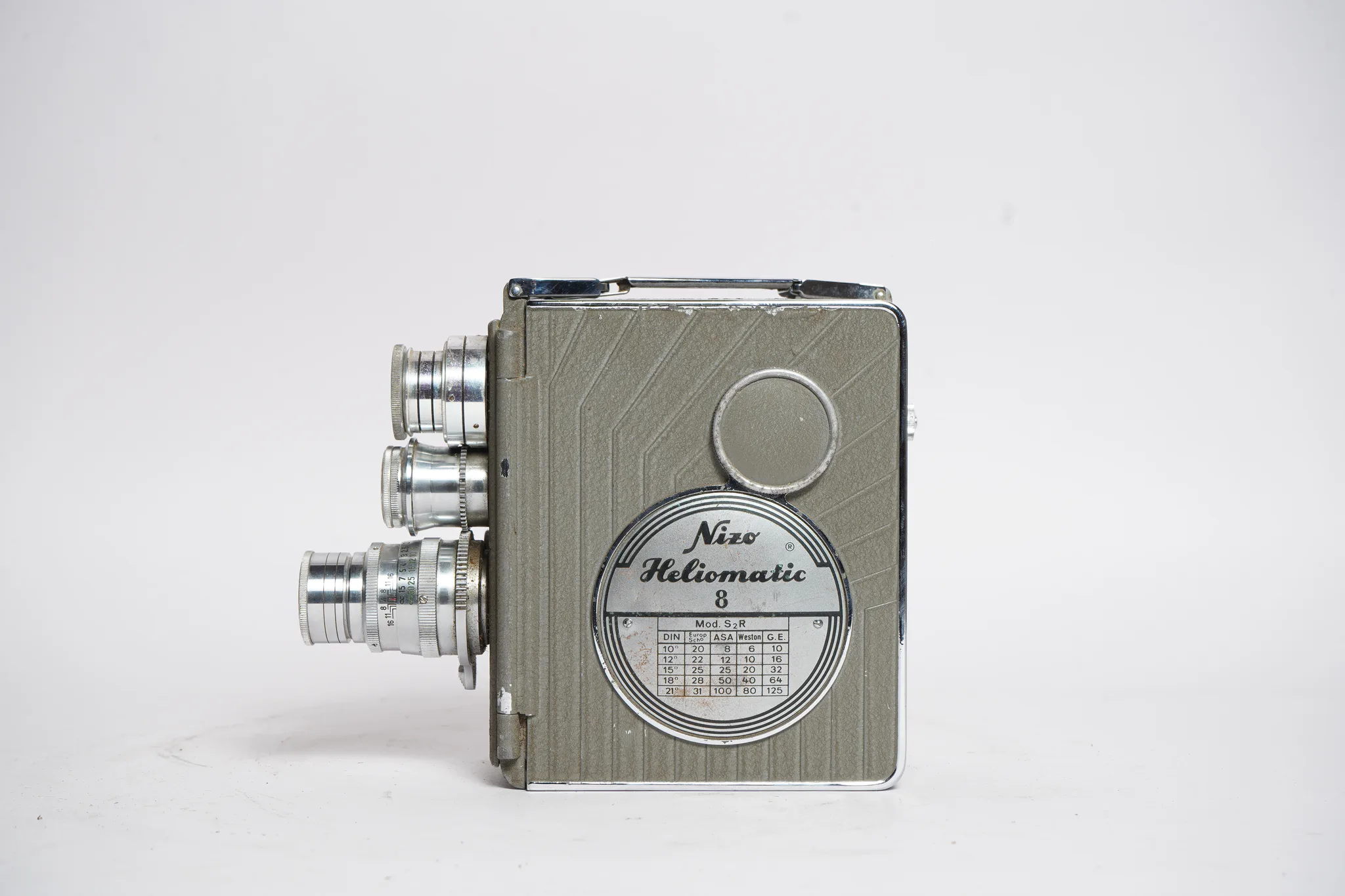
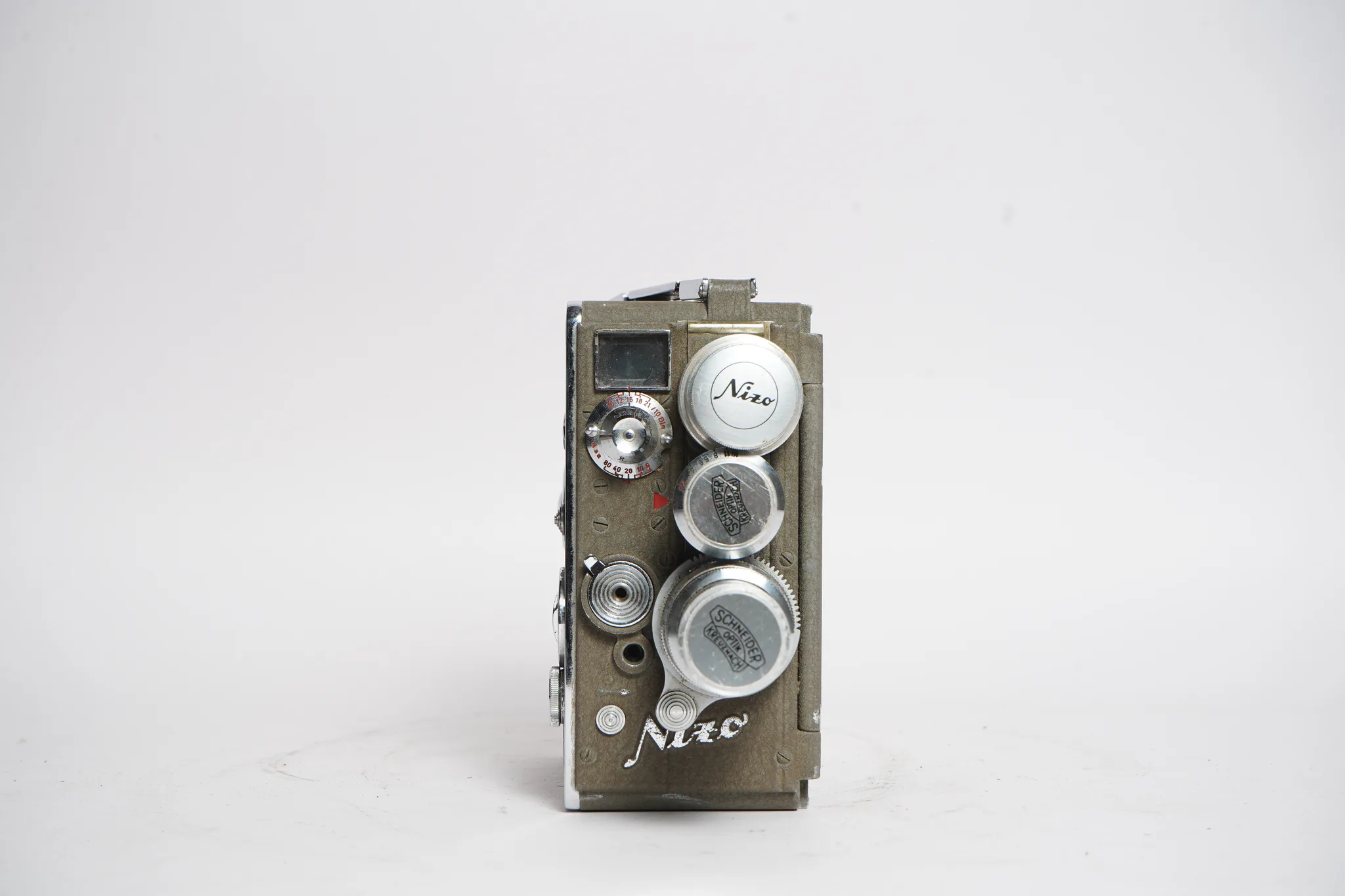
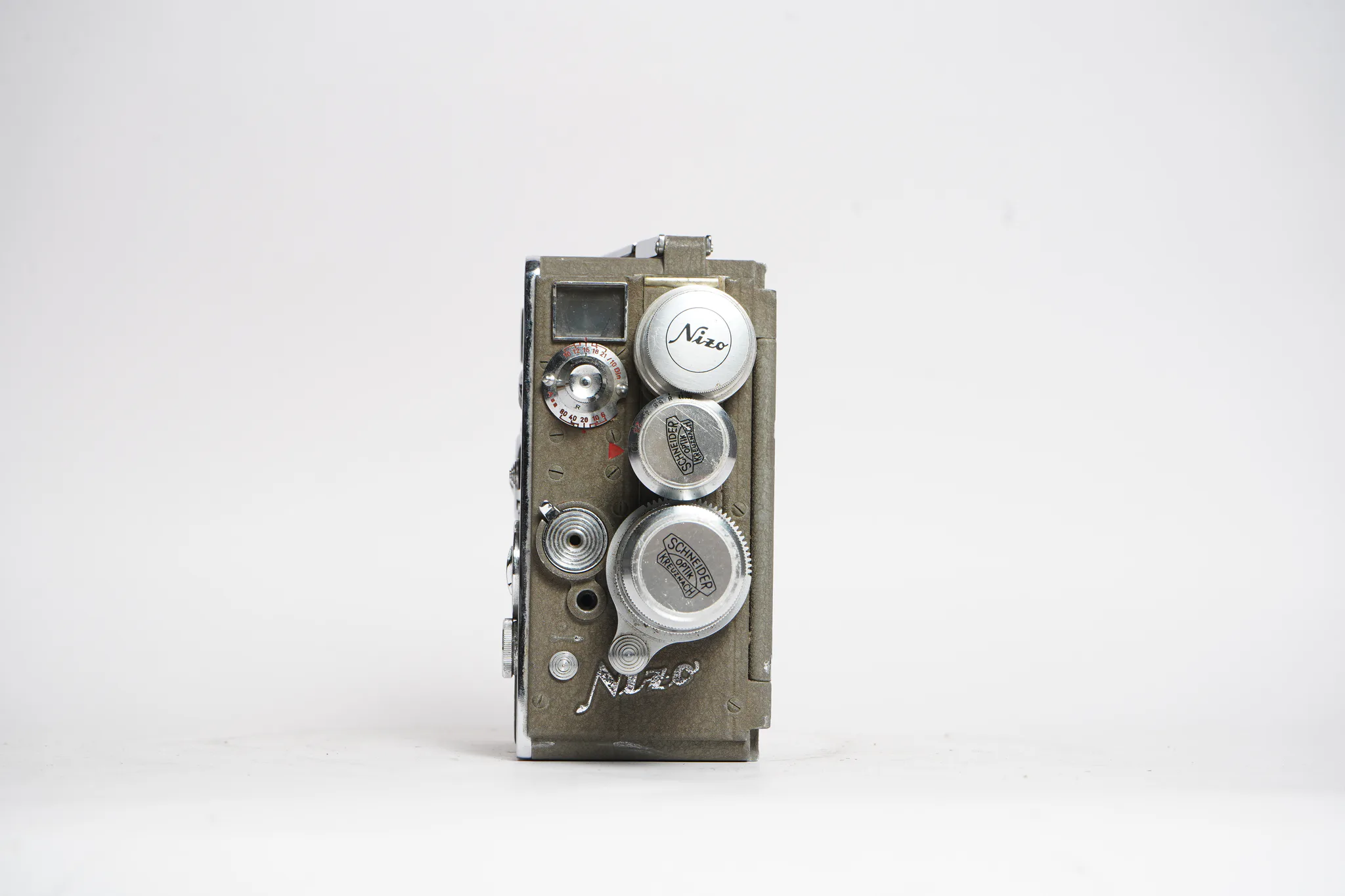
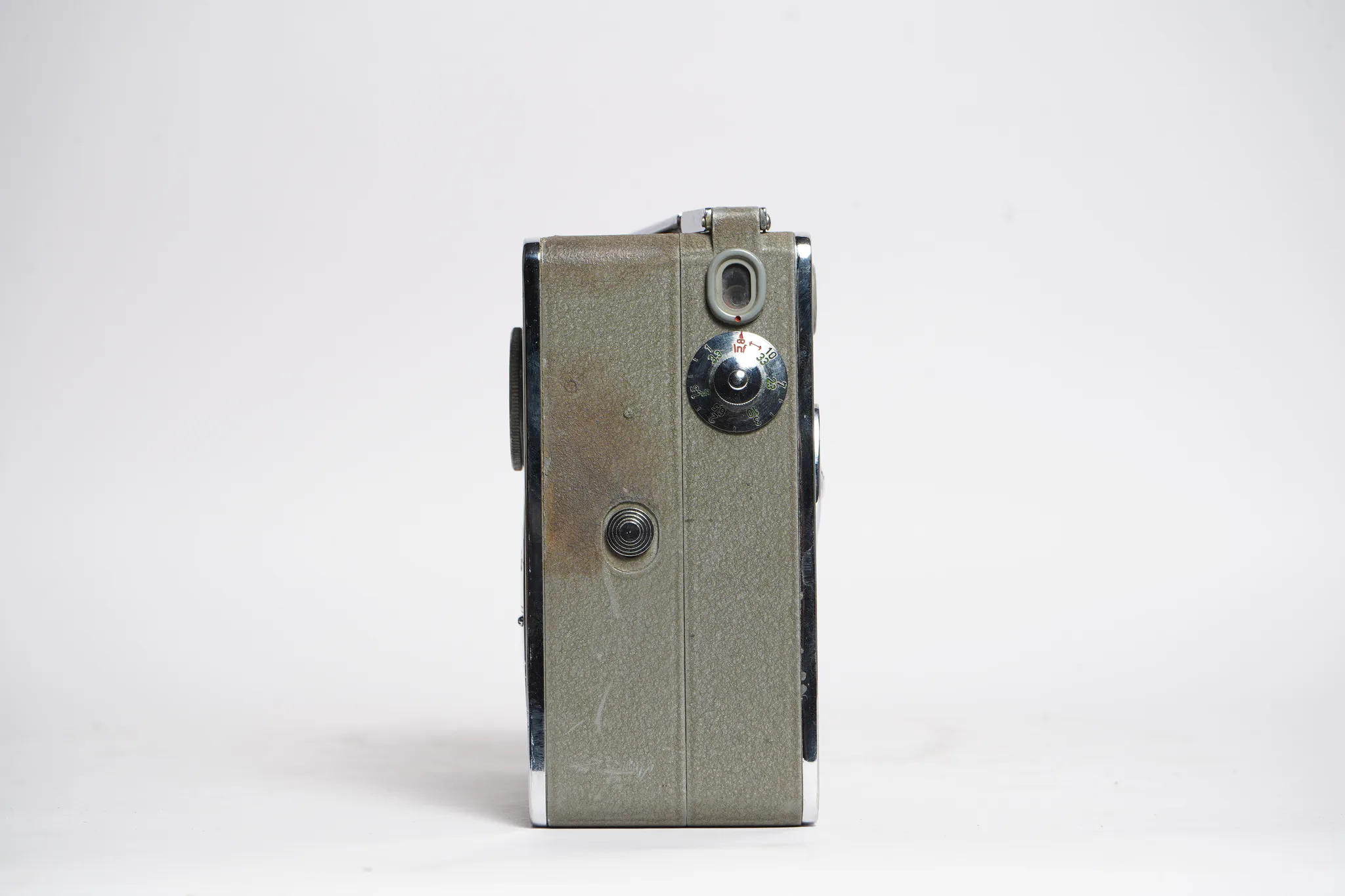
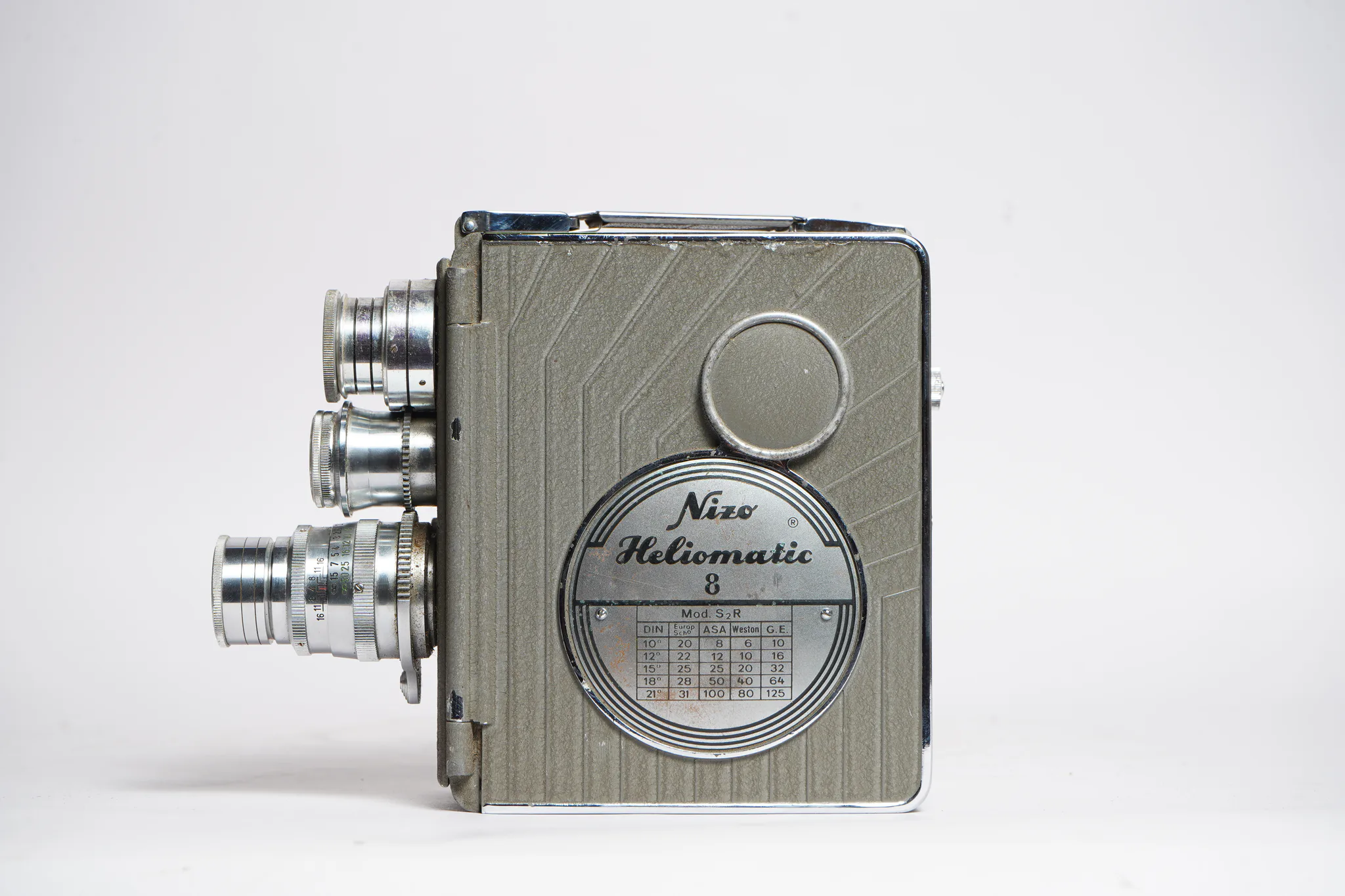
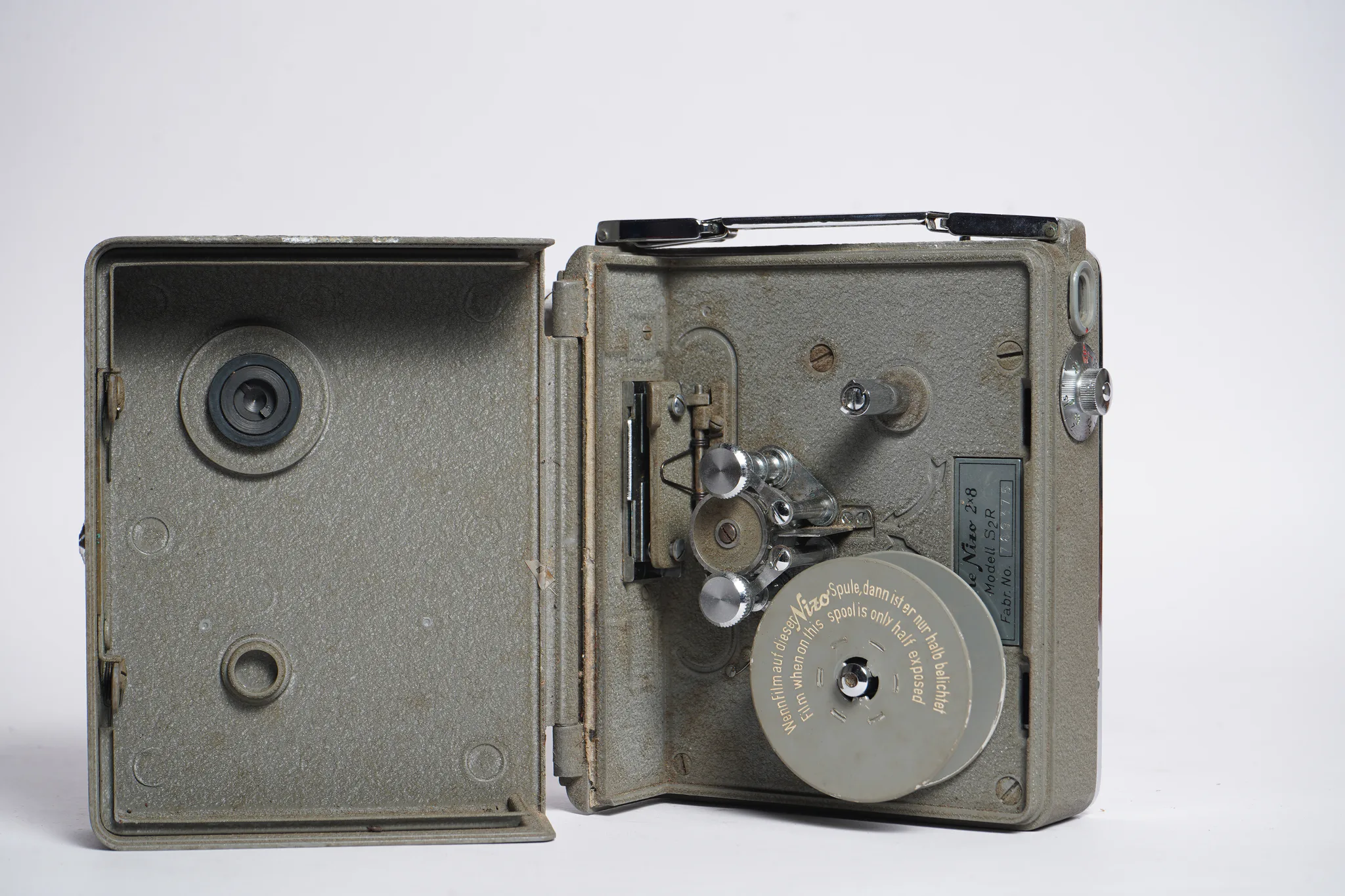
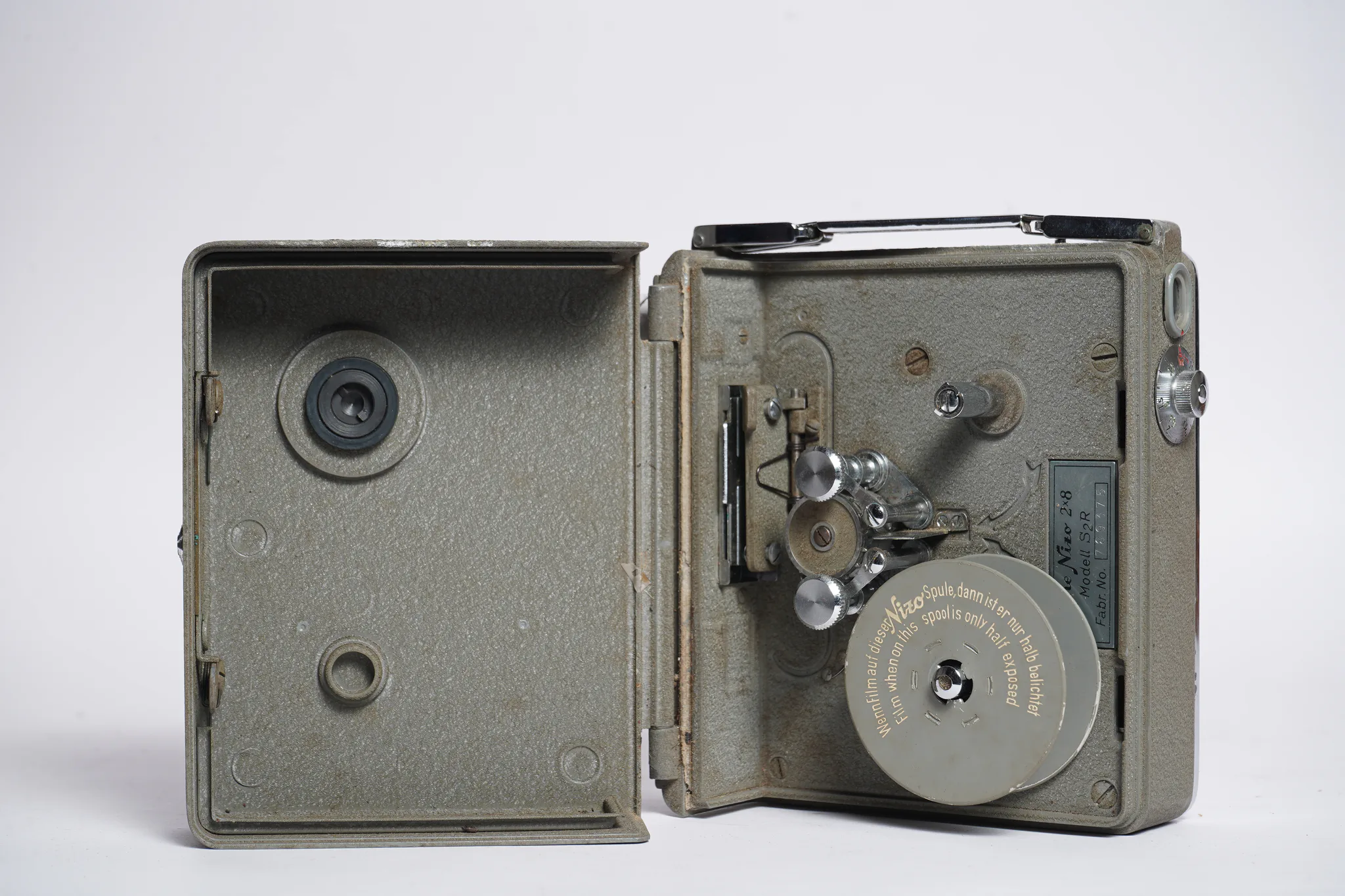
A jewel of German mechanical engineering by Niezoldi & Krämer Munich, featuring a vertical dual-lens slide mechanism and Rodenstock Heligon optics.
Dual slide-turret German cine masterpiece with Rodenstock optical glass.
The photographed Nizo Heliomatic 8 Mod. S2R Cine Camera shows age-consistent surface wear and preserved period details; functionality is not claimed unless separately tested.
Sourced from the documented Curio Gallery archival catalogue: Nizo Heliomatic 8 Mod. S2R Cine Camera.
Dual slide turret: Rodenstock Heligon 1:1.5/12.5mm & Euron 1:2.8/37.5mm
Coupled dual-slide photoelectric selenium exposure system
8, 16, 24, 32, 48, 64 fps & Single Frame
Clockwork spring motor with smooth winding fold-out lever
Nizo Heliomatic 8 Mod. S2R Cine Camera by Niezoldi & Krämer (Nizo), identified from the supplied photographs and catalogue evidence.
Niezoldi & Krämer (Nizo) period construction; visible finish and hardware are recorded without adding unseen components.
Germany period specification
Distinctive proportions, controls, markings, and surface details visible on this individual Nizo Heliomatic 8 Mod. S2R Cine Camera.
Niezoldi & Krämer (Nizo) production places this piece within the documented history of Nizo Heliomatic 8 Mod. S2R Cine Camera.
The included image set for Nizo Heliomatic 8 Mod. S2R Cine Camera is the reference for identity, completeness, and condition; details not shown are not assumed.
Nizo Heliomatic 8 Mod. S2R Cine Camera carries the material language of Germany manufacturing around 1954: purposeful controls, repairable construction, and a design made for use rather than disposal. Its surviving details connect today's collector with the hands that made and used it.
Every mark and fitting shown belongs to this individual Nizo Heliomatic 8 Mod. S2R Cine Camera. Its documented details give collectors a precise, honest connection to the people and practices that shaped Niezoldi & Krämer (Nizo). The photographic record keeps that connection specific, personal, and grounded in the evidence presented.
Produced by Niezoldi & Krämer (Nizo) in Germany; the photographed Nizo Heliomatic 8 Mod. S2R Cine Camera retains its period design language.
Used in cameras work during the working life of Nizo Heliomatic 8 Mod. S2R Cine Camera, with the controls and surfaces shown in the supplied photographs.
Preserved after active service, this Nizo Heliomatic 8 Mod. S2R Cine Camera became a reference point for collectors studying Niezoldi & Krämer (Nizo) workmanship.
Nizo Heliomatic 8 Mod. S2R Cine Camera was photographed, condition-reviewed, and catalogued for a documented Curio Gallery acquisition.
The photographed Nizo Heliomatic 8 Mod. S2R Cine Camera shows age-consistent surface wear and preserved period details; functionality is not claimed unless separately tested.
Only components visible in the photographs of this Nizo Heliomatic 8 Mod. S2R Cine Camera are included; unseen accessories are not assumed.
Operational performance for this individual Nizo Heliomatic 8 Mod. S2R Cine Camera is not claimed unless demonstrated in the photographs or separately tested.
Age, patina, wear, and any missing elements shown in the Nizo Heliomatic 8 Mod. S2R Cine Camera images should be considered part of its condition.
Photographs and catalogue attribution: Curio Gallery.
United Kingdom / British India, 1868
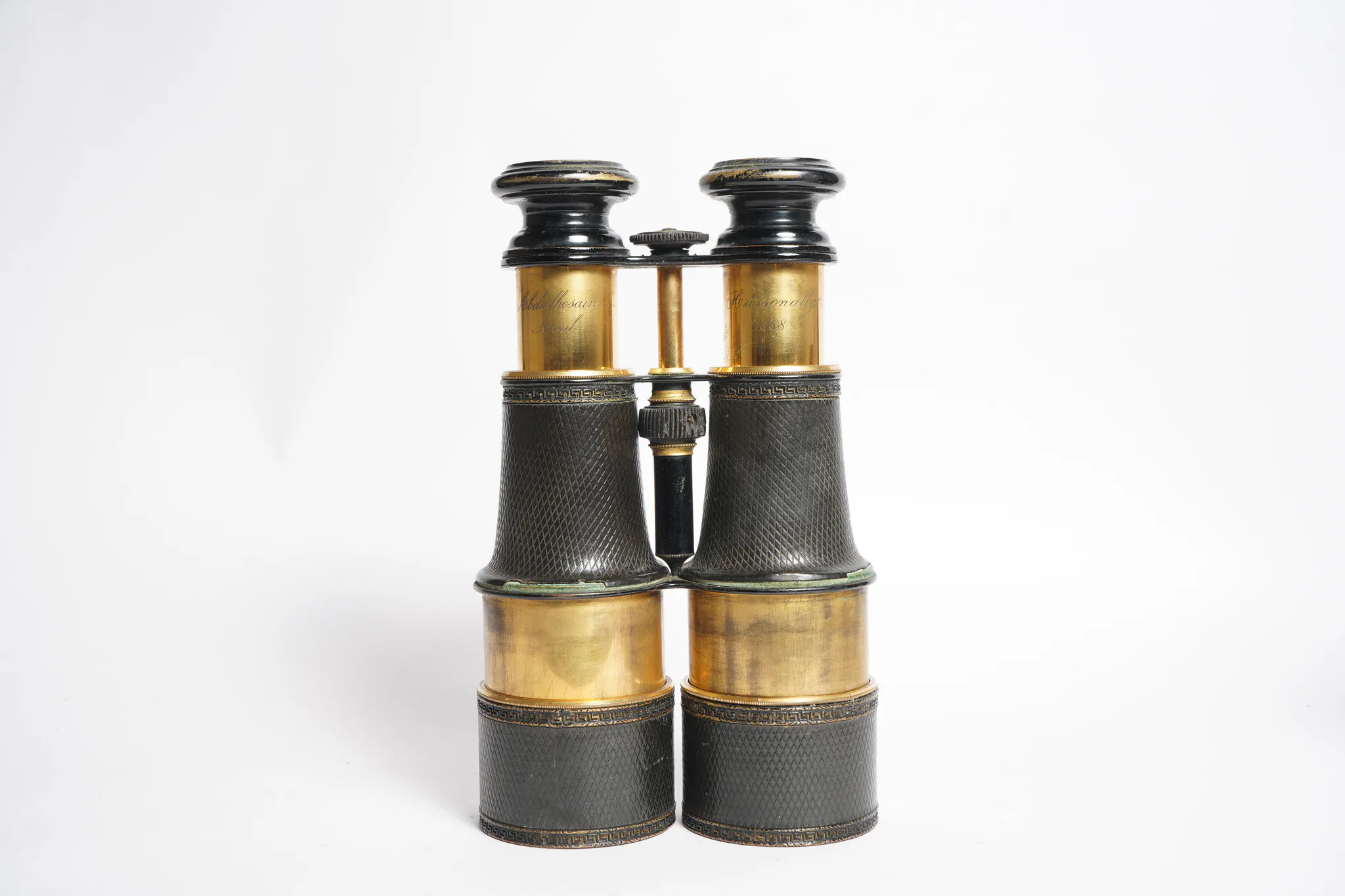
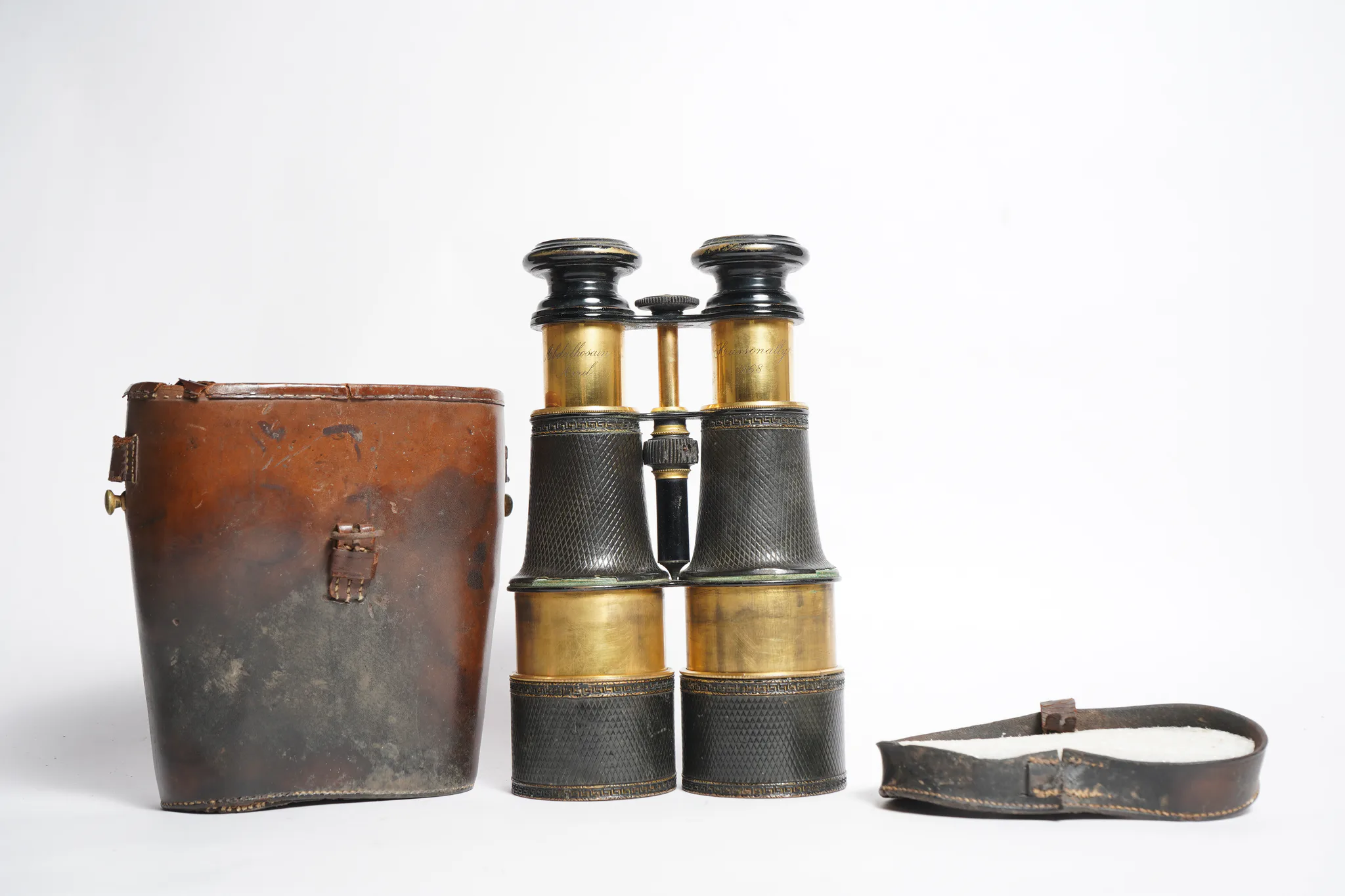
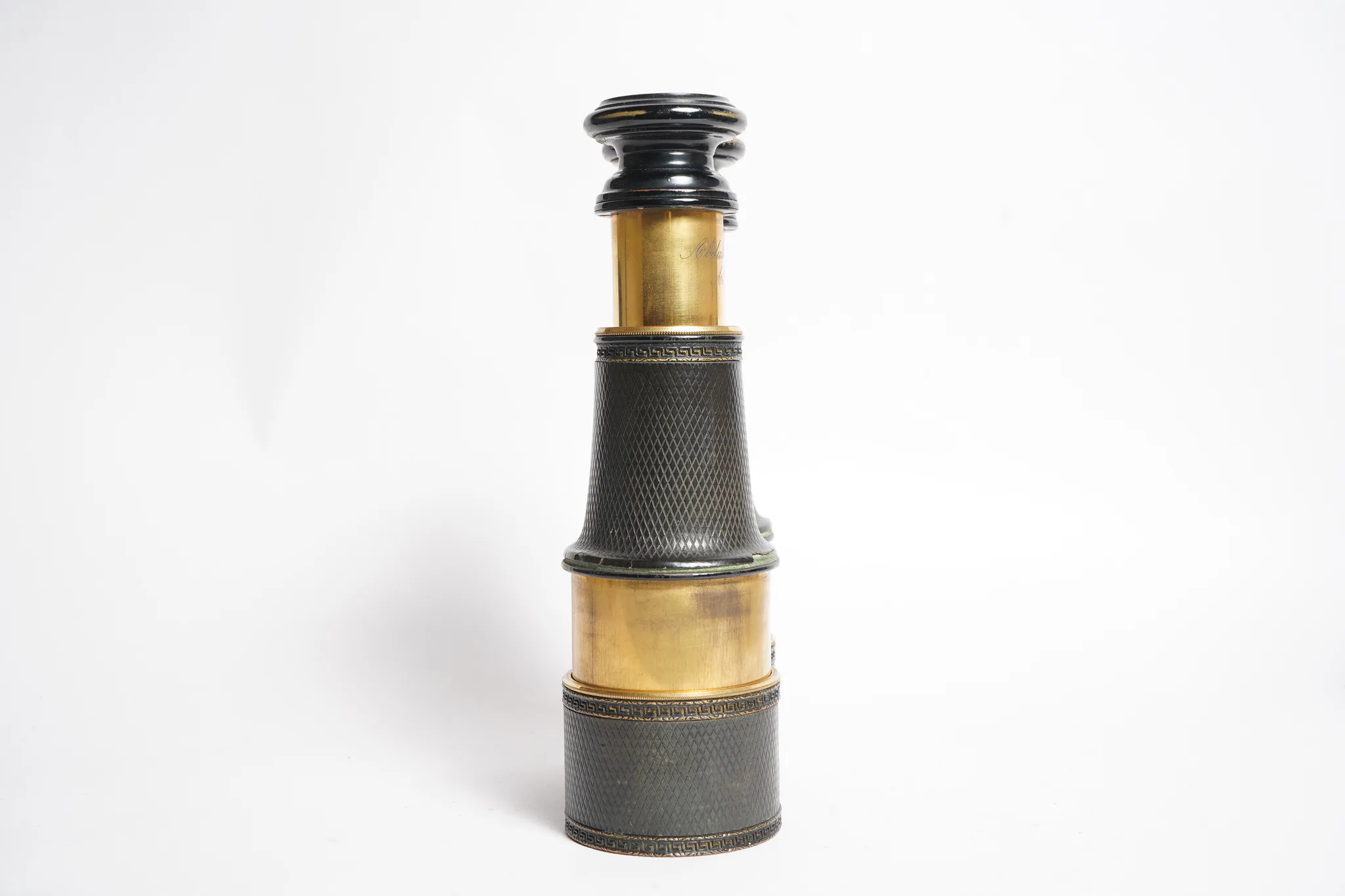
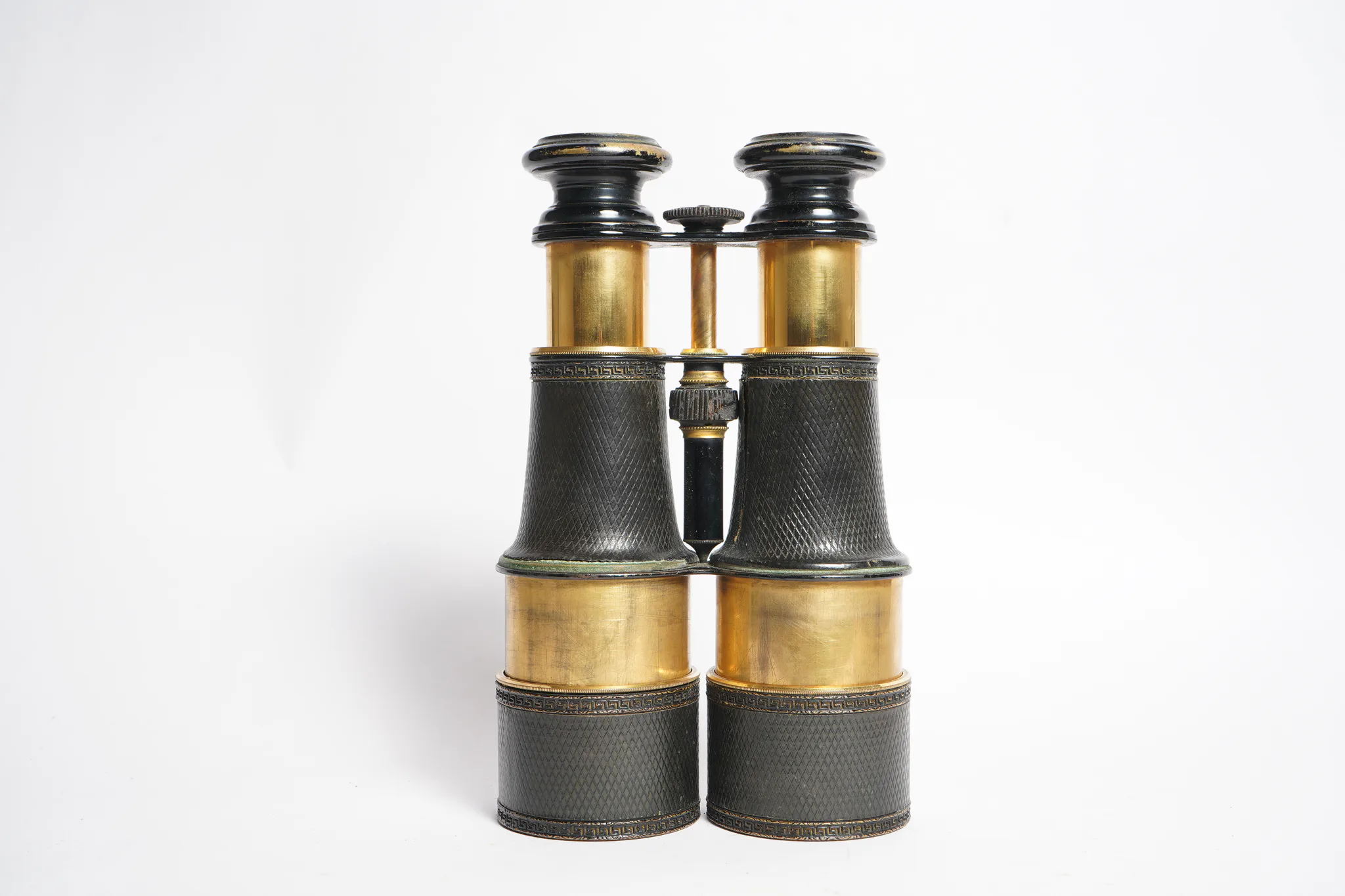
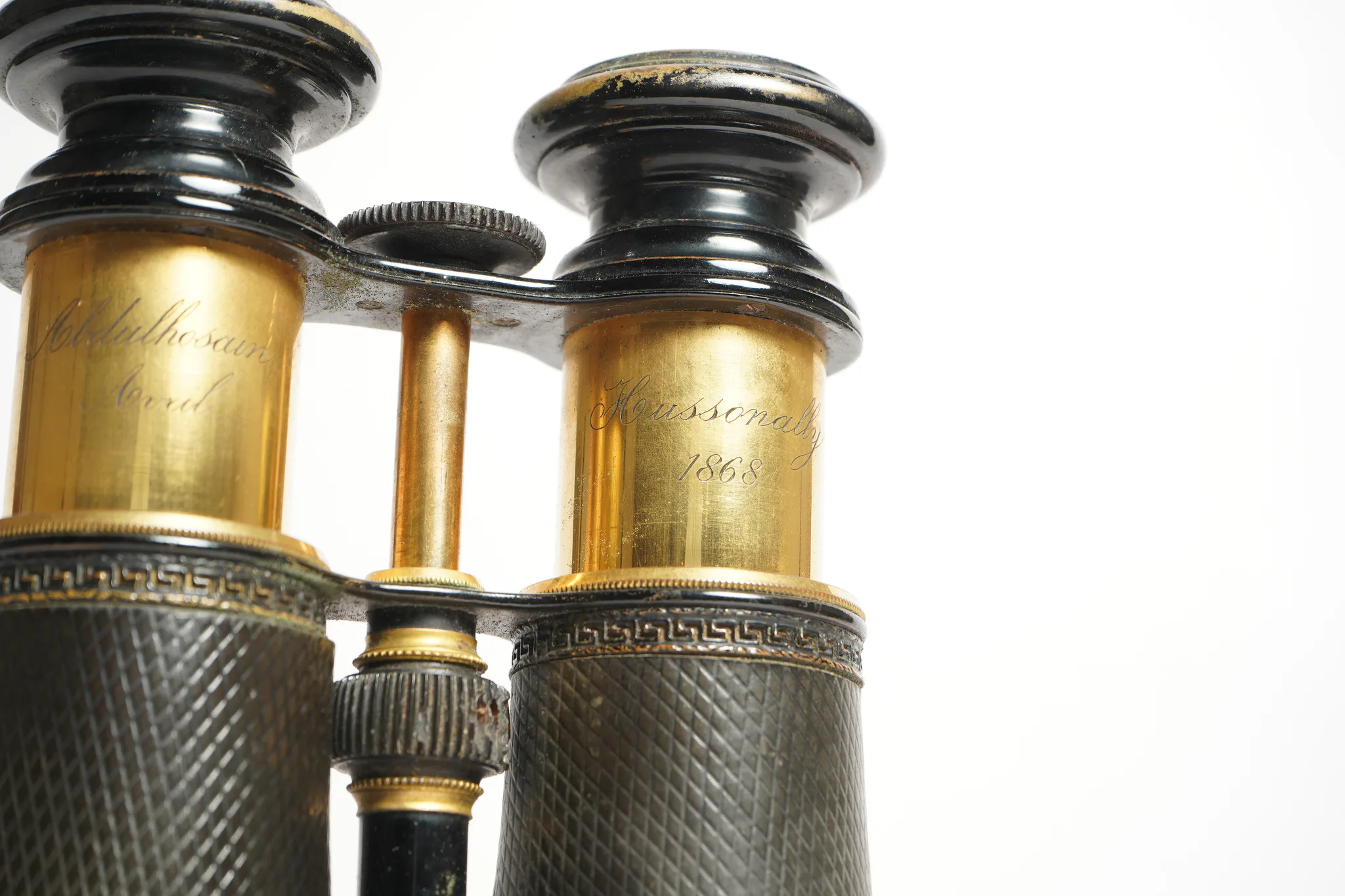
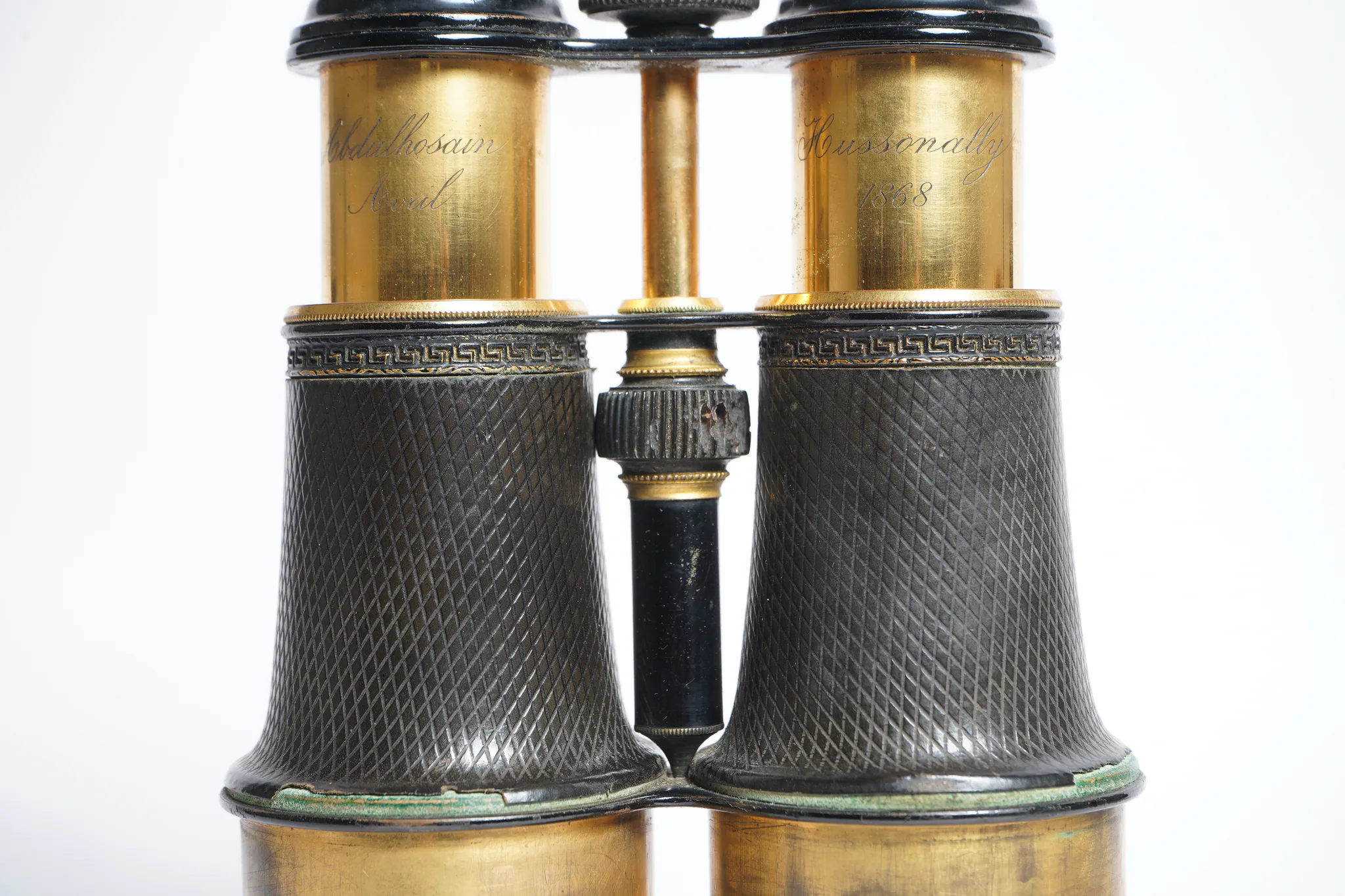
An extraordinary Victorian presentation binocular engraved 'Abdulhosain Houssonally 1868', featuring telescoping brass sunshades, ribbed leather barrels, and center-wheel focusing.
Magnificent 19th-century gilt brass and Morocco leather optical field glasses.
The photographed Antique 1868 Victorian Field Binoculars shows age-consistent surface wear and preserved period details; functionality is not claimed unless separately tested.
Sourced from the documented Curio Gallery archival catalogue: Antique 1868 Victorian Field Binoculars.
Abdulhosain Houssonally · 1868
Extendable dual cylindrical brass sunshields
Central knurled brass focusing wheel
Antique 1868 Victorian Field Binoculars by Abdulhosain Houssonally, identified from the supplied photographs and catalogue evidence.
Solid gilt brass with textured Morocco leather wrap; visible finish and hardware are recorded without adding unseen components.
United Kingdom / British India period specification
Distinctive proportions, controls, markings, and surface details visible on this individual Antique 1868 Victorian Field Binoculars.
Abdulhosain Houssonally production places this piece within the documented history of Antique 1868 Victorian Field Binoculars.
The included image set for Antique 1868 Victorian Field Binoculars is the reference for identity, completeness, and condition; details not shown are not assumed.
Antique 1868 Victorian Field Binoculars carries the material language of United Kingdom / British India manufacturing around 1868: purposeful controls, repairable construction, and a design made for use rather than disposal. Its surviving details connect today's collector with the hands that made and used it.
Every mark and fitting shown belongs to this individual Antique 1868 Victorian Field Binoculars. Its documented details give collectors a precise, honest connection to the people and practices that shaped Abdulhosain Houssonally. The photographic record keeps that connection specific, personal, and grounded in the evidence presented.
Produced by Abdulhosain Houssonally in United Kingdom / British India; the photographed Antique 1868 Victorian Field Binoculars retains its period design language.
Used in optics work during the working life of Antique 1868 Victorian Field Binoculars, with the controls and surfaces shown in the supplied photographs.
Preserved after active service, this Antique 1868 Victorian Field Binoculars became a reference point for collectors studying Abdulhosain Houssonally workmanship.
Antique 1868 Victorian Field Binoculars was photographed, condition-reviewed, and catalogued for a documented Curio Gallery acquisition.
The photographed Antique 1868 Victorian Field Binoculars shows age-consistent surface wear and preserved period details; functionality is not claimed unless separately tested.
Only components visible in the photographs of this Antique 1868 Victorian Field Binoculars are included; unseen accessories are not assumed.
Operational performance for this individual Antique 1868 Victorian Field Binoculars is not claimed unless demonstrated in the photographs or separately tested.
Age, patina, wear, and any missing elements shown in the Antique 1868 Victorian Field Binoculars images should be considered part of its condition.
Photographs and catalogue attribution: Curio Gallery.
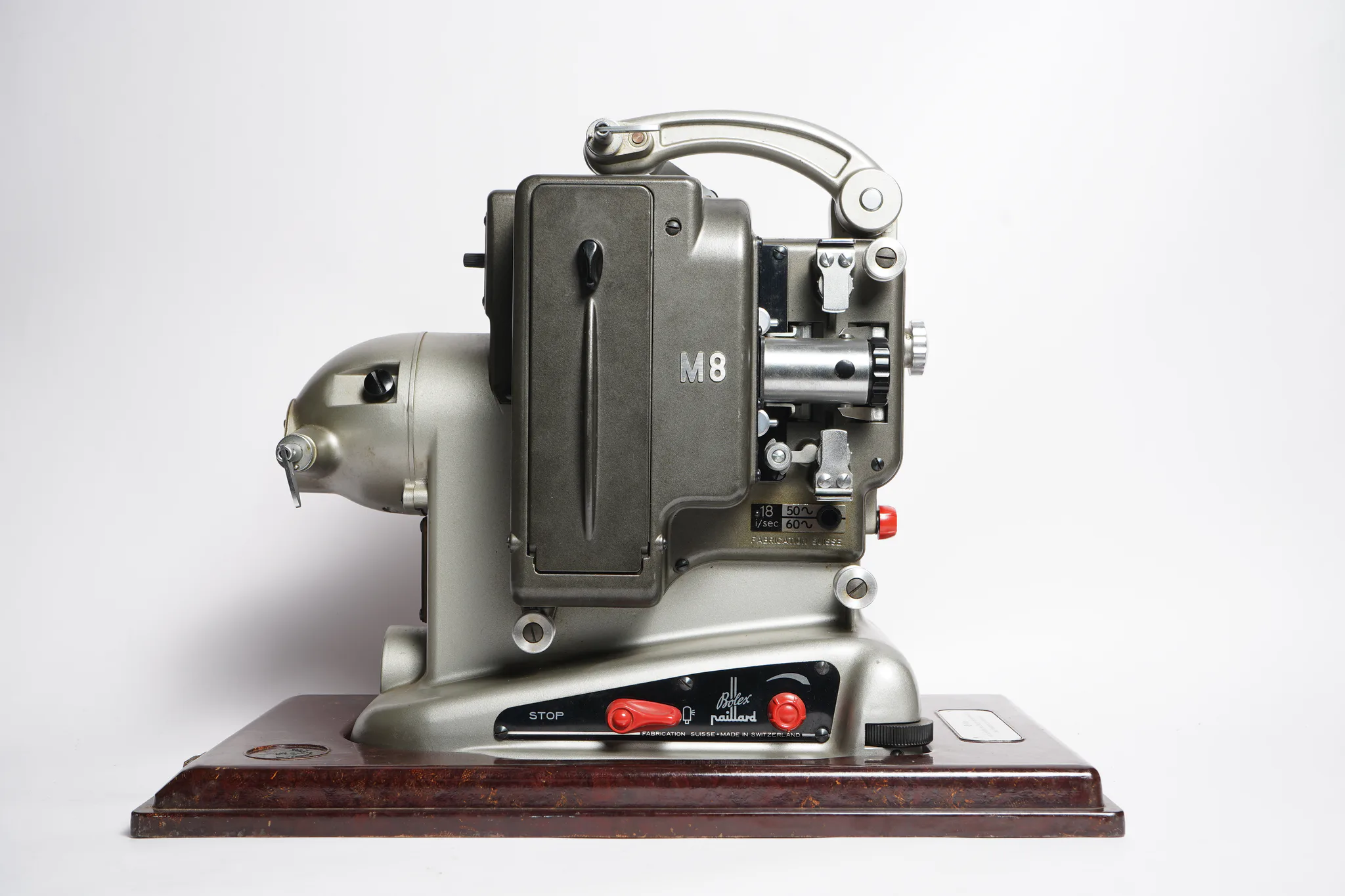
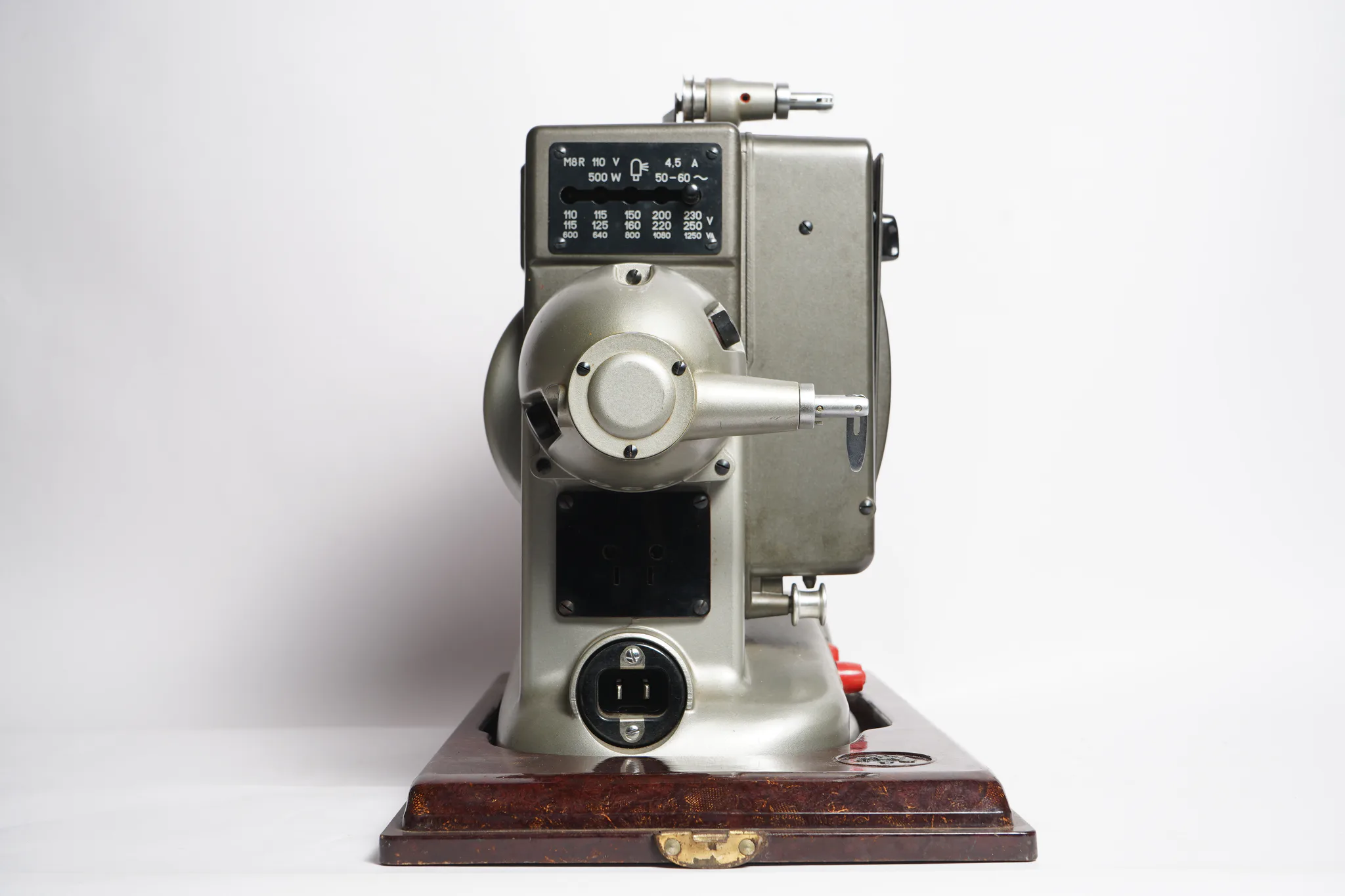
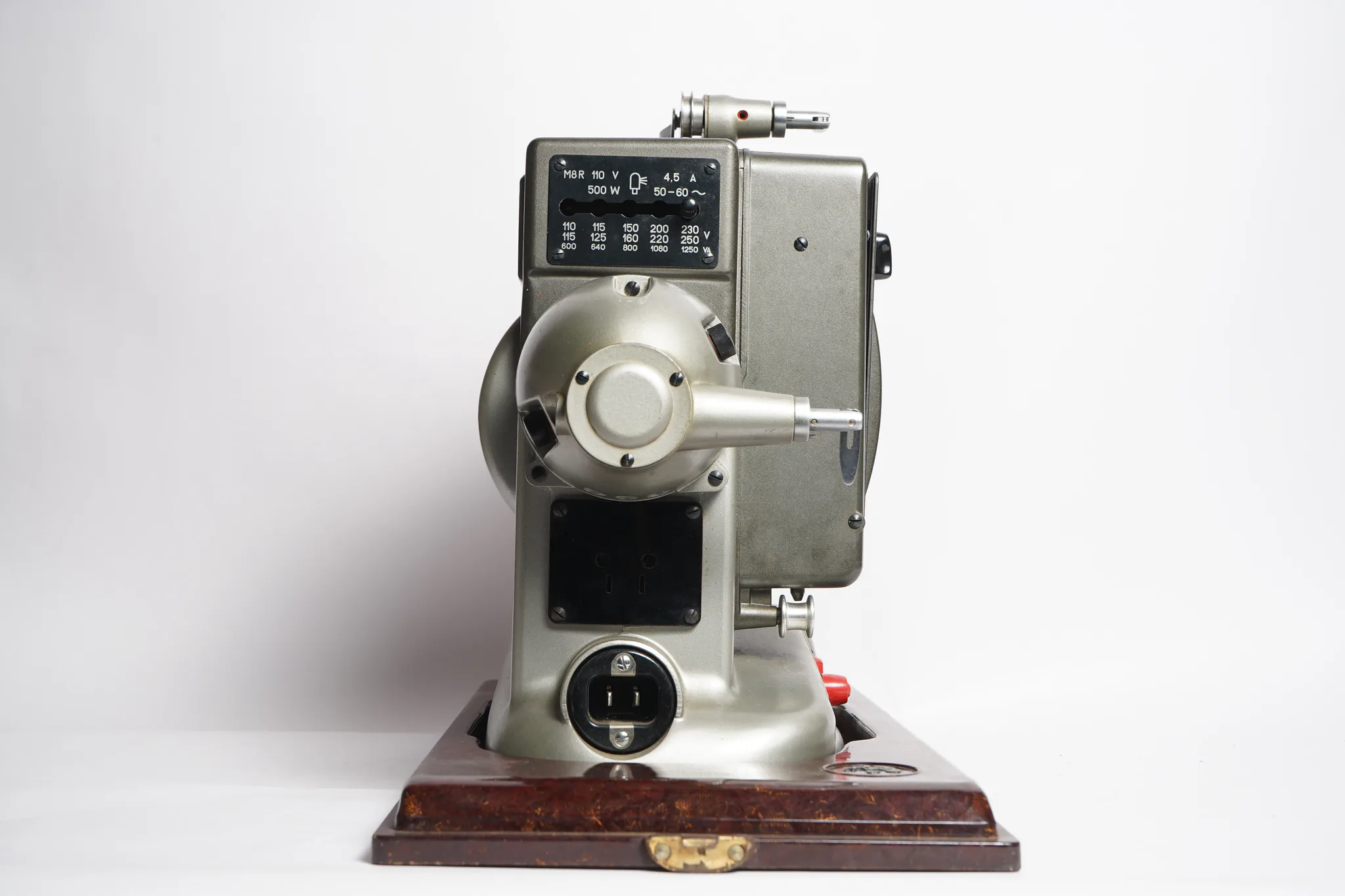
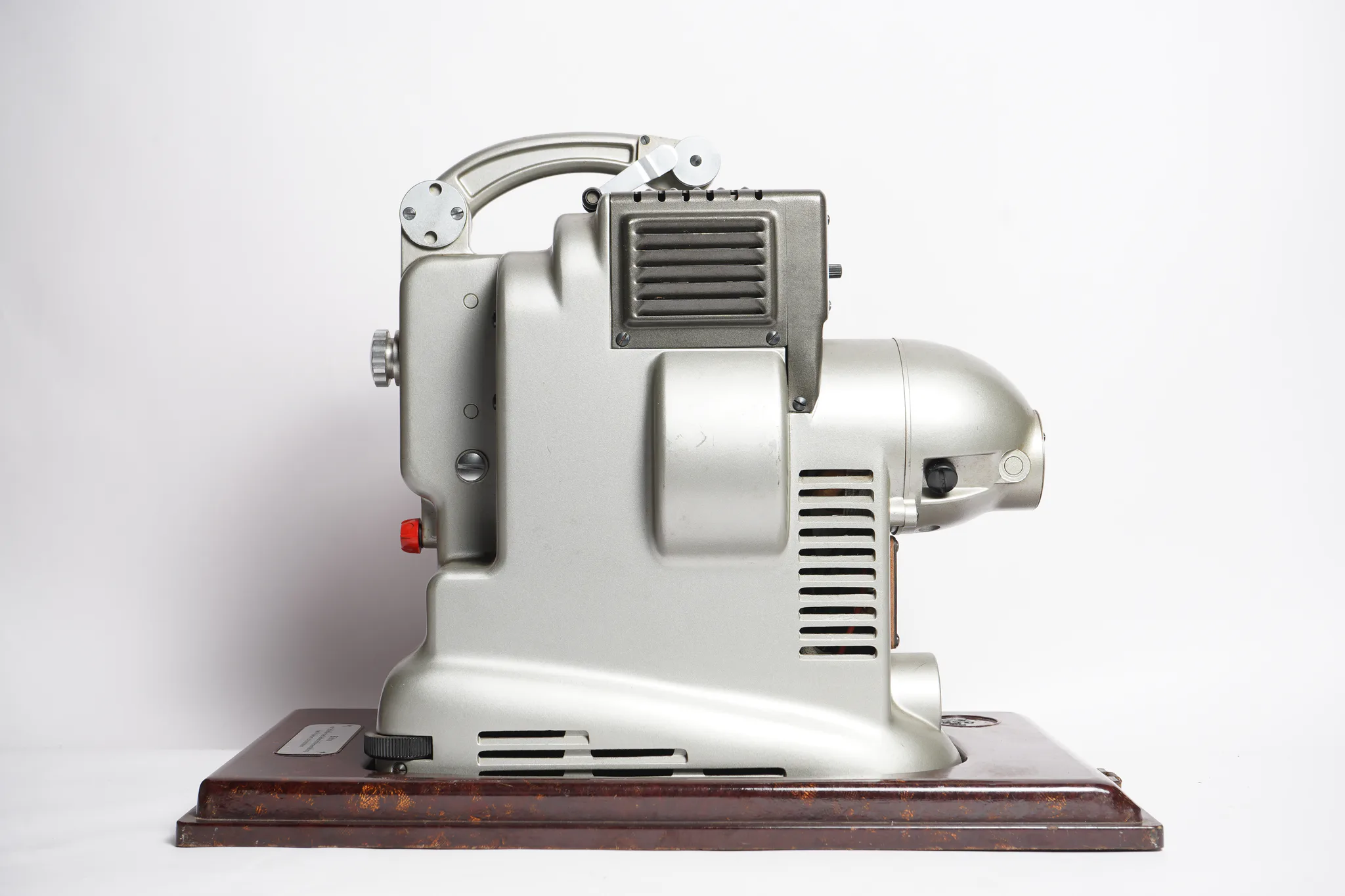
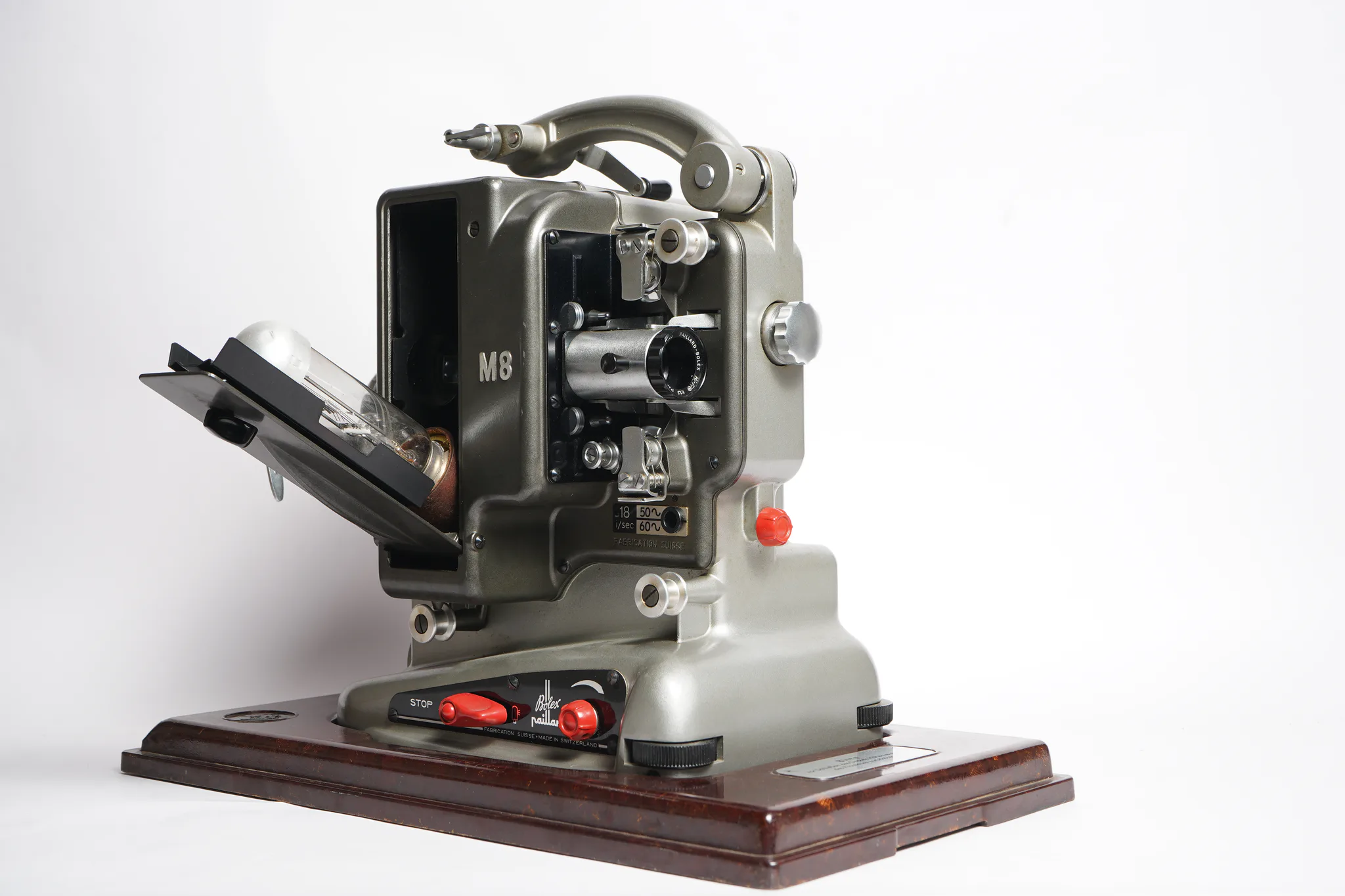
Switzerland, 1955
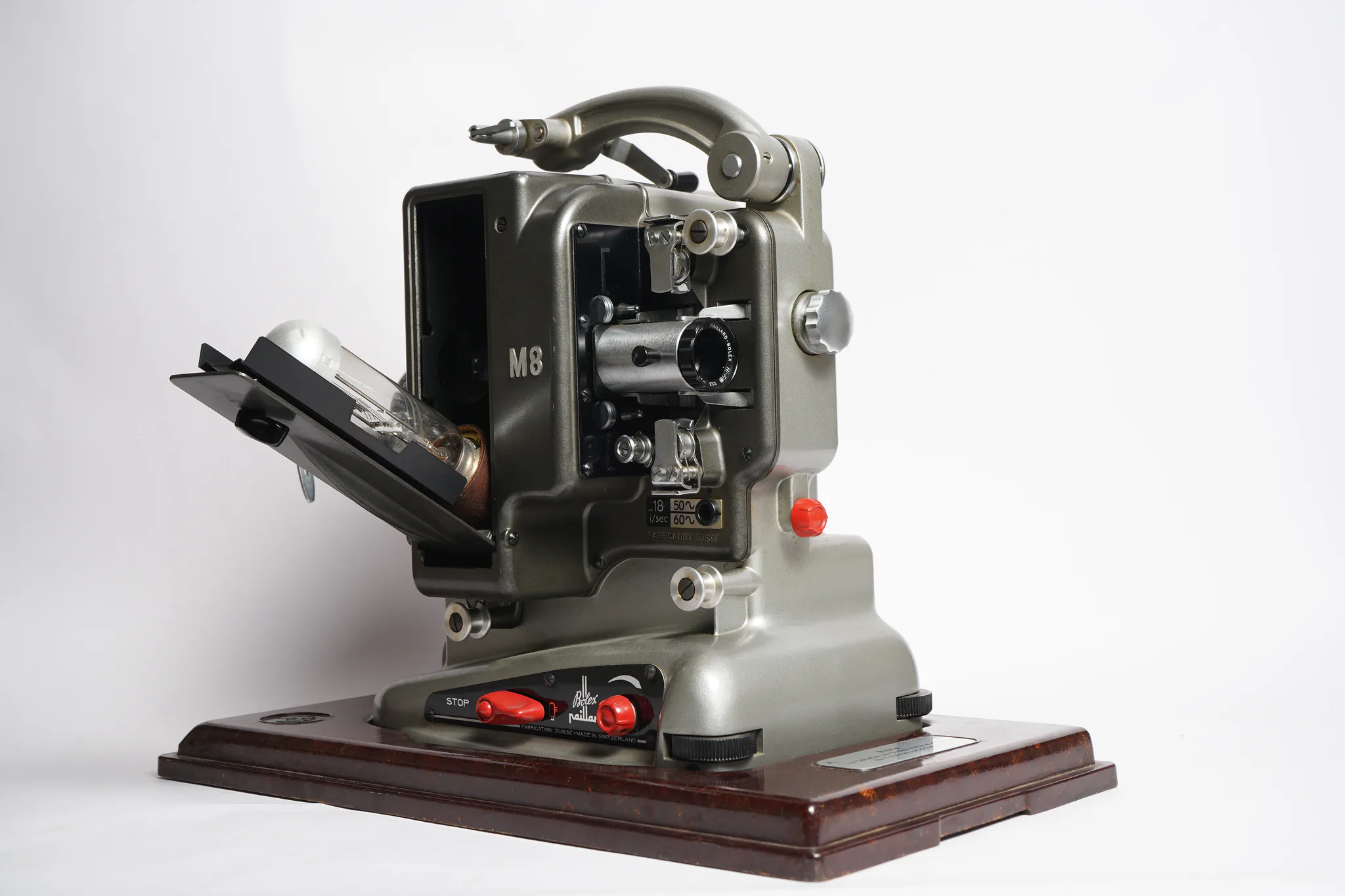
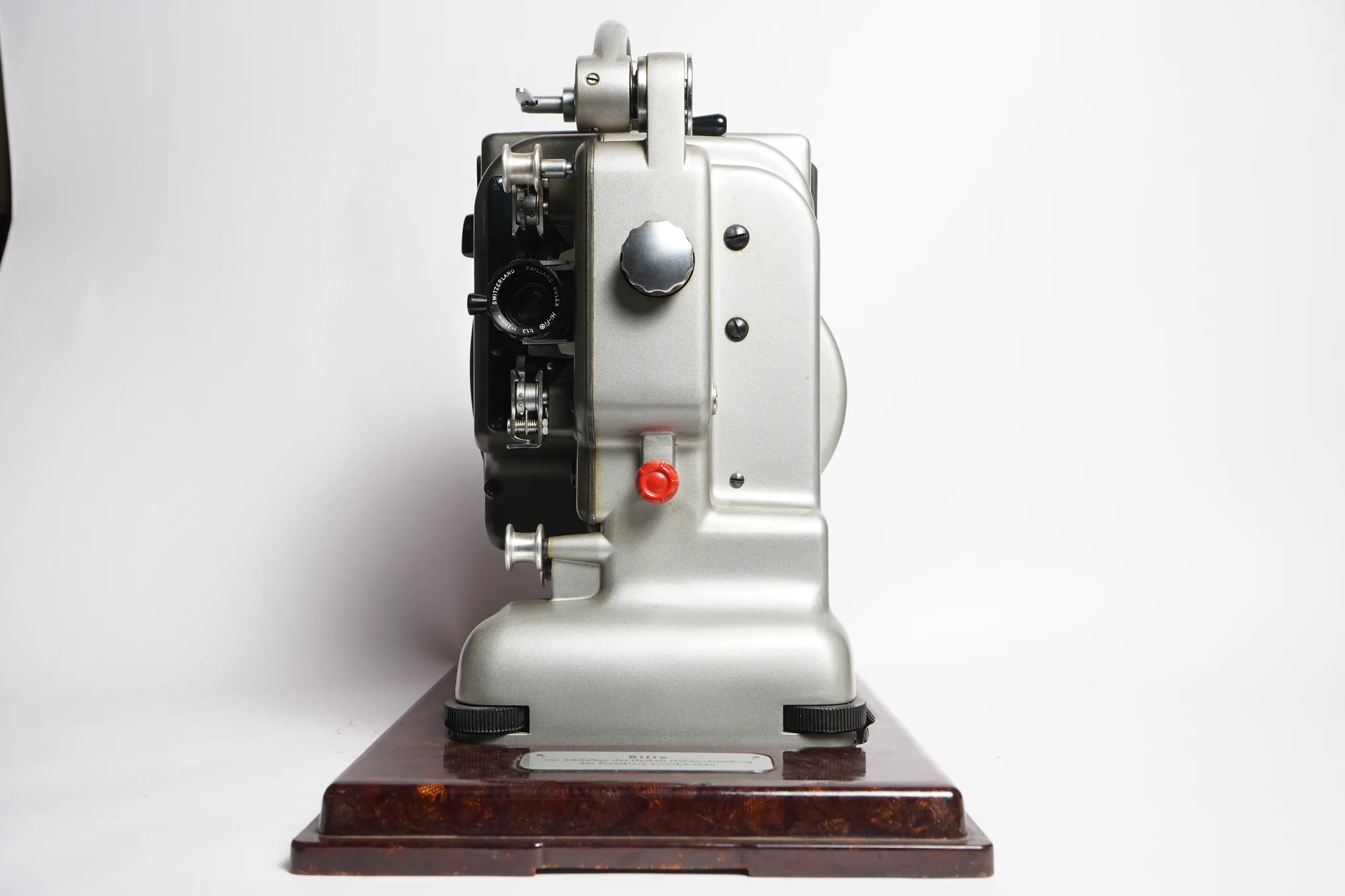
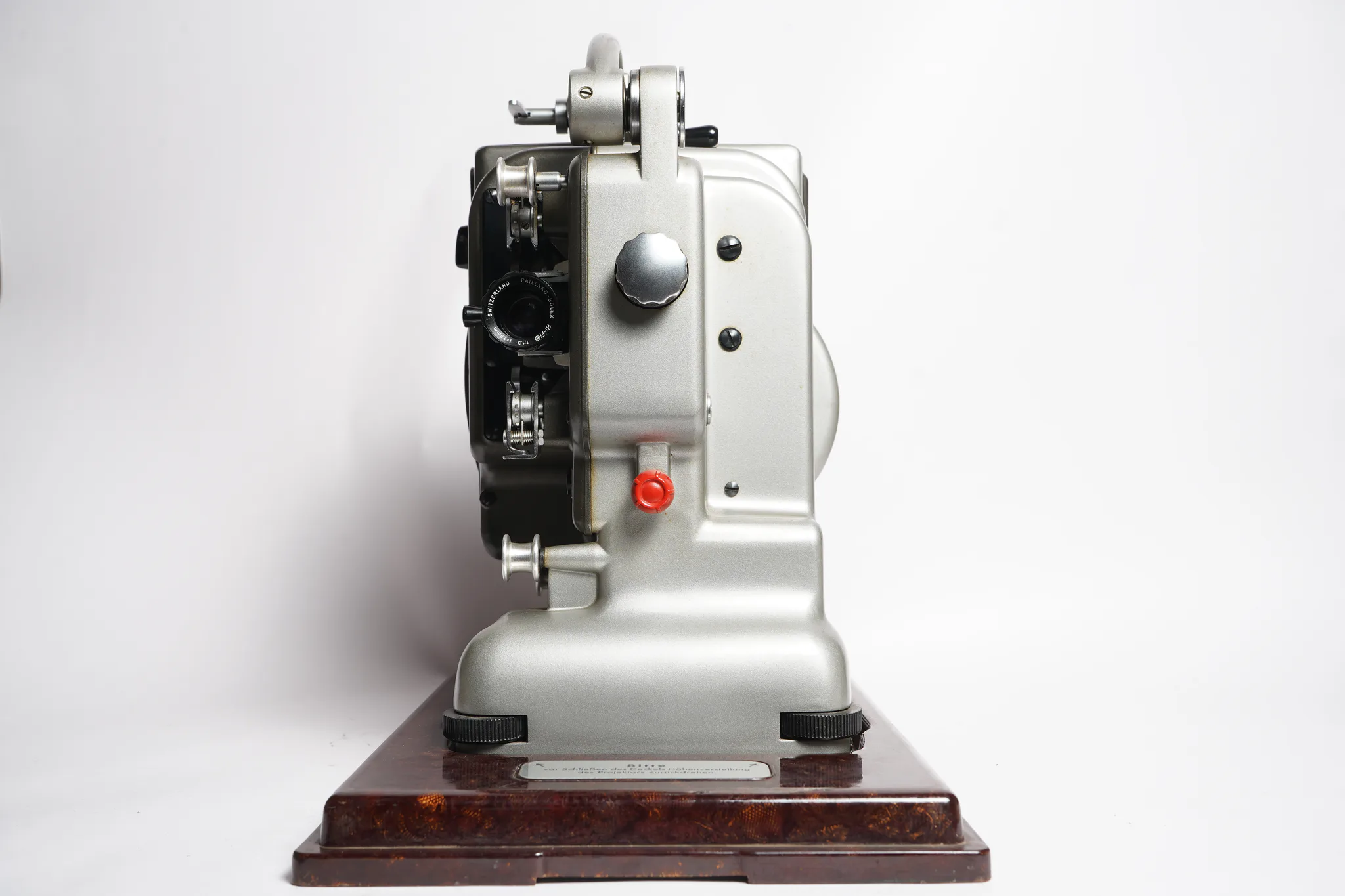
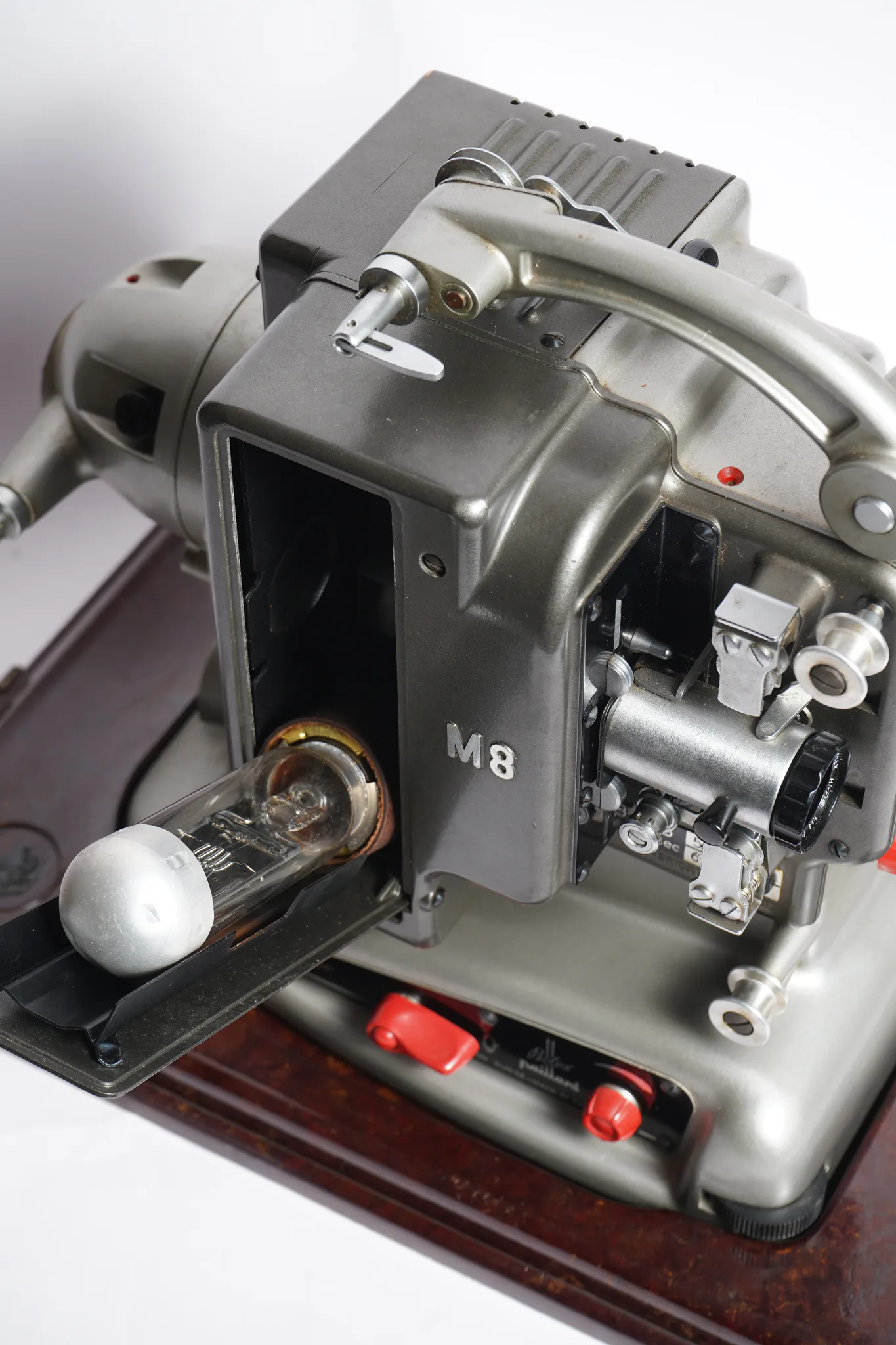
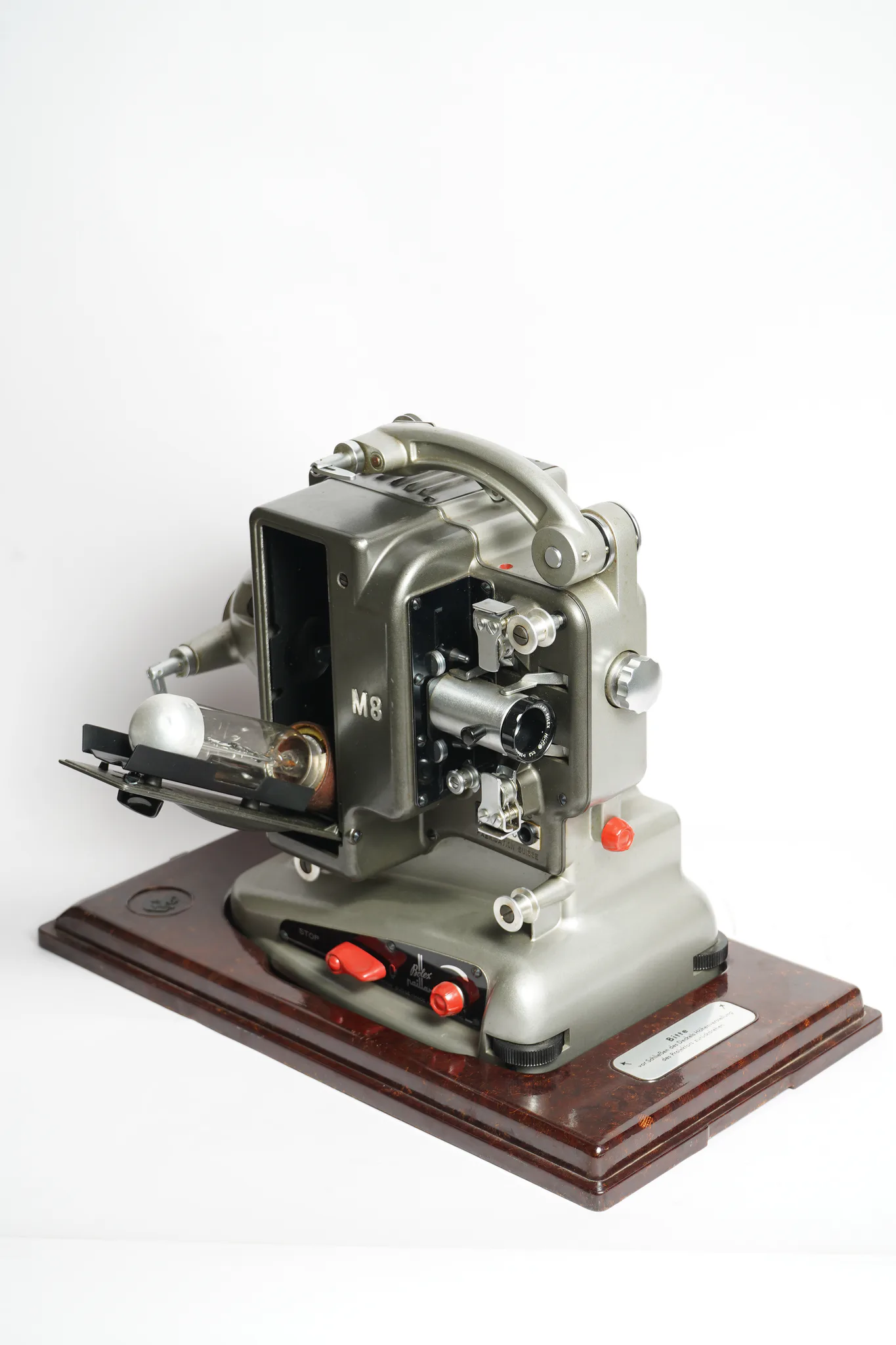
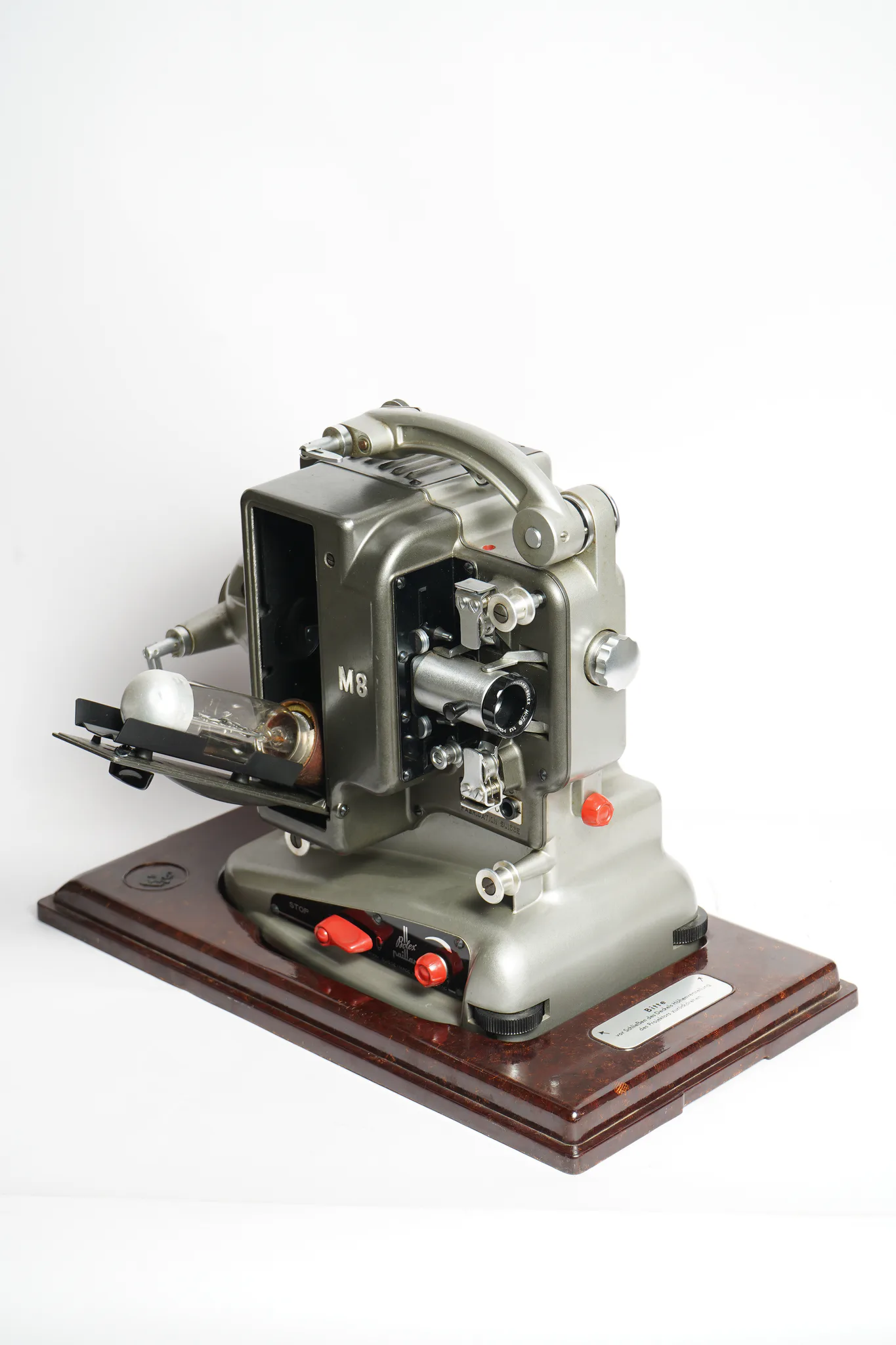
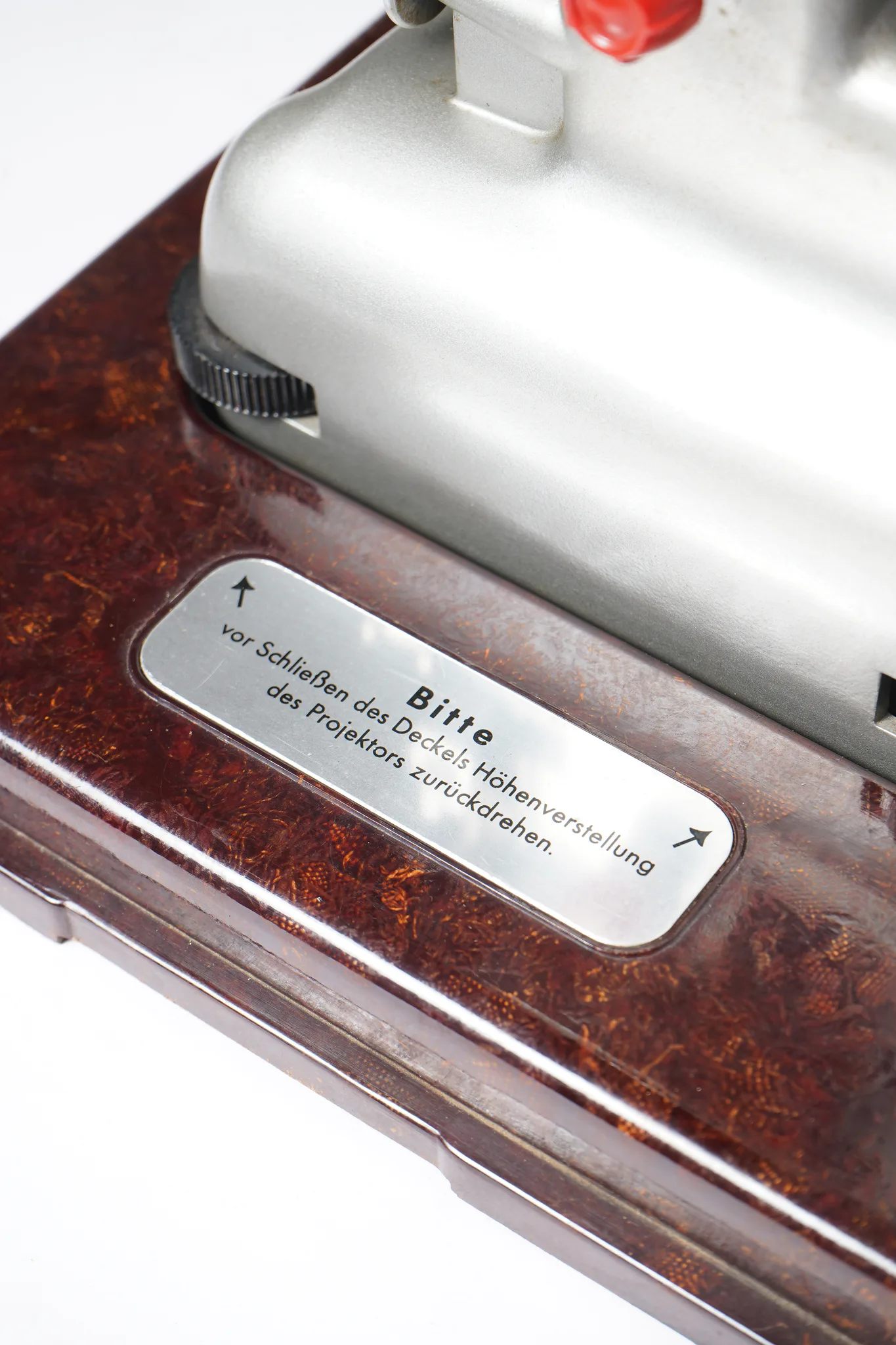
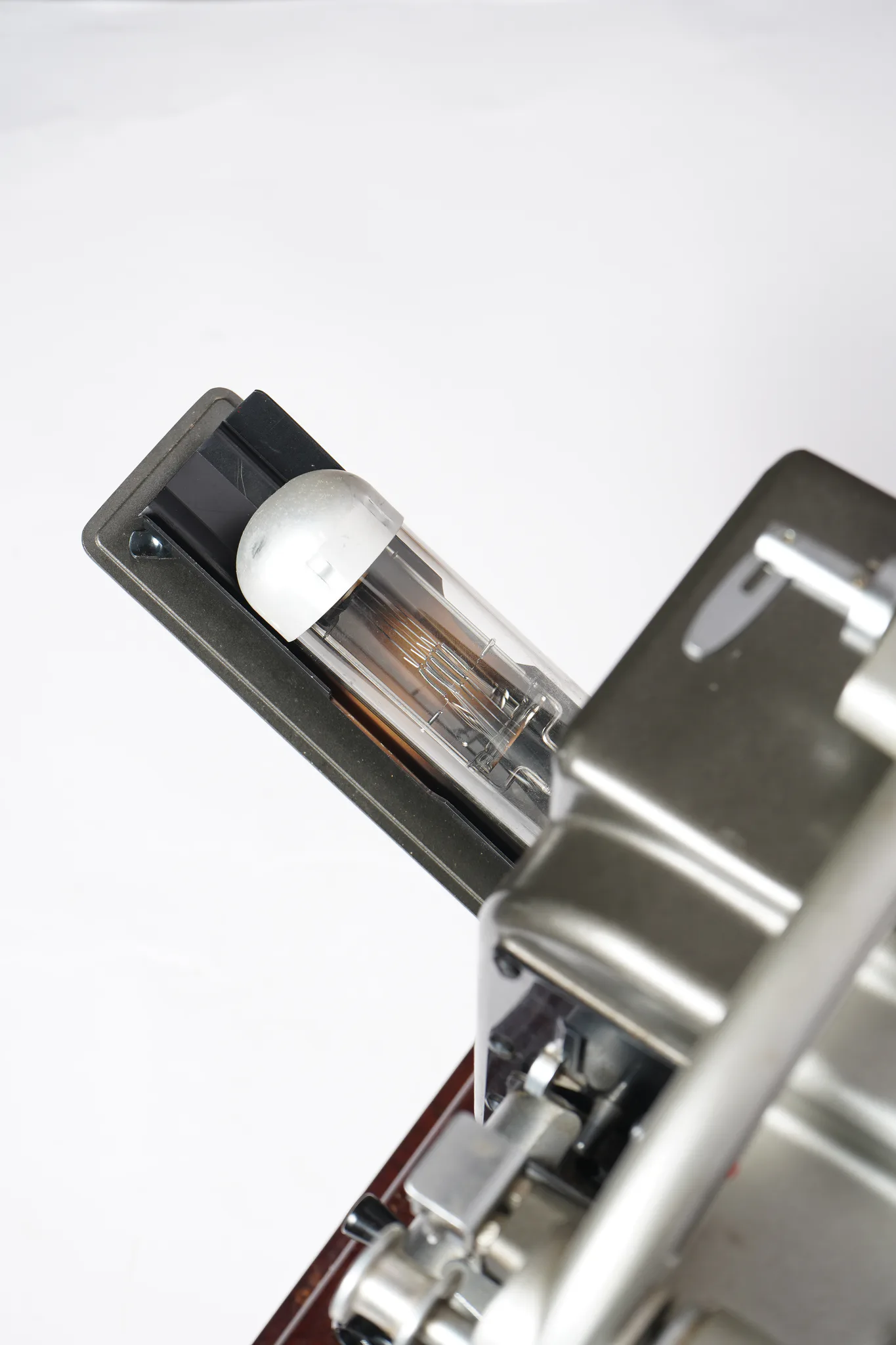
An iconic Swiss-made 8mm motion picture projector engineered with watchmaker precision, offering rock-steady film advance and Hi-Fi 20mm optics.
Swiss horological cine projection with Paillard-Bolex Hi-Fi optics.
The photographed Paillard Bolex M8 8mm Film Projector shows age-consistent surface wear and preserved period details; functionality is not claimed unless separately tested.
Sourced from the documented Curio Gallery archival catalogue: Paillard Bolex M8 8mm Film Projector.
Paillard-Bolex Hi-Fi f=20mm 1:1.3 prime lens
Standard 8mm (up to 120m reels)
Swiss synchronous electric motor with rheostat speed control
Two-tone metallic olive and polished chrome
Paillard Bolex M8 8mm Film Projector by Paillard-Bolex, identified from the supplied photographs and catalogue evidence.
Paillard-Bolex period construction; visible finish and hardware are recorded without adding unseen components.
Paillard-Bolex Hi-Fi f=20mm 1:1.3 prime lens
Distinctive proportions, controls, markings, and surface details visible on this individual Paillard Bolex M8 8mm Film Projector.
Paillard-Bolex production places this piece within the documented history of Paillard Bolex M8 8mm Film Projector.
The included image set for Paillard Bolex M8 8mm Film Projector is the reference for identity, completeness, and condition; details not shown are not assumed.
Paillard Bolex M8 8mm Film Projector carries the material language of Switzerland manufacturing around 1955: purposeful controls, repairable construction, and a design made for use rather than disposal. Its surviving details connect today's collector with the hands that made and used it.
Every mark and fitting shown belongs to this individual Paillard Bolex M8 8mm Film Projector. Its documented details give collectors a precise, honest connection to the people and practices that shaped Paillard-Bolex. The photographic record keeps that connection specific, personal, and grounded in the evidence presented.
Produced by Paillard-Bolex in Switzerland; the photographed Paillard Bolex M8 8mm Film Projector retains its period design language.
Used in optics work during the working life of Paillard Bolex M8 8mm Film Projector, with the controls and surfaces shown in the supplied photographs.
Preserved after active service, this Paillard Bolex M8 8mm Film Projector became a reference point for collectors studying Paillard-Bolex workmanship.
Paillard Bolex M8 8mm Film Projector was photographed, condition-reviewed, and catalogued for a documented Curio Gallery acquisition.
The photographed Paillard Bolex M8 8mm Film Projector shows age-consistent surface wear and preserved period details; functionality is not claimed unless separately tested.
Only components visible in the photographs of this Paillard Bolex M8 8mm Film Projector are included; unseen accessories are not assumed.
Operational performance for this individual Paillard Bolex M8 8mm Film Projector is not claimed unless demonstrated in the photographs or separately tested.
Age, patina, wear, and any missing elements shown in the Paillard Bolex M8 8mm Film Projector images should be considered part of its condition.
Photographs and catalogue attribution: Curio Gallery.
Germany, 1954
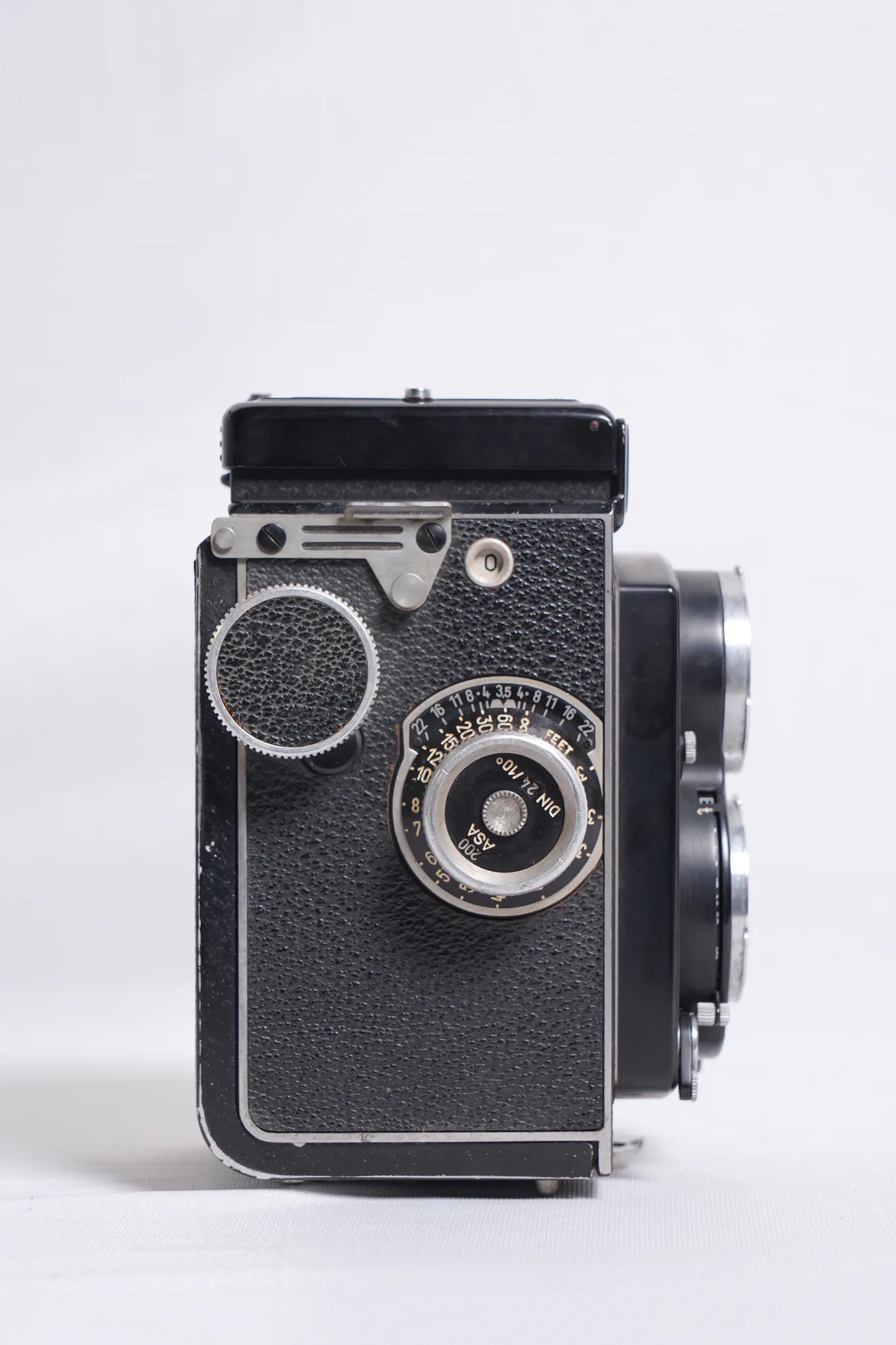
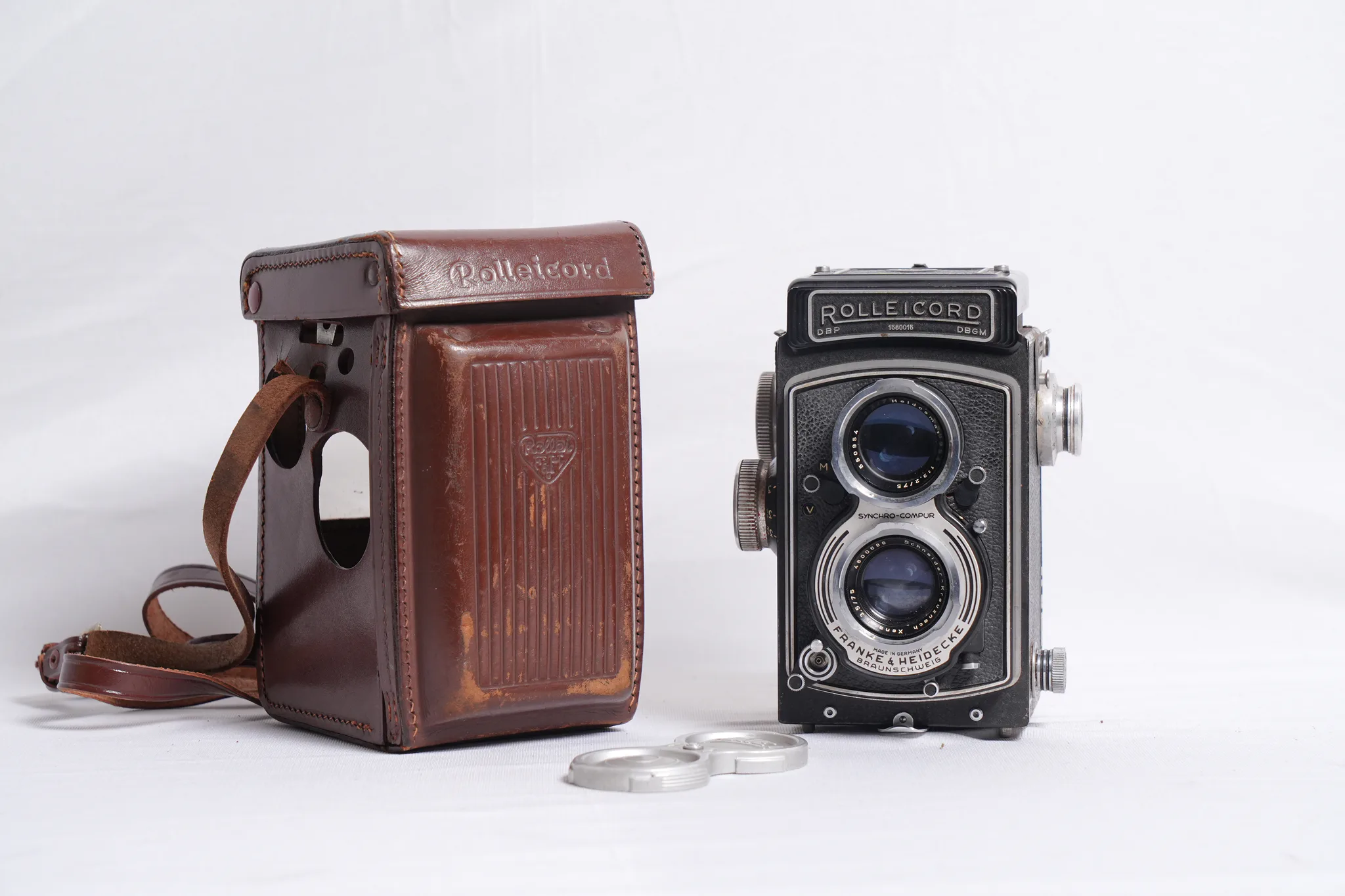
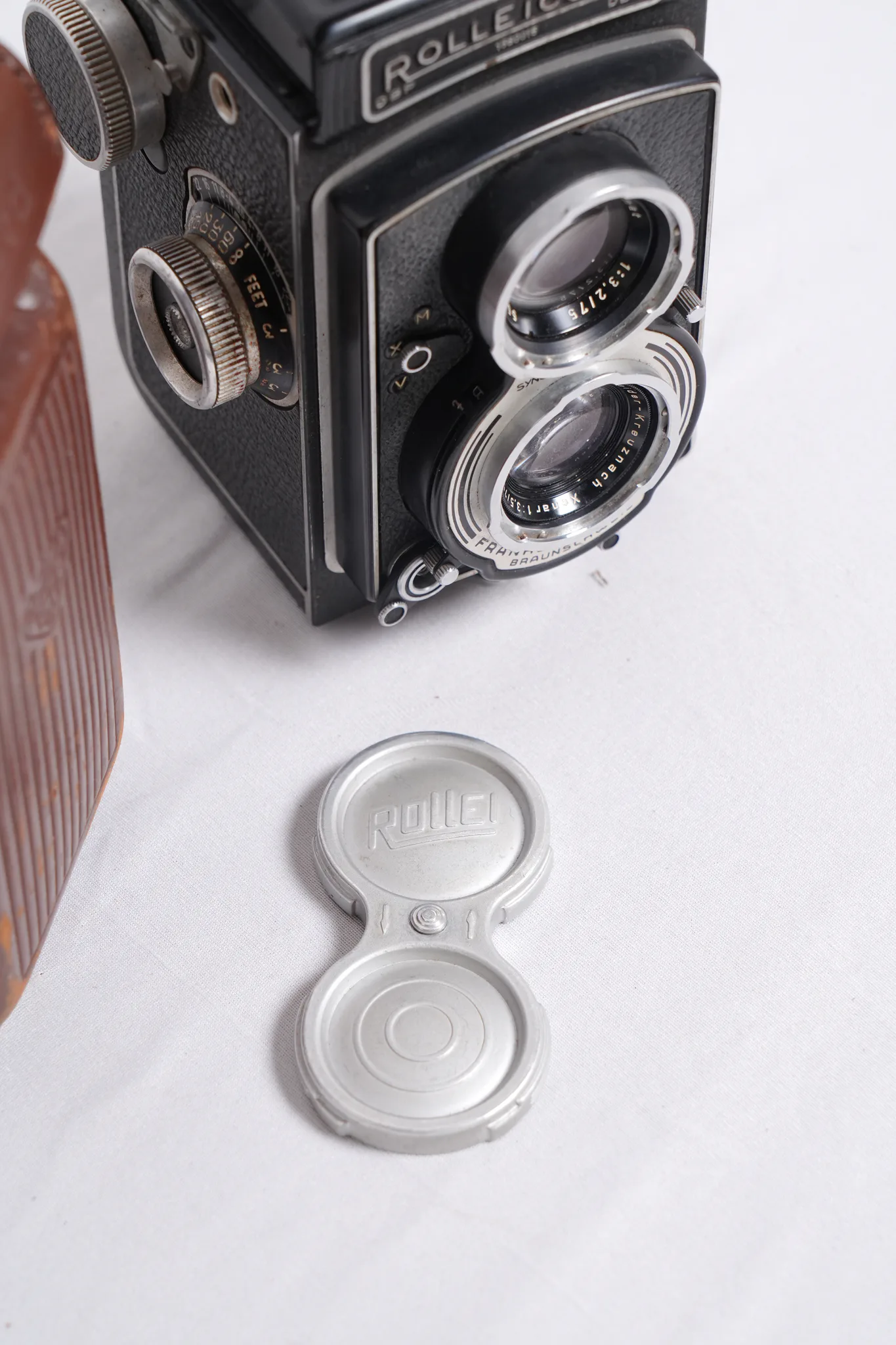
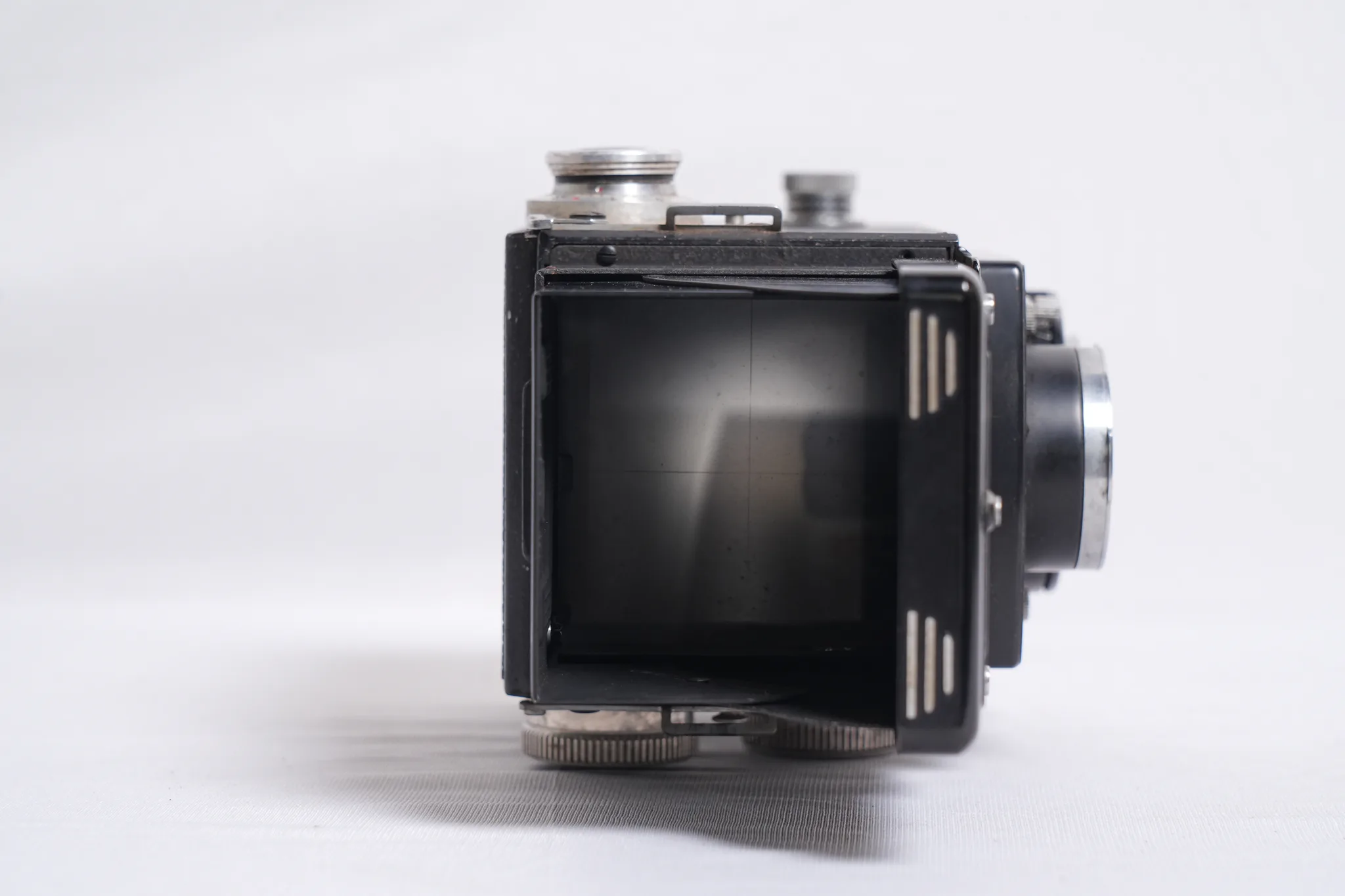
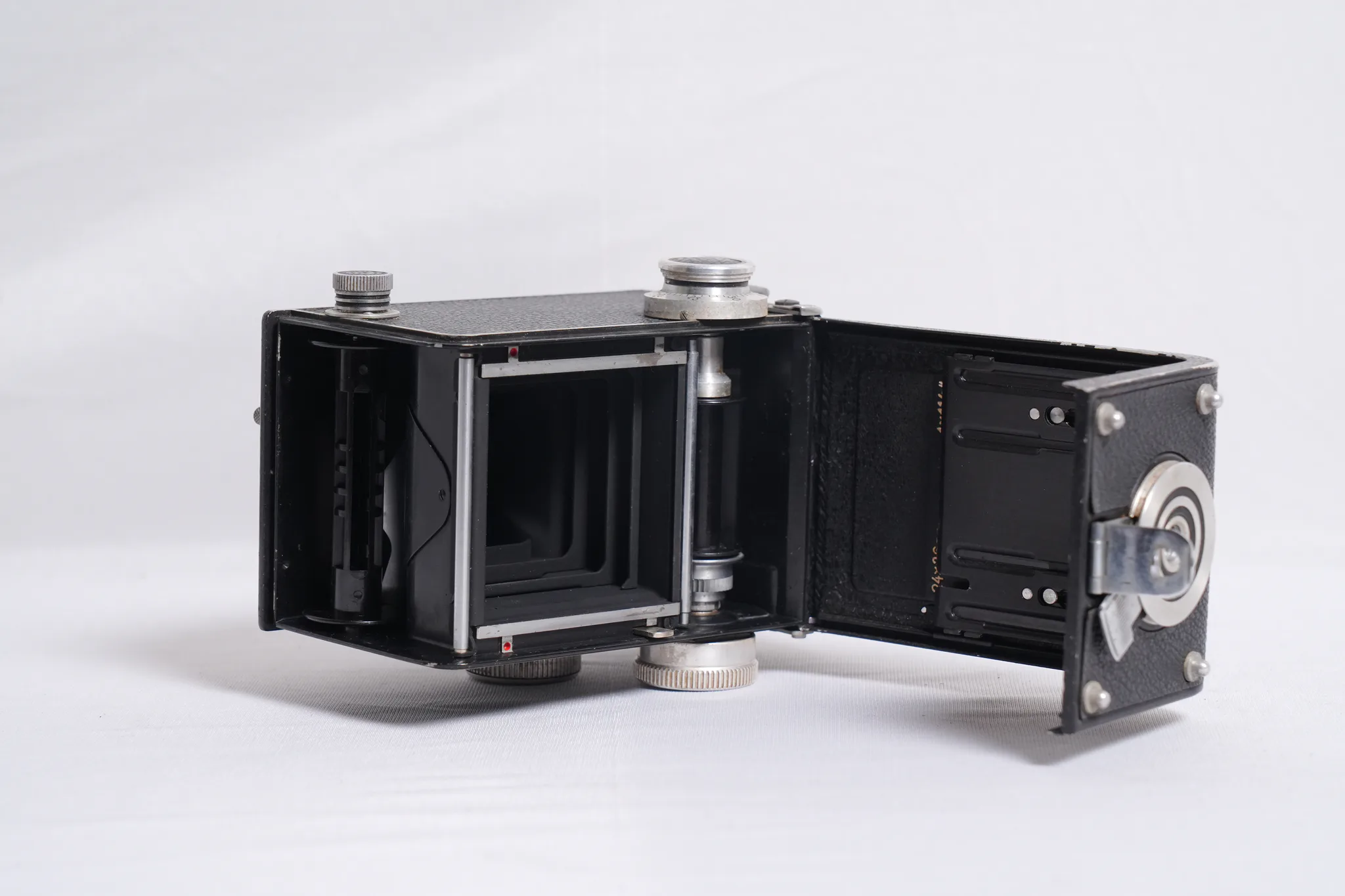
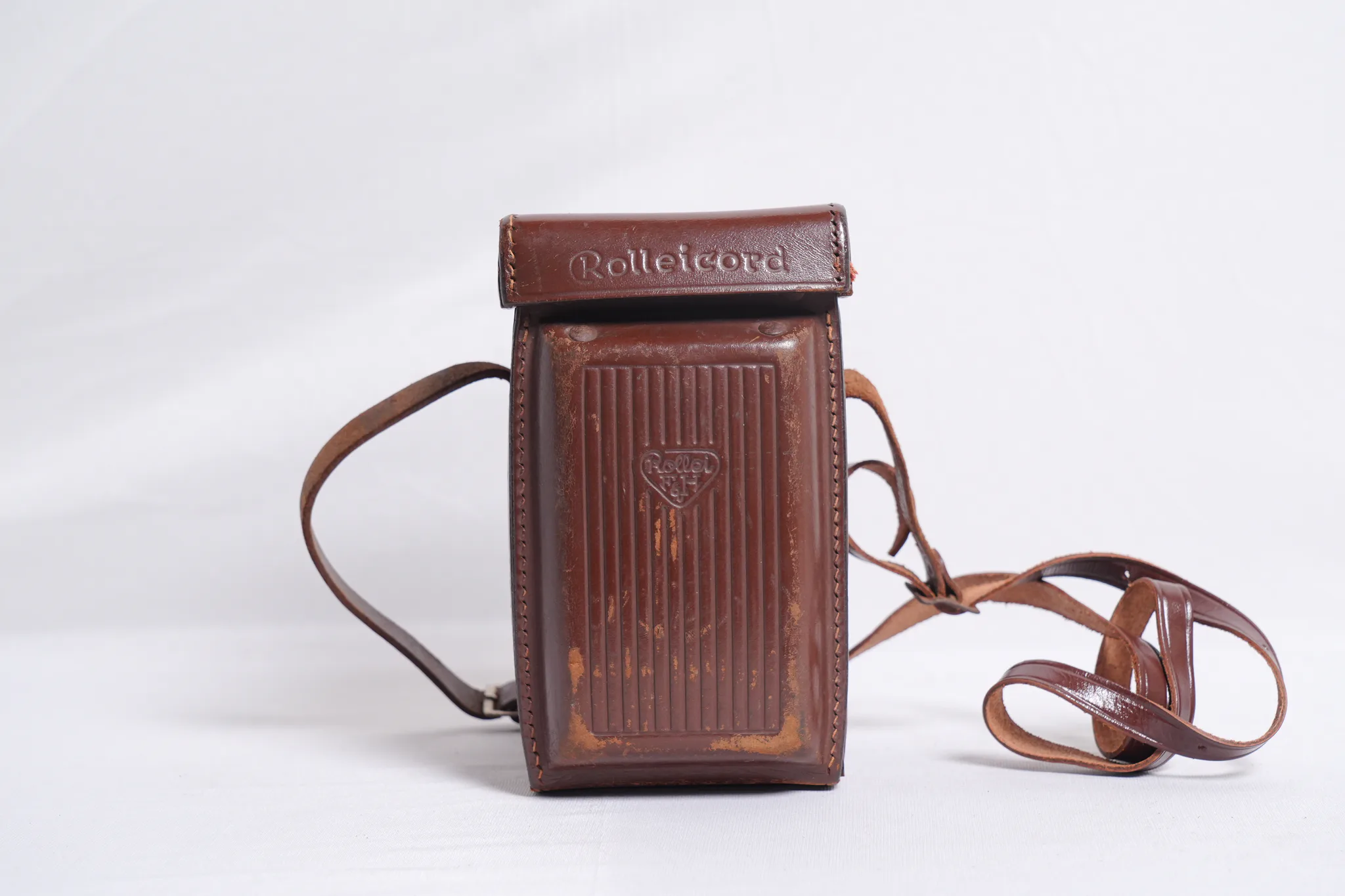
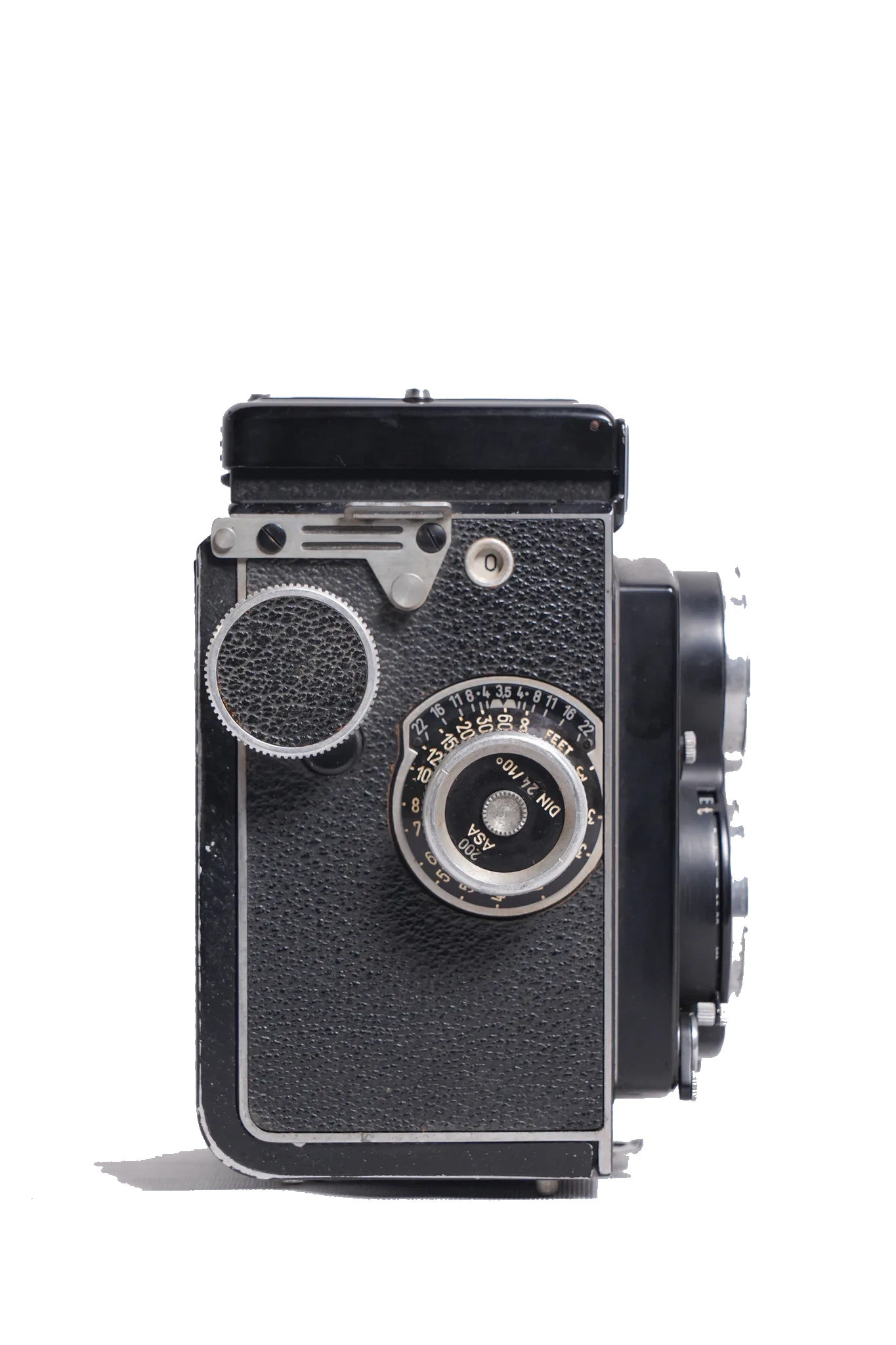
This vintage twin-lens reflex camera features the iconic Rolleicord branding across the top viewing hood, accompanied by a fitted brown leather ever-ready case and an original dual metal lens cap embossed with the 'Rollei' logo. The camera body showcases a structured leatherette wrap, mechanical adjustment dials on the sides, and a prominent Synchro-Compur shutter assembly surrounding the taking lens.
Classic German twin-lens reflex camera by Franke & Heidecke featuring a Schneider-Kreuznach Xenar lens.
The camera body shows moderate wear consistent with age, including slight scuffing on the leatherette and metal components. The accompanying brown leather case exhibits noticeable aging, scuffs, and surface wear on its textured front panel.
Provenance documentation was not supplied for this specific Franke & Heidecke Rolleicord TLR Camera with Case and Lens Cap; this listing is based on the supplied photographs only.
Twin-Lens Reflex (TLR)
Schneider-Kreuznach Xenar 1:3.5/75
Synchro-Compur
Franke & Heidecke, Braunschweig
Germany
Leather ever-ready case, dual metal lens cap
Franke & Heidecke Rolleicord TLR Camera with Case and Lens Cap by Franke & Heidecke, identified from the supplied photographs and catalogue evidence.
Franke & Heidecke period construction; visible finish and hardware are recorded without adding unseen components.
Schneider-Kreuznach Xenar 1:3.5/75
Distinctive proportions, controls, markings, and surface details visible on this individual Franke & Heidecke Rolleicord TLR Camera with Case and Lens Cap.
Franke & Heidecke production places this piece within the documented history of Franke & Heidecke Rolleicord TLR Camera with Case and Lens Cap.
The included image set for Franke & Heidecke Rolleicord TLR Camera with Case and Lens Cap is the reference for identity, completeness, and condition; details not shown are not assumed.
Franke & Heidecke Rolleicord TLR Camera with Case and Lens Cap carries the material language of Germany manufacturing around 1954: purposeful controls, repairable construction, and a design made for use rather than disposal. Its surviving details connect today's collector with the hands that made and used it.
Every mark and fitting shown belongs to this individual Franke & Heidecke Rolleicord TLR Camera with Case and Lens Cap. Its documented details give collectors a precise, honest connection to the people and practices that shaped Franke & Heidecke. The photographic record keeps that connection specific, personal, and grounded in the evidence presented.
Produced by Franke & Heidecke in Germany; the photographed Franke & Heidecke Rolleicord TLR Camera with Case and Lens Cap retains its period design language.
Used in cameras work during the working life of Franke & Heidecke Rolleicord TLR Camera with Case and Lens Cap, with the controls and surfaces shown in the supplied photographs.
Preserved after active service, this Franke & Heidecke Rolleicord TLR Camera with Case and Lens Cap became a reference point for collectors studying Franke & Heidecke workmanship.
Franke & Heidecke Rolleicord TLR Camera with Case and Lens Cap was photographed, condition-reviewed, and catalogued for a documented Curio Gallery acquisition.
The camera body shows moderate wear consistent with age, including slight scuffing on the leatherette and metal components. The accompanying brown leather case exhibits noticeable aging, scuffs, and surface wear on its textured front panel.
Only components visible in the photographs of this Franke & Heidecke Rolleicord TLR Camera with Case and Lens Cap are included; unseen accessories are not assumed.
Operational performance for this individual Franke & Heidecke Rolleicord TLR Camera with Case and Lens Cap is not claimed unless demonstrated in the photographs or separately tested.
Age, patina, wear, and any missing elements shown in the Franke & Heidecke Rolleicord TLR Camera with Case and Lens Cap images should be considered part of its condition.
Photographs and catalogue attribution: Curio Gallery.
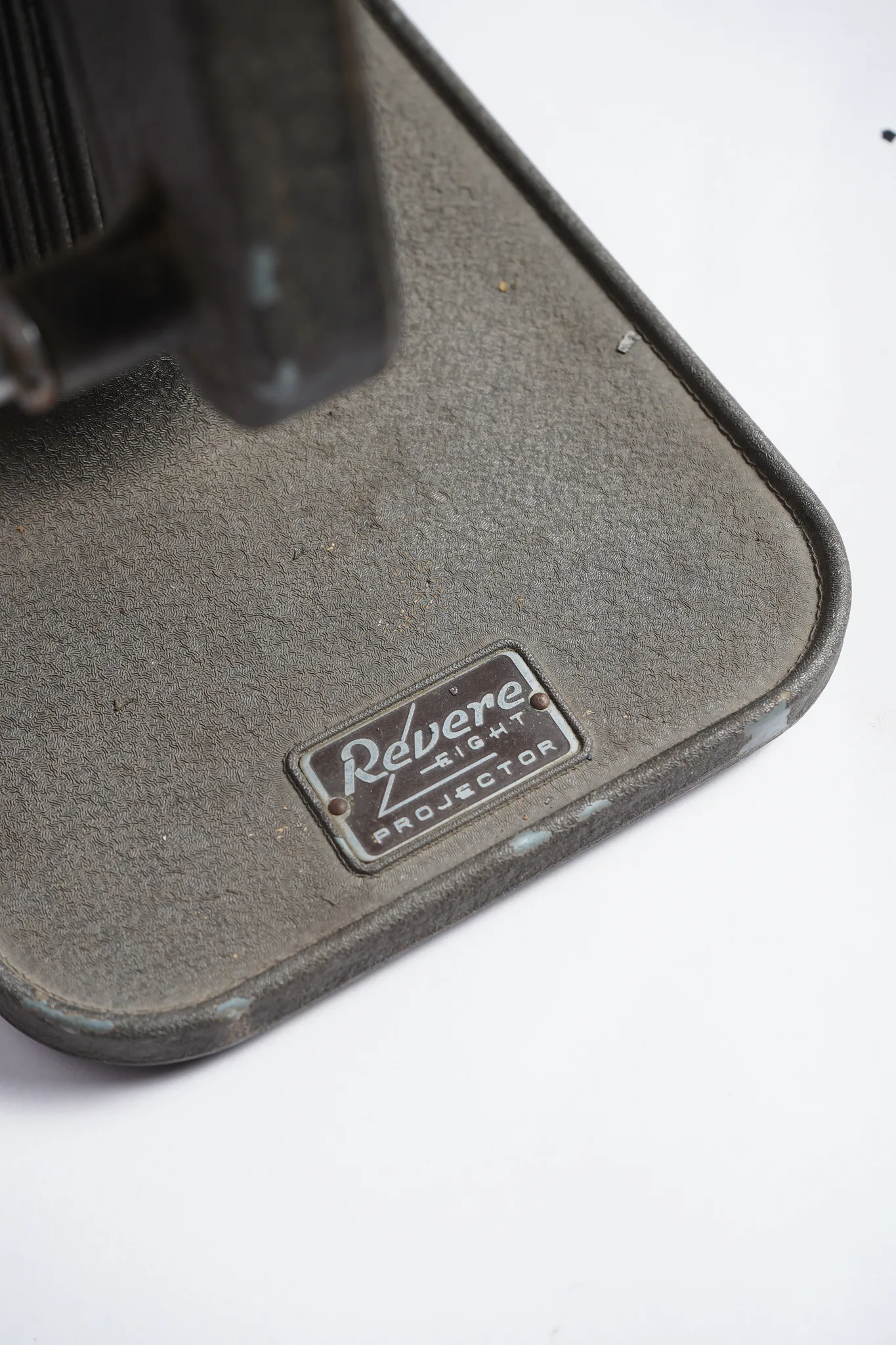
USA, 1948
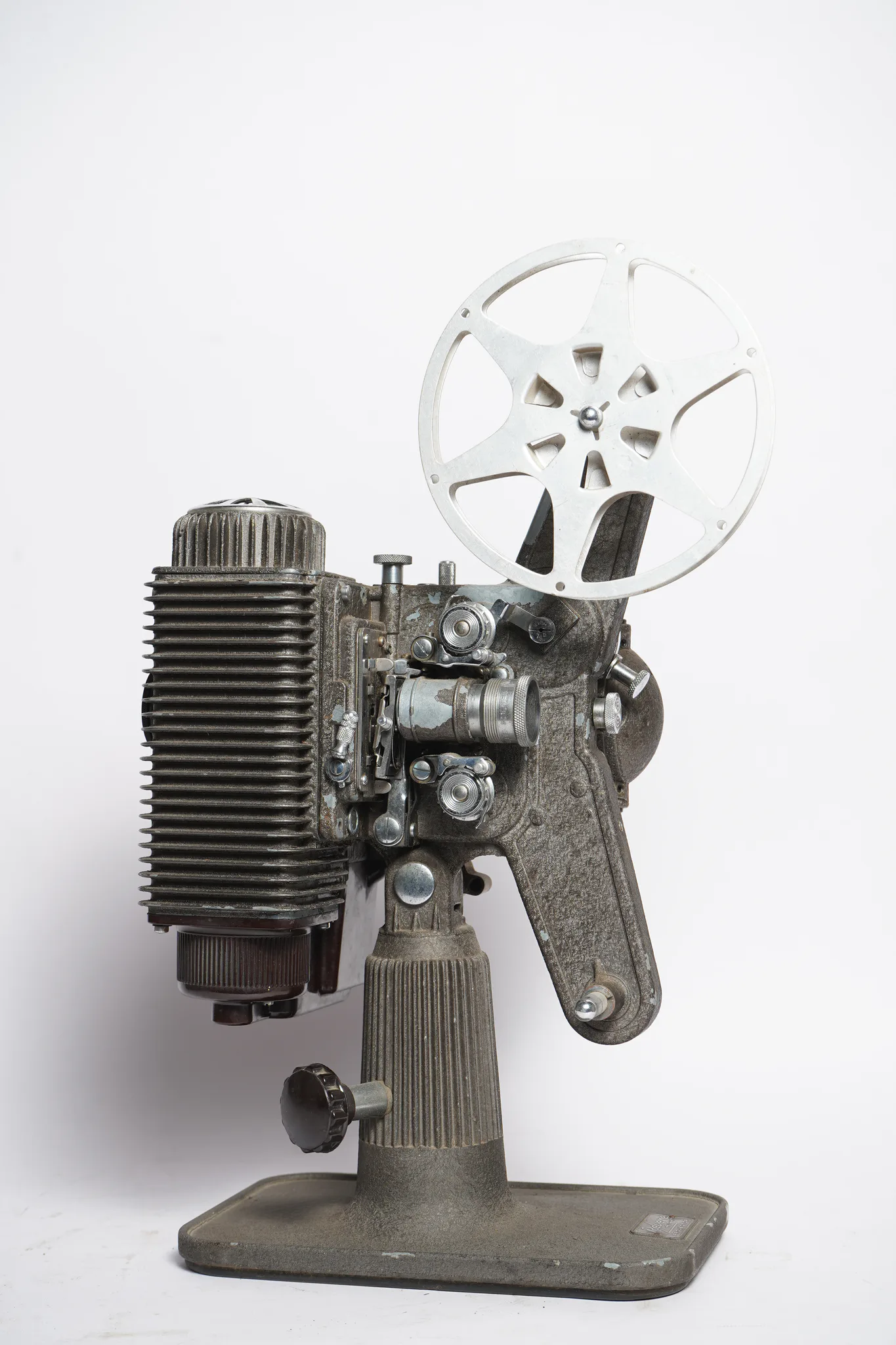
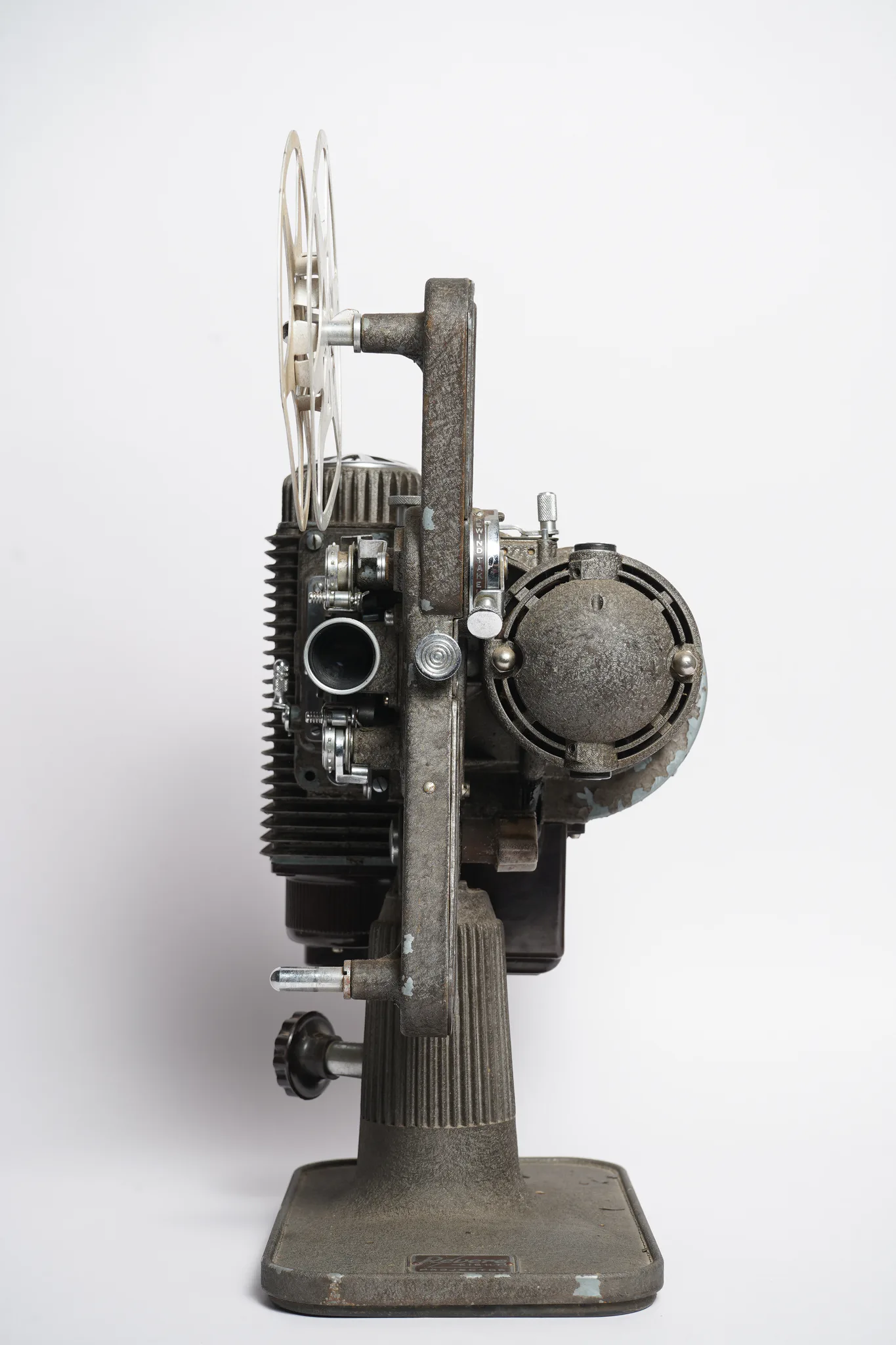
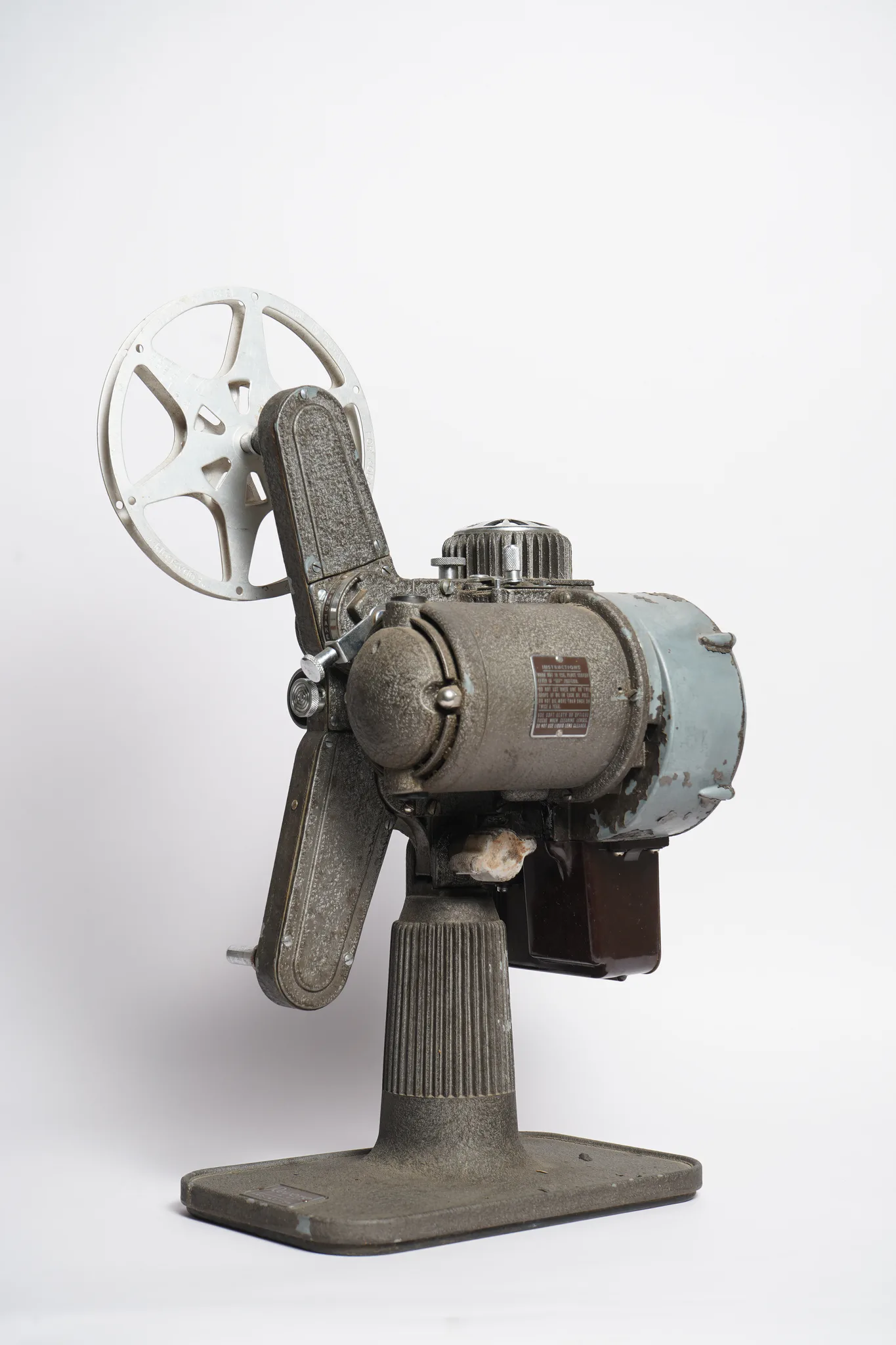
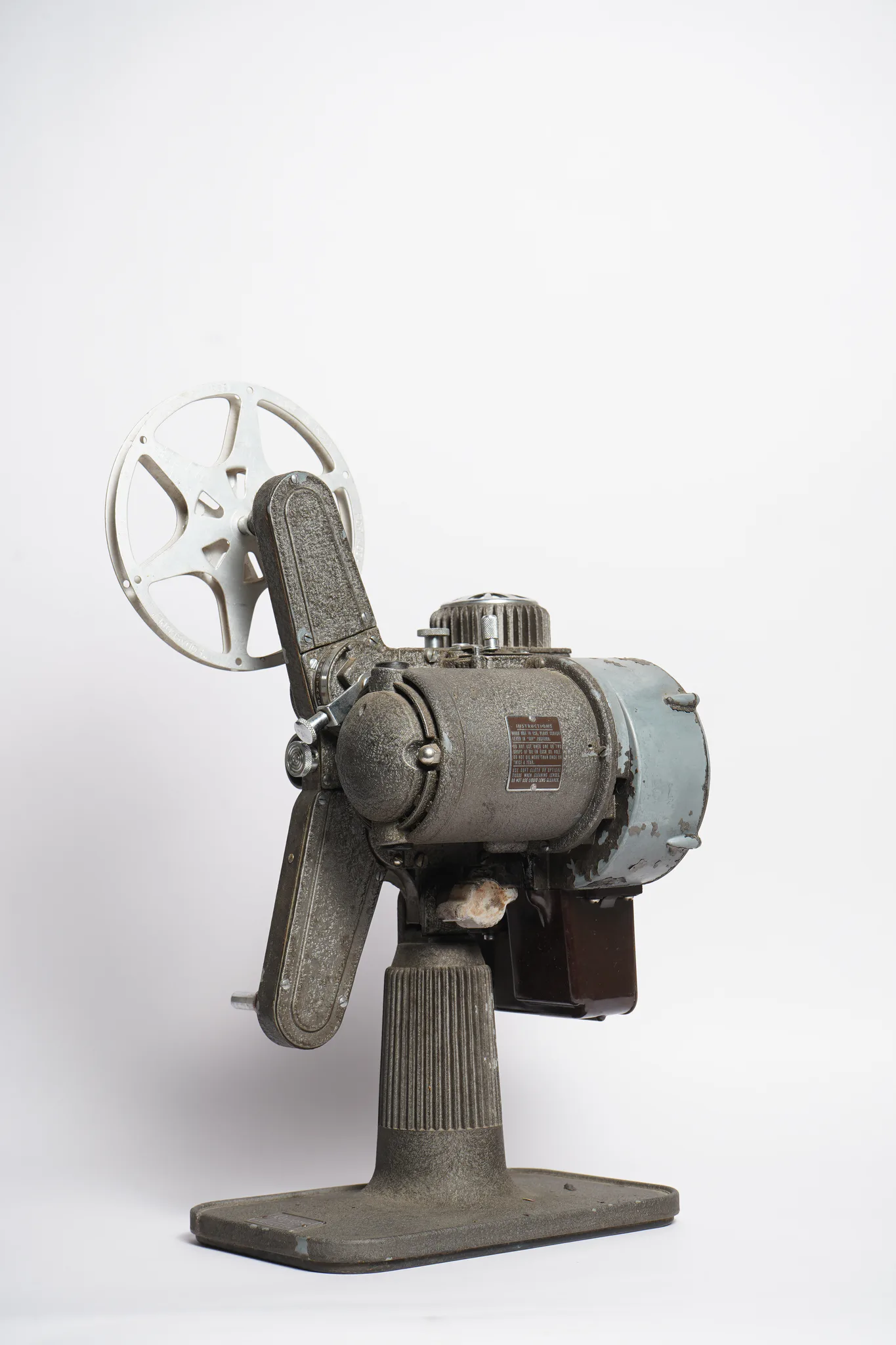
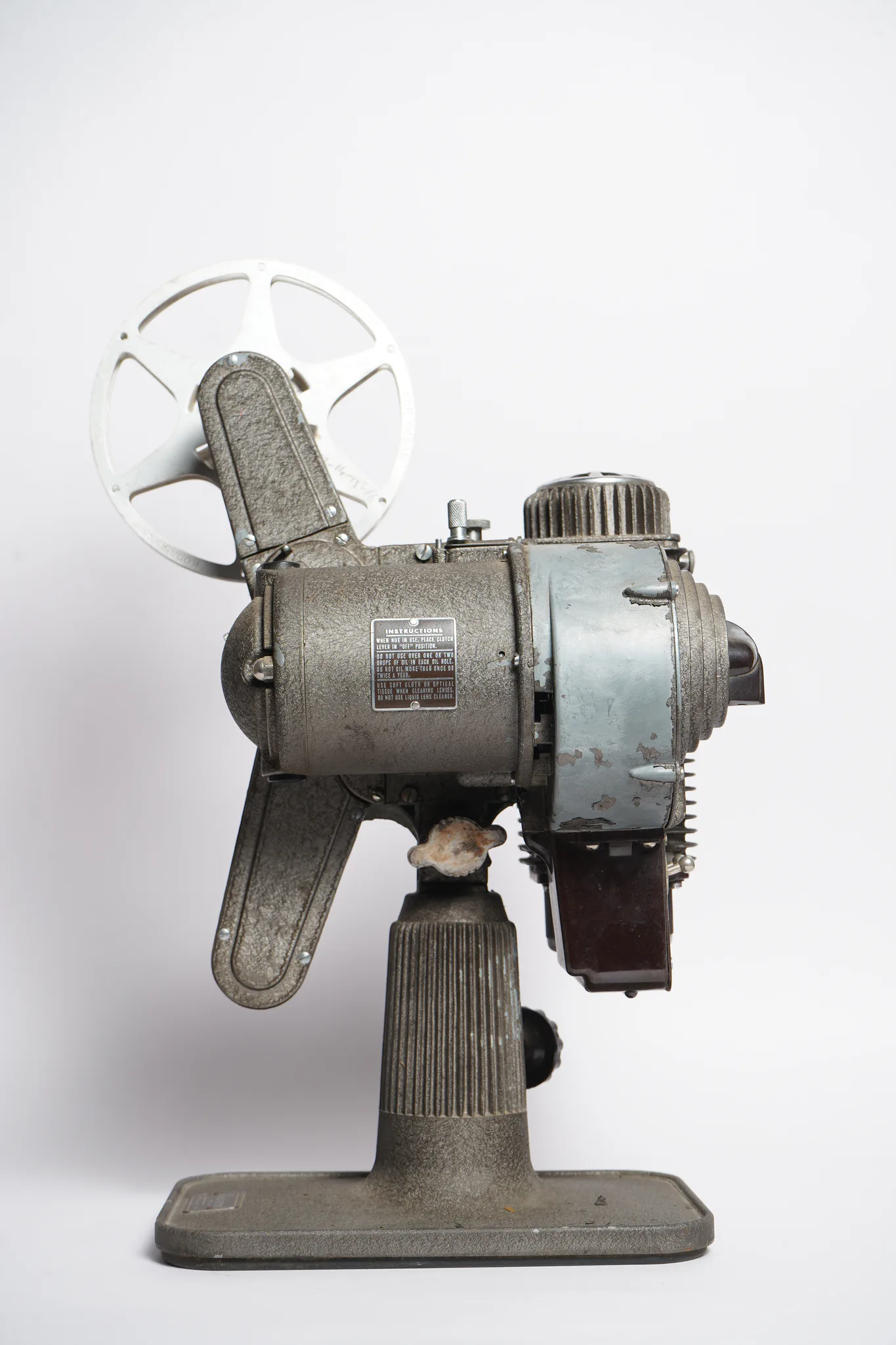
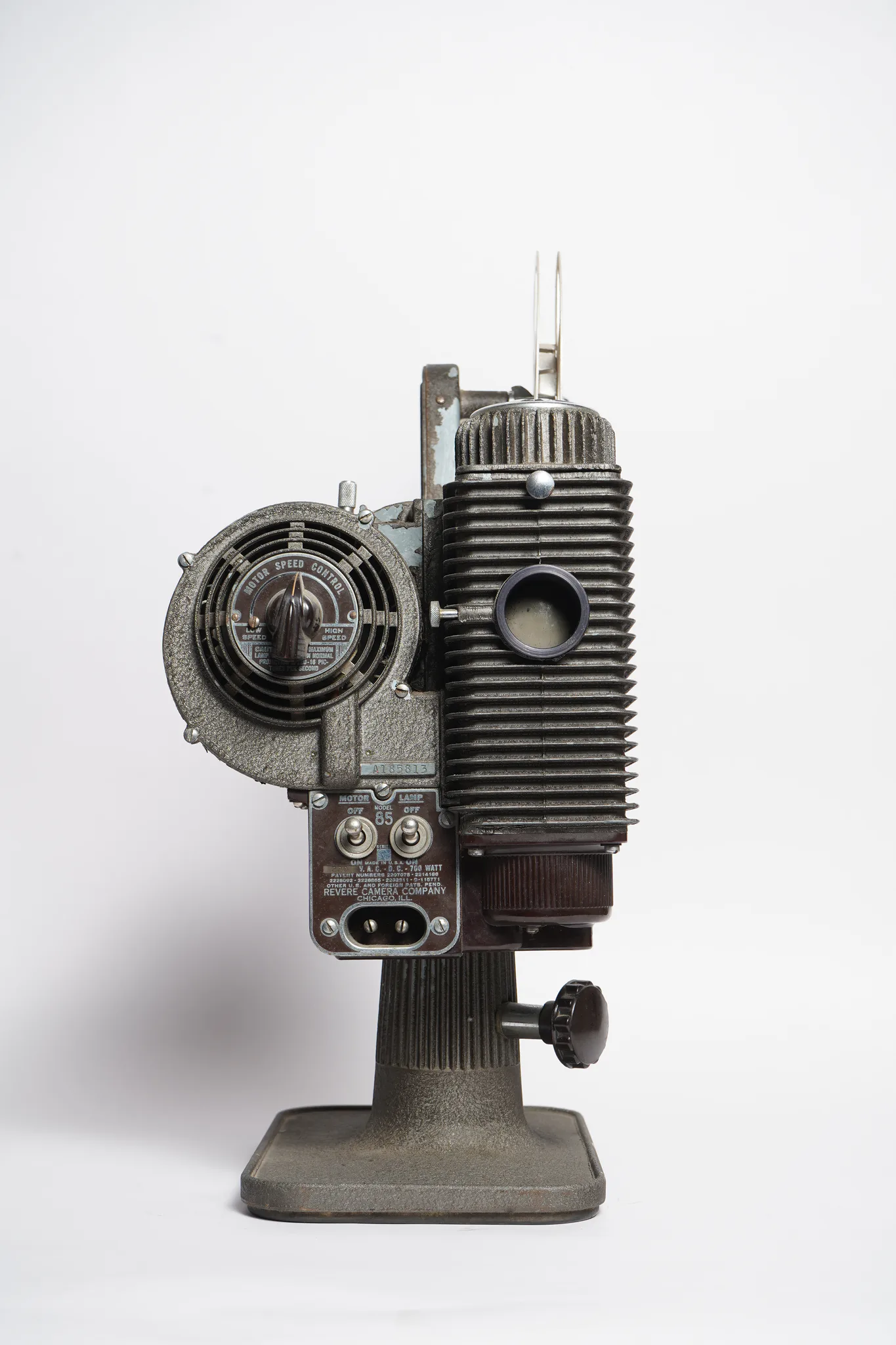
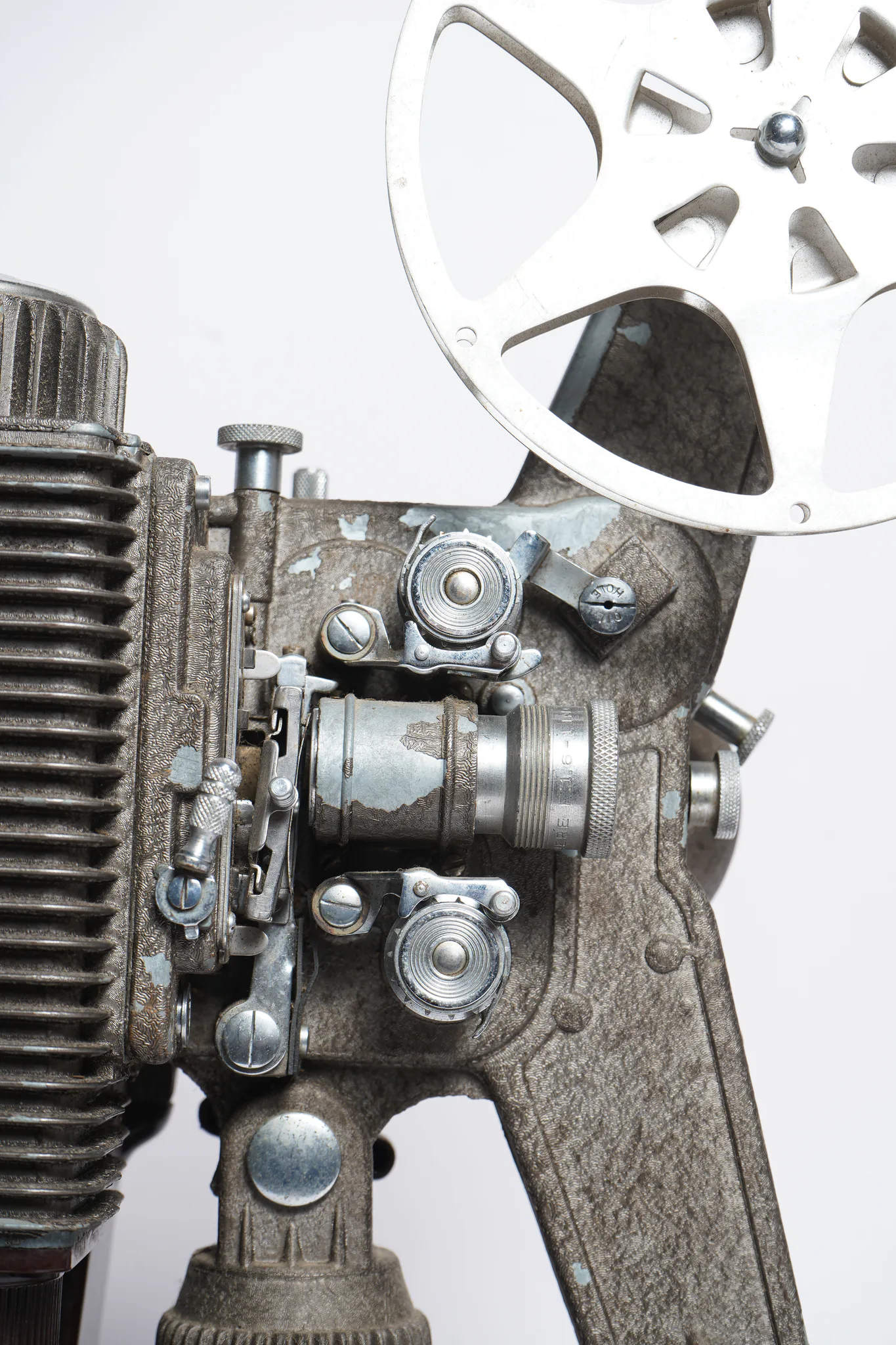
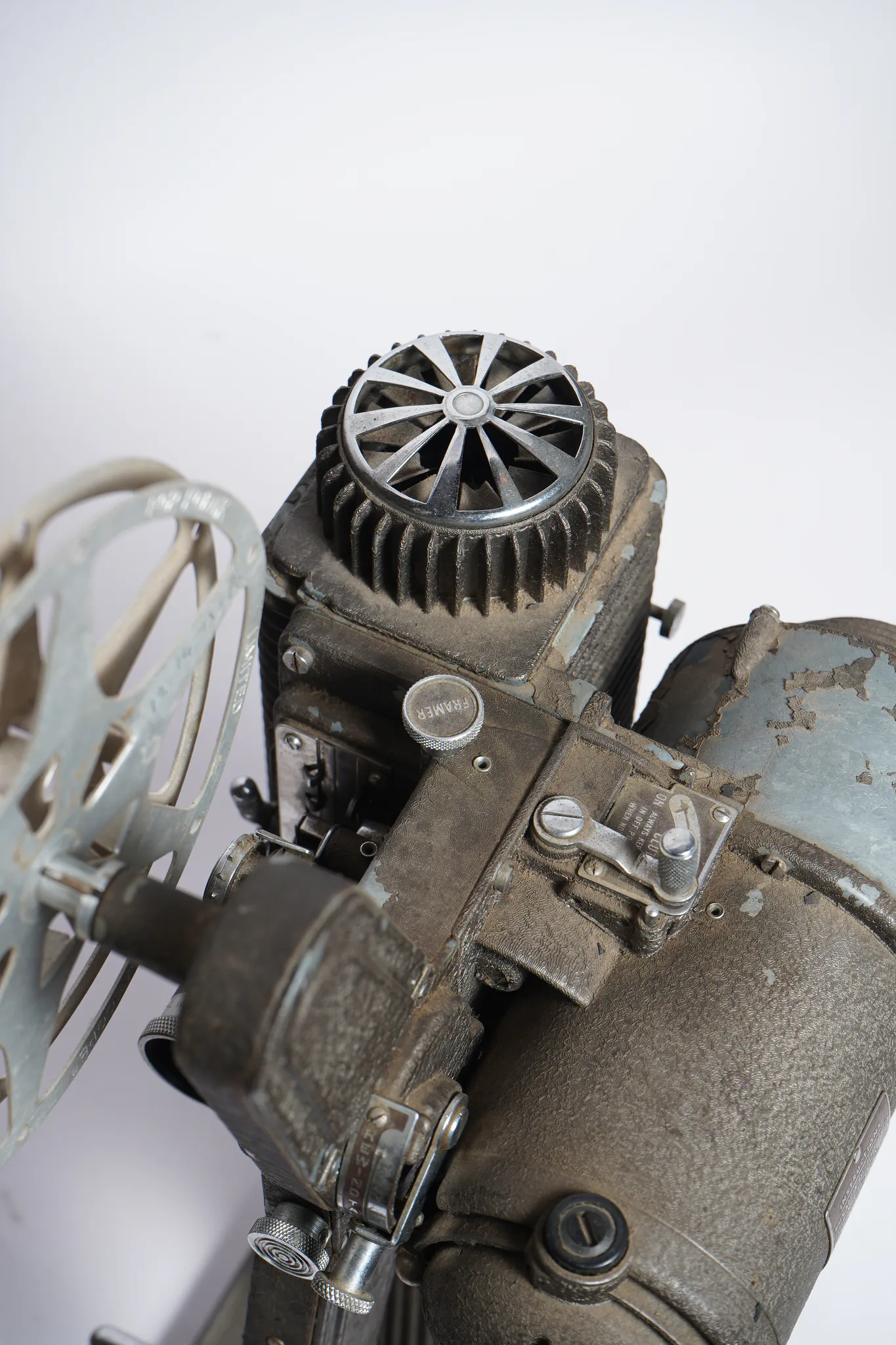
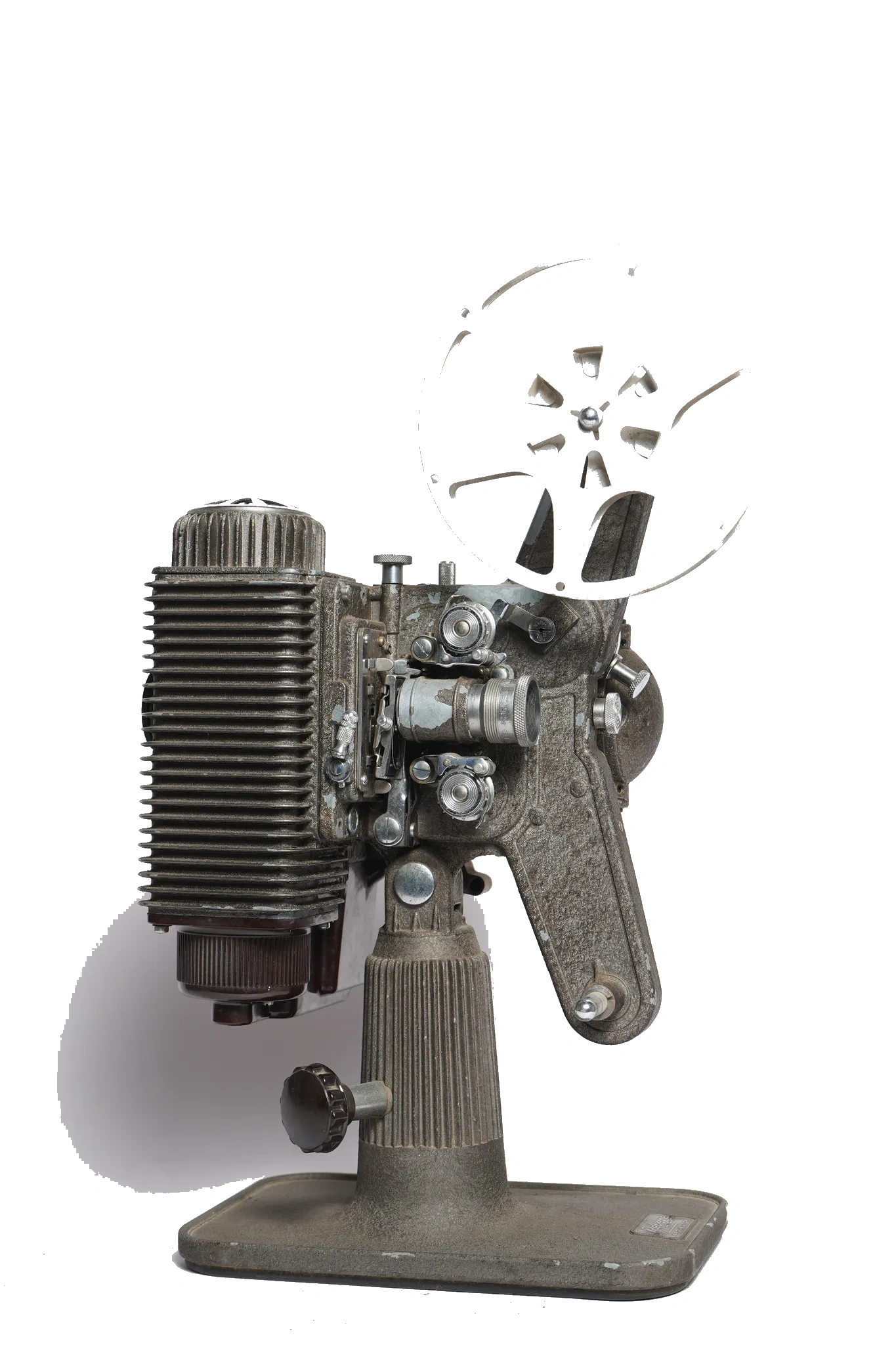
An iconic 1940s-1950s Chicago-built 8mm cinema projector featuring cast bronze crinkle enamel, polished chrome fittings, and heavy-duty gear train.
Art Deco American motion picture engineering with rich bronze crinkle finish.
The photographed Revere 85 8mm Cine Projector shows age-consistent surface wear and preserved period details; functionality is not claimed unless separately tested.
Sourced from the documented Curio Gallery archival catalogue: Revere 85 8mm Cine Projector.
Revere coated 1-inch f/1.6 projection lens
Standard 8mm cine reels
Heavy die-cast alloy with bronze wrinkle finish
Independent lamp, motor, and rheostat speed switches
Revere 85 8mm Cine Projector by Revere Camera Company, identified from the supplied photographs and catalogue evidence.
Revere Camera Company period construction; visible finish and hardware are recorded without adding unseen components.
Standard 8mm cine reels
Distinctive proportions, controls, markings, and surface details visible on this individual Revere 85 8mm Cine Projector.
Revere Camera Company production places this piece within the documented history of Revere 85 8mm Cine Projector.
The included image set for Revere 85 8mm Cine Projector is the reference for identity, completeness, and condition; details not shown are not assumed.
Revere 85 8mm Cine Projector carries the material language of USA manufacturing around 1948: purposeful controls, repairable construction, and a design made for use rather than disposal. Its surviving details connect today's collector with the hands that made and used it.
Every mark and fitting shown belongs to this individual Revere 85 8mm Cine Projector. Its documented details give collectors a precise, honest connection to the people and practices that shaped Revere Camera Company. The photographic record keeps that connection specific, personal, and grounded in the evidence presented.
Produced by Revere Camera Company in USA; the photographed Revere 85 8mm Cine Projector retains its period design language.
Used in optics work during the working life of Revere 85 8mm Cine Projector, with the controls and surfaces shown in the supplied photographs.
Preserved after active service, this Revere 85 8mm Cine Projector became a reference point for collectors studying Revere Camera Company workmanship.
Revere 85 8mm Cine Projector was photographed, condition-reviewed, and catalogued for a documented Curio Gallery acquisition.
The photographed Revere 85 8mm Cine Projector shows age-consistent surface wear and preserved period details; functionality is not claimed unless separately tested.
Only components visible in the photographs of this Revere 85 8mm Cine Projector are included; unseen accessories are not assumed.
Operational performance for this individual Revere 85 8mm Cine Projector is not claimed unless demonstrated in the photographs or separately tested.
Age, patina, wear, and any missing elements shown in the Revere 85 8mm Cine Projector images should be considered part of its condition.
Photographs and catalogue attribution: Curio Gallery.
United Kingdom, 1946
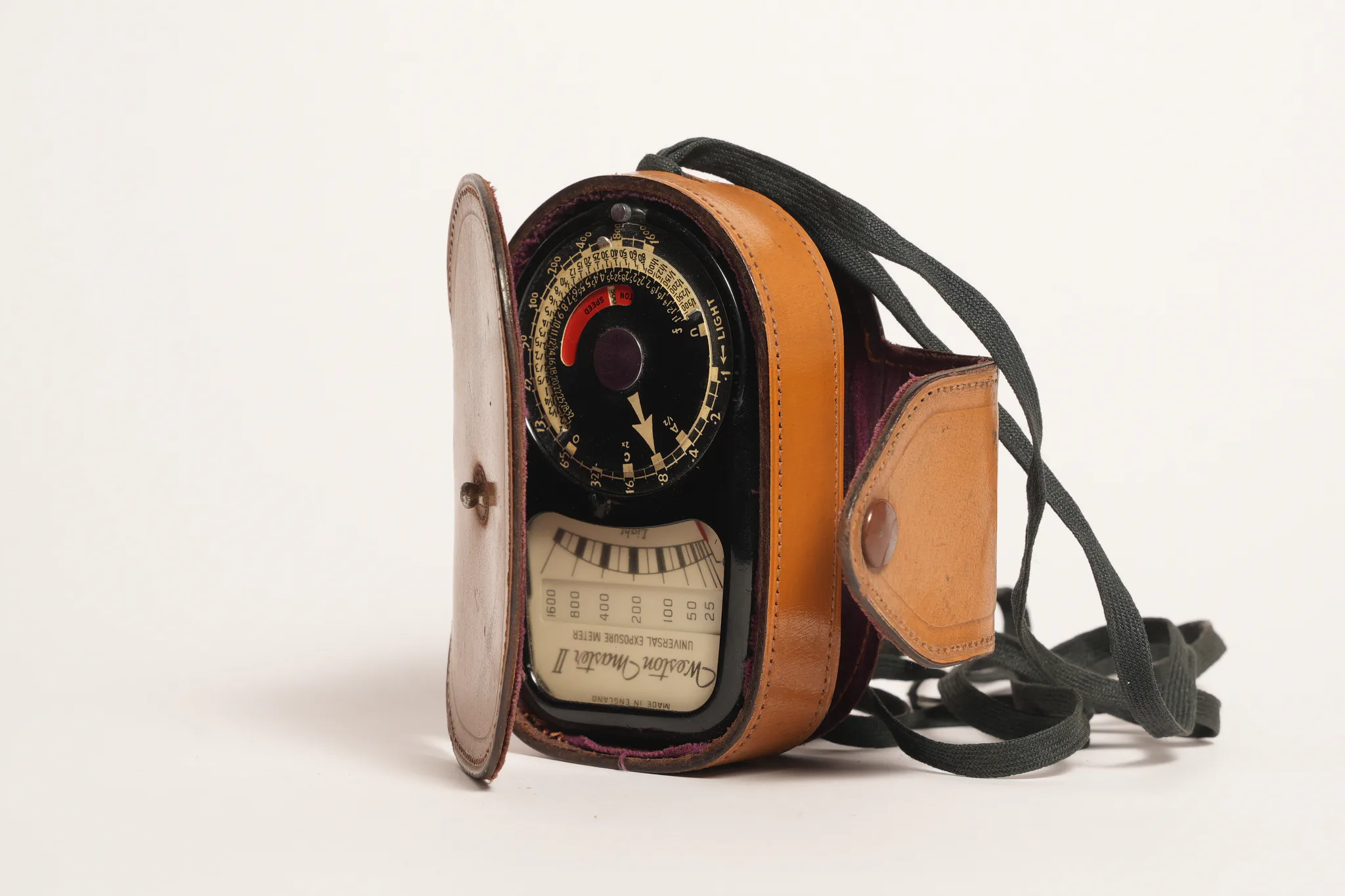
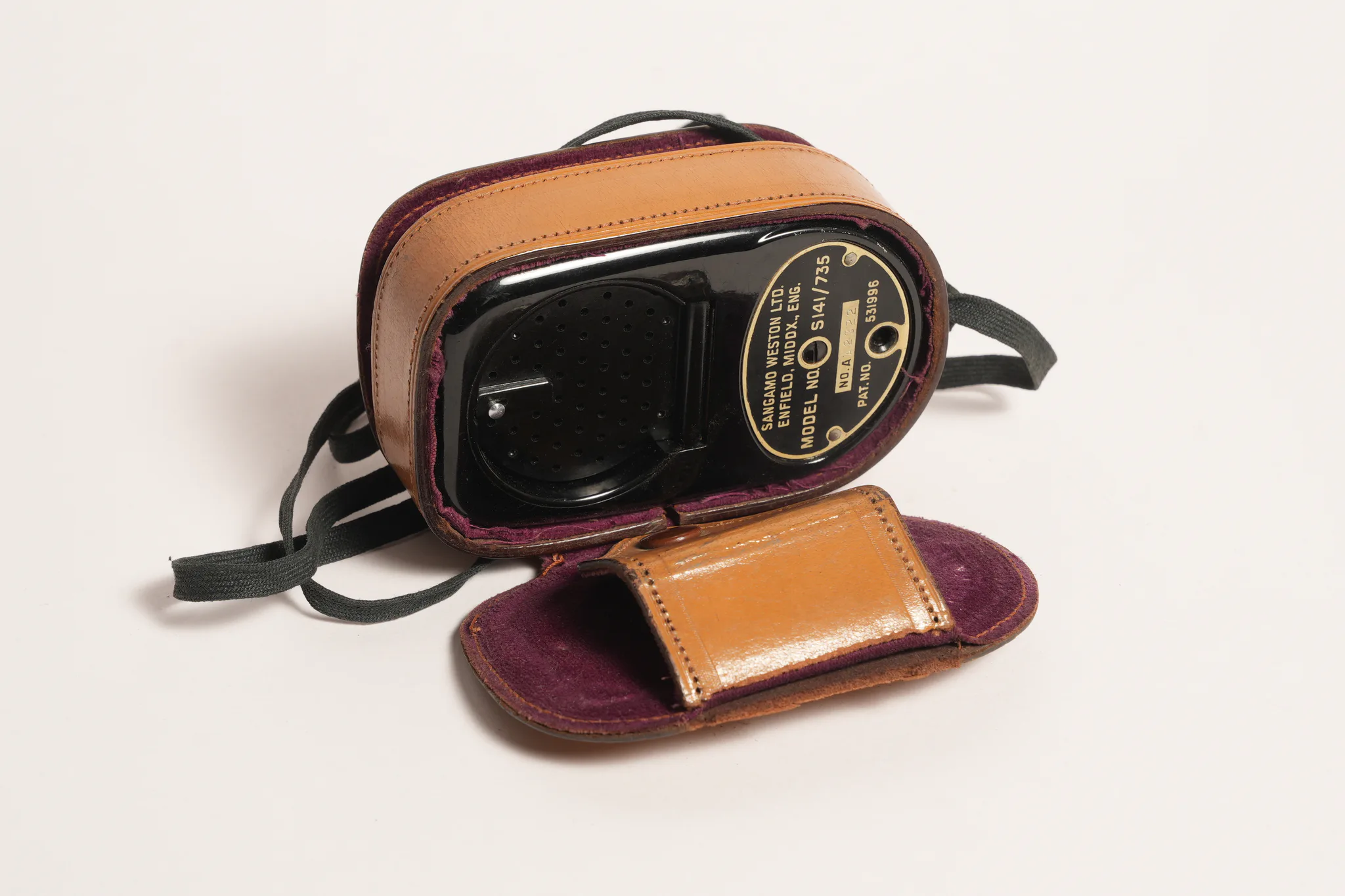
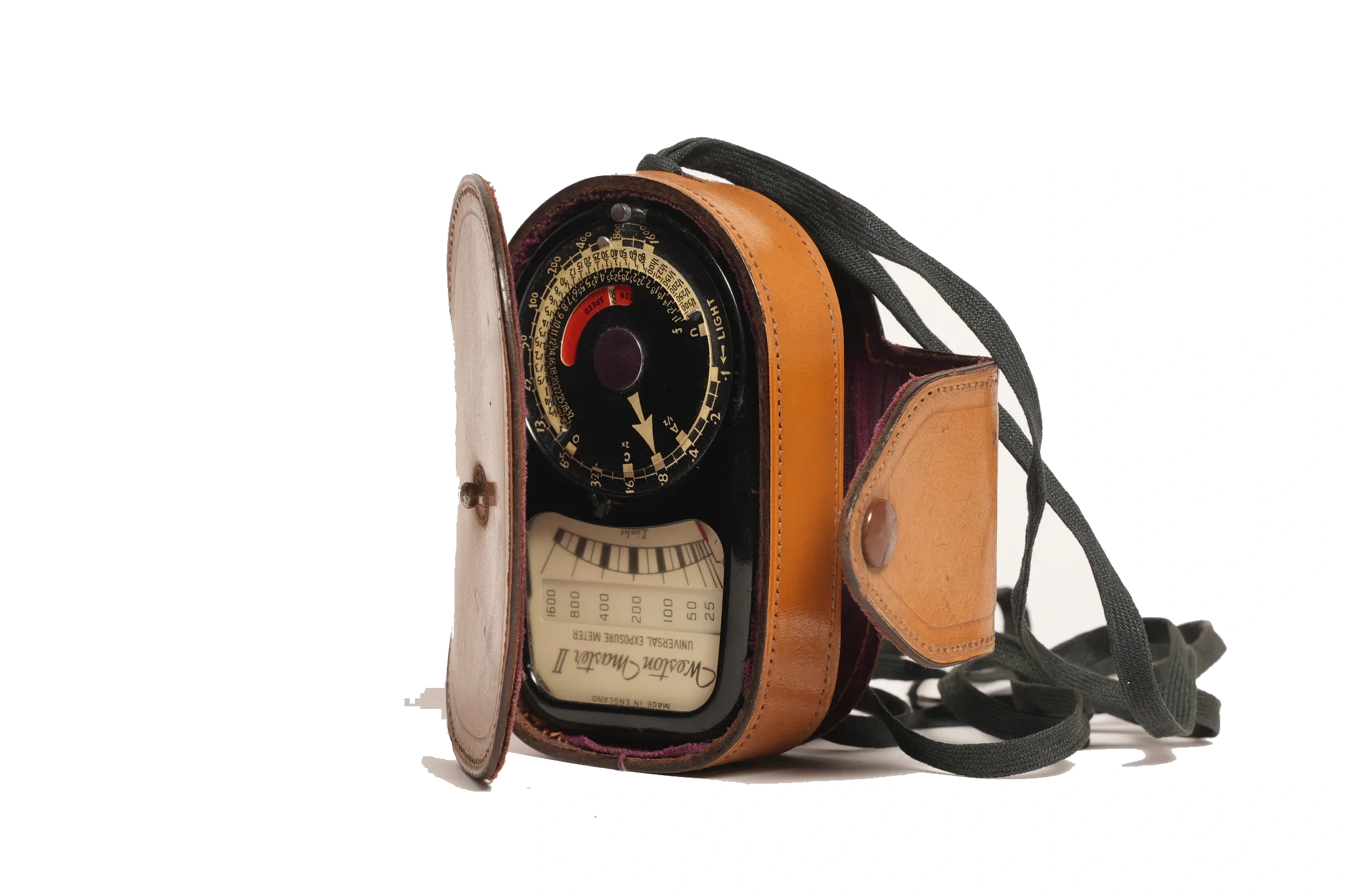
The Weston Master II is an analog universal photographic exposure meter housed in a molded black phenolic case. It features a dual-range dial system coupled to a hinged perforated baffle over a selenium photovoltaic cell. This unit includes its original tan leather case with velvet lining and neck strap.
British-made selenium cell light meter by Sangamo Weston
The exposure meter shows light cosmetic wear consistent with age, with intact black casing and legible dial markings. The selenium cell lens array is clear, and the rear baffle hinges smoothly. The fitted tan leather case shows surface rubbing, edge wear, and intact stitching with an operational snap.
Provenance documentation was not supplied for this specific Weston Master II Universal Exposure Meter Model S141/735; this listing is based on the supplied photographs only.
Master II (Model S141/735)
A 12322
531996
Selenium photovoltaic cell (battery-free)
Dual scale with hinged baffle
Operates without batteries using an integrated light-sensitive selenium cell.
Hinged rear baffle shifts the galvanometer scale between high and low light levels.
Manufactured at the Enfield plant under UK patent 531996.
Circular slide-rule computer converts light values to shutter and aperture pairs.
Supplied with an original tan leather pouch featuring plum-colored velvet lining.
Retains original specification plate with serial number A 12322 clearly stamped.
Visible in photo three, the hinged baffle flips open to expose the honeycomb selenium cell for dim lighting, while closing the perforated flap restricts light for bright daylight measurements without needing separate neutral-density filters.
Visible in photo two, the stamped Sangamo Weston plaque documents the Enfield factory's role in precision instrument making, delivering reliable post-war photographic meters that operated independently of external battery power worldwide.
Original Master universal exposure meter establishes industry standard.
Redesigned slimmer body and updated calculator dial launched.
Sangamo Weston begins manufacturing the Master II in Enfield, Middlesex.
Replaced by the Weston Master III with updated film speed scales.
Black body and aluminum calculator dial show mild surface handling marks without structural cracks.
Rear hinged perforated baffle operates properly, revealing an intact honeycomb selenium grid.
Front galvanometer window is clear and legible with 'Made in England' and model text intact.
Original tan leather case displays surface patina, intact purple velvet lining, and secure straps.
Photographs and catalogue attribution: Curio Gallery.
West Germany, 1957
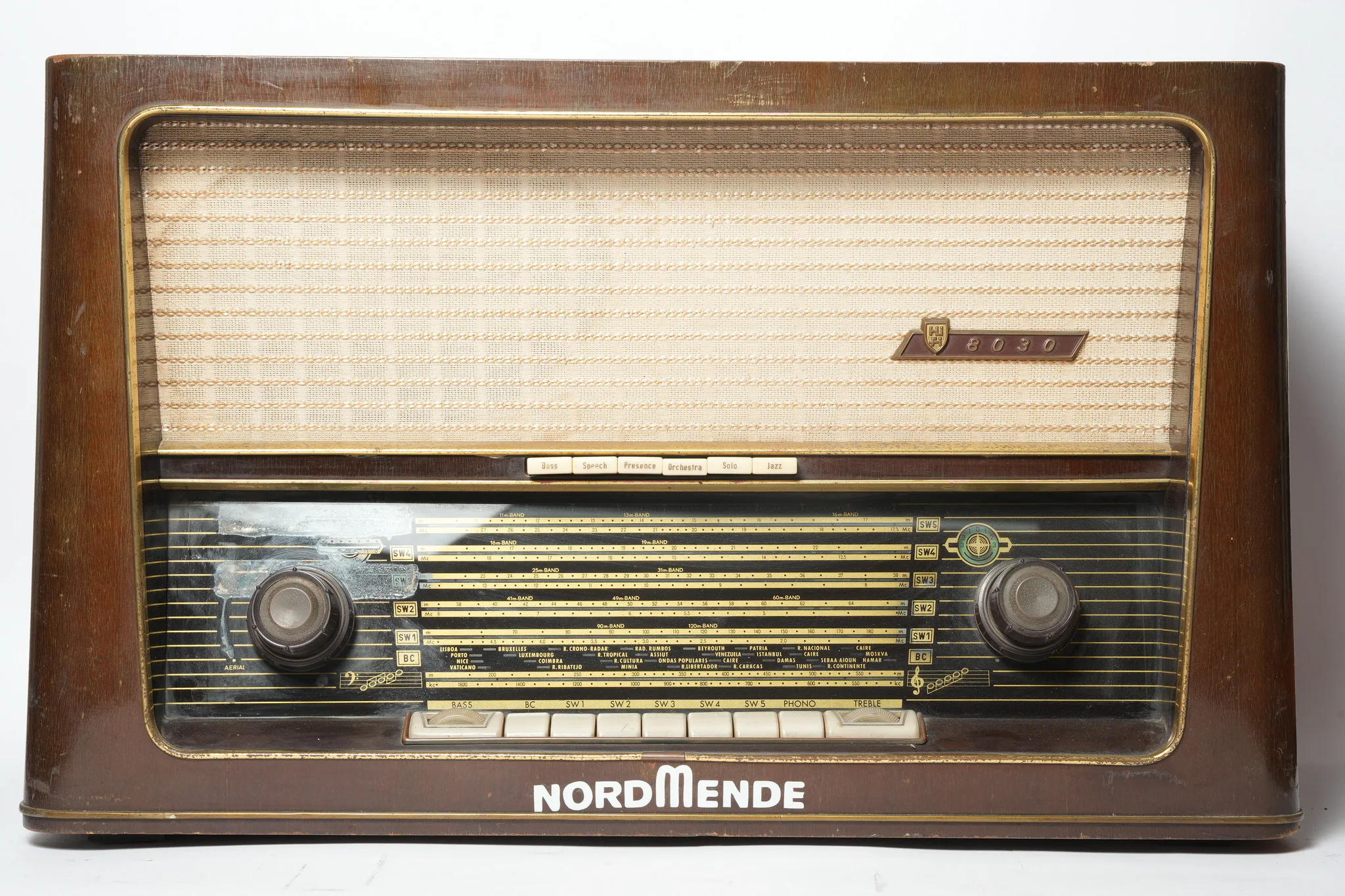
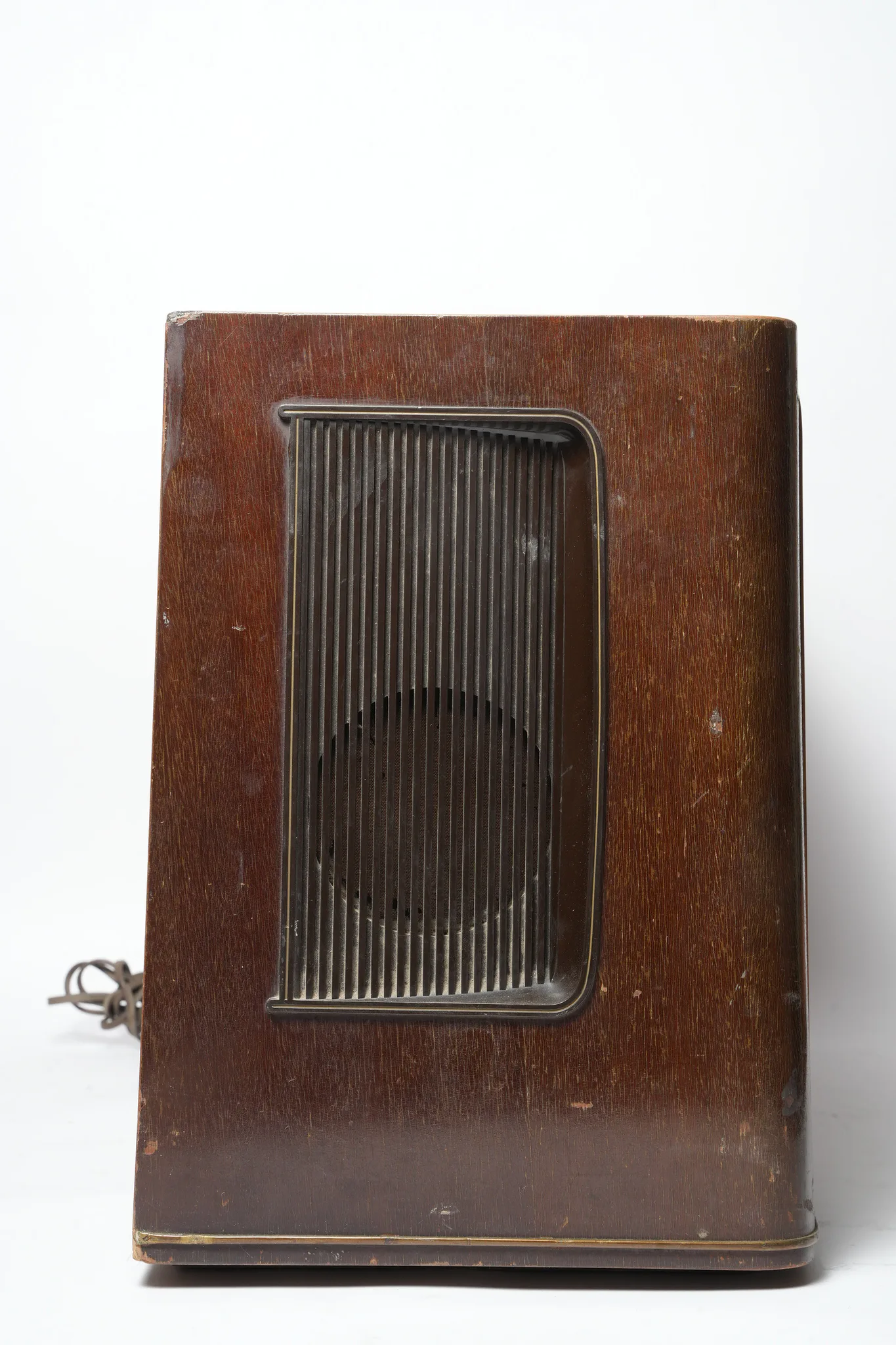
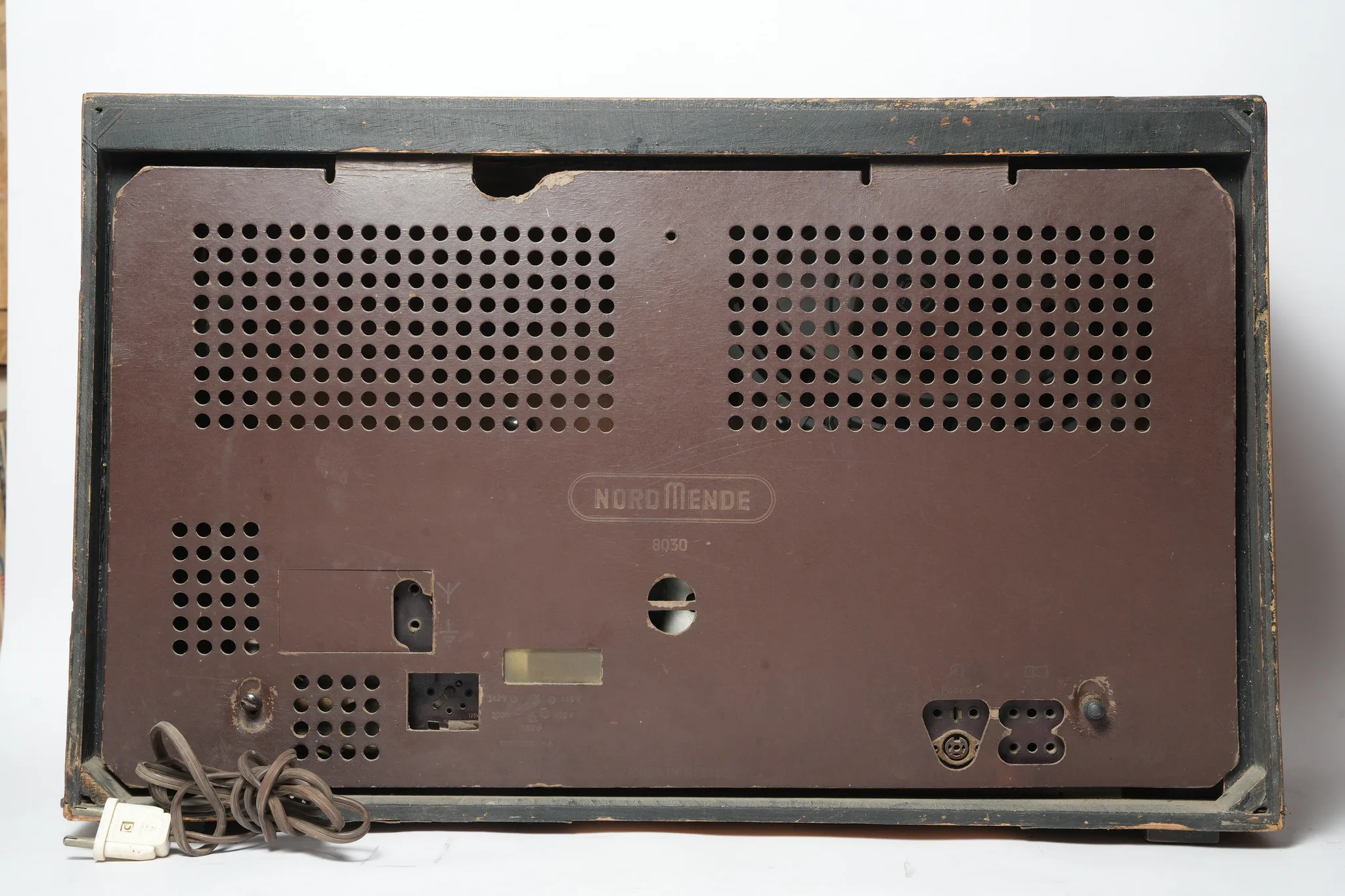
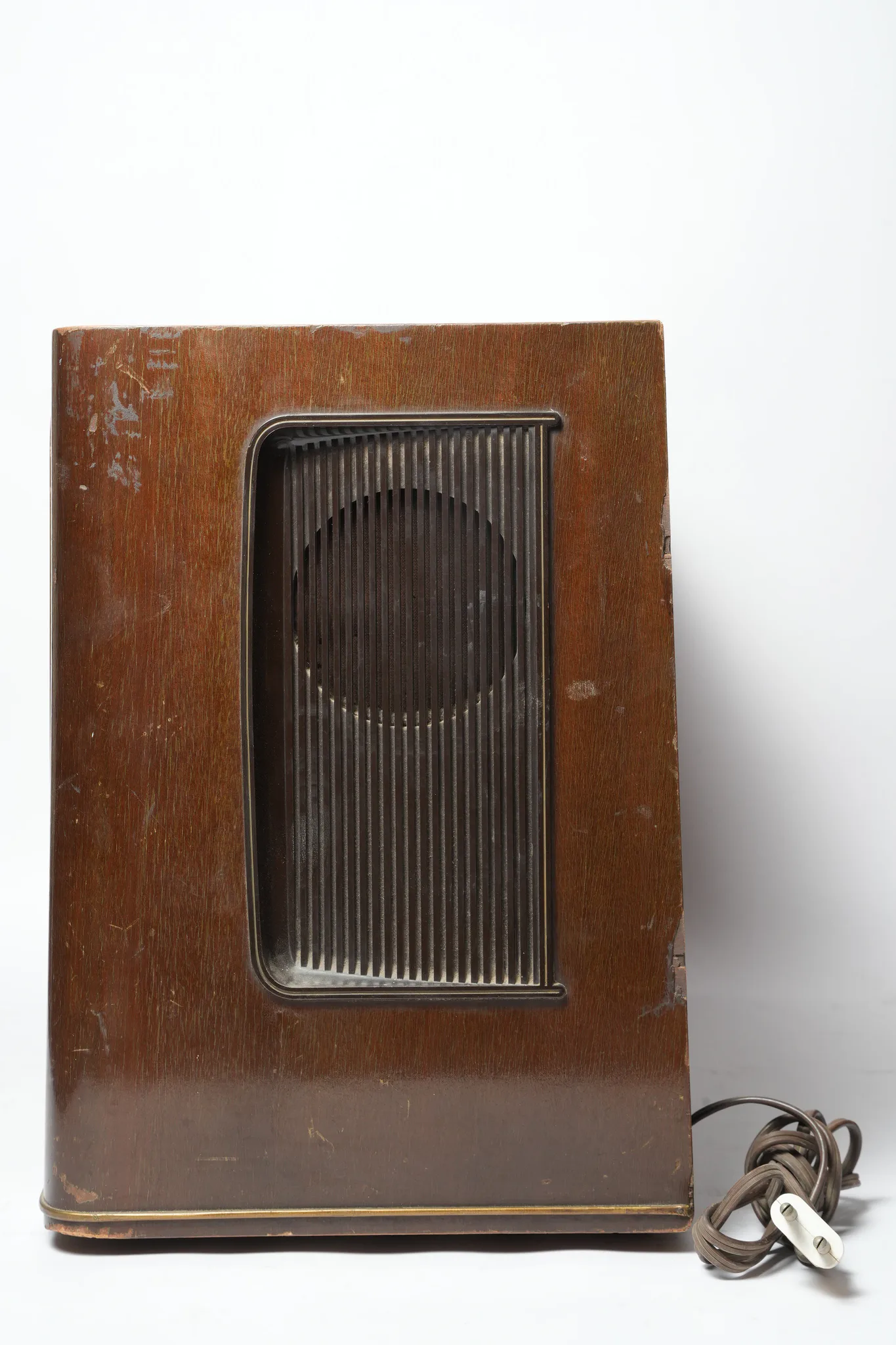
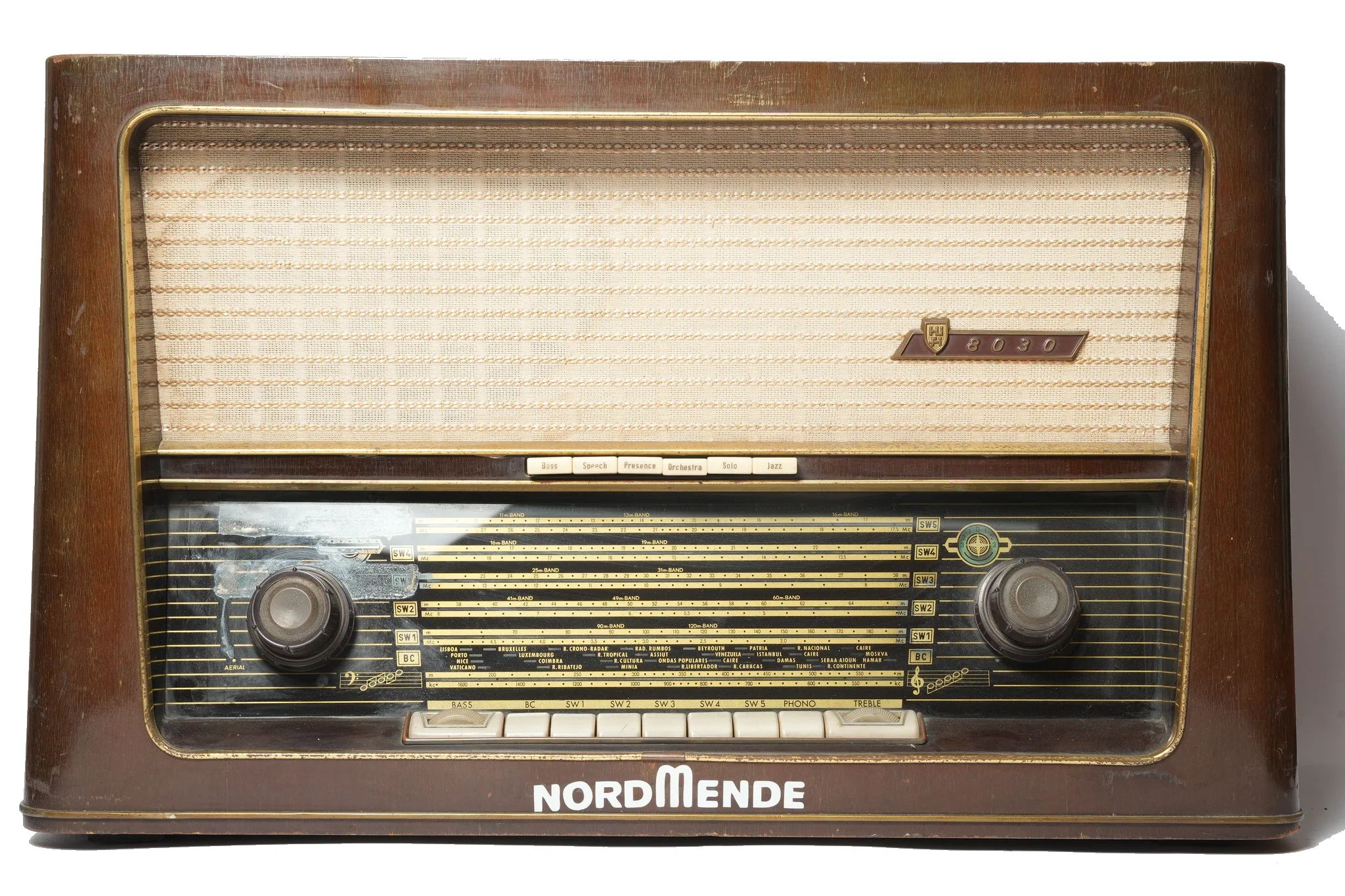
The Nordmende Rigoletto 58 (chassis type 8030) is a classic West German tabletop tube radio housed in a curved-edge wooden veneer cabinet. Built during the peak of Germany's post-war audio golden age, it features side-firing secondary speaker apertures framed in fluted plastic louvers to create a broad spatial soundfield. The ventilated rear fiberboard panel retains the factory Nordmende emblem, voltage selector window, and original European power wiring.
56 × 36 × 24 cm
Mid-century German valve table radio with integrated side-firing 3D acoustic grilles
The wooden cabinet shows authentic vintage cosmetic wear, including surface scratches, finish scuffs, and minor edge chipping along the lower borders. Both plastic side-grille inserts are intact with backing cloth visible, though exhibiting dust accumulation. The rear fiberboard backplate is well preserved with clear factory stampings, complete port cutouts, and the original power cord coiled at the base.
Provenance documentation was not supplied for this specific Nordmende Rigoletto 58 Tube Radio (Chassis 8030); this listing is based on the supplied photographs only.
Nordmende (Norddeutsche Mende-Rundfunk GmbH, Bremen)
8030 (Rigoletto 58)
West Germany
Stained wood veneer with curved front corners and metallic accent trim
Multi-speaker 3D system with dual side-firing louvered speaker grilles
AM/FM antenna terminals, DIN phono socket, and external speaker jacks
Manufactured by Norddeutsche Mende-Rundfunk in Bremen, symbolizing West German economic miracle industrial design.
Integrated left and right side louvers direct upper frequencies laterally into the listening room.
Factory rear plate prominently stamped with model code 8030 directly beneath the Nordmende emblem.
Rear-accessible rotary selector window permits operation across 110V to 240V international mains.
Includes standard vintage inputs for external gramophone phono source and auxiliary loudspeaker.
Gracefully rounded wooden chassis corners bordered by slim metallic decorative beading.
The louvered side panel in photo 1 reveals Nordmende's 3D-Klang concept, projecting mid and high frequencies sideways to reflect off surrounding walls and simulate a live stage presence.
The stamped rear plate in photo 2 documents West German manufacturing excellence, featuring chassis code 8030 alongside dedicated phono input ports designed for contemporaneous vinyl record changers. That specificity gives the buyer a traceable, emotionally resonant piece of West Germany design history rather than a generic decorative substitute.
Martin Mende re-establishes Mende radio production in Bremen-Hemelingen, West Germany.
Nordmende pioneers multi-directional acoustic arrays using side-directed high-frequency Klangstrahler units.
Production commences on the 1957/58 season model line, featuring the 8030 multi-band chassis.
Nordmende transitions its tabletop lines toward modern stereophonic and solid-state architectures.
Even dark tone with light scratching and minor chips along the base edges visible on the side panels.
Plastic horizontal louvers are complete and uncracked on both sides, with internal speaker circular cutouts clearly defined.
Original backplate is firmly seated with intact vent perforations, embossed Nordmende logo, and type 8030 marking.
Original bundled brown two-core mains lead and vintage European two-pin wall plug remain attached.
Photographs and catalogue attribution: Curio Gallery.